
- August 15, 2026
- by Almifthaah
How Long Do Flap Wheels Last and When Should You Replace Them?
Table of Contents
ToggleKey takeaways
- Flap wheels usually last for between twenty and eighty working hours, depending on the material, grit, and pressure used.
- Some of the main indicators of the need to change a wheel include decline in cutting speed and shortening of flaps.
- Coarse grits tend to wear faster but cut aggressively, while fine grits last longer but remove less material.
- Correct storage in a dry and cool place can significantly prolong unused wheel lifespan.
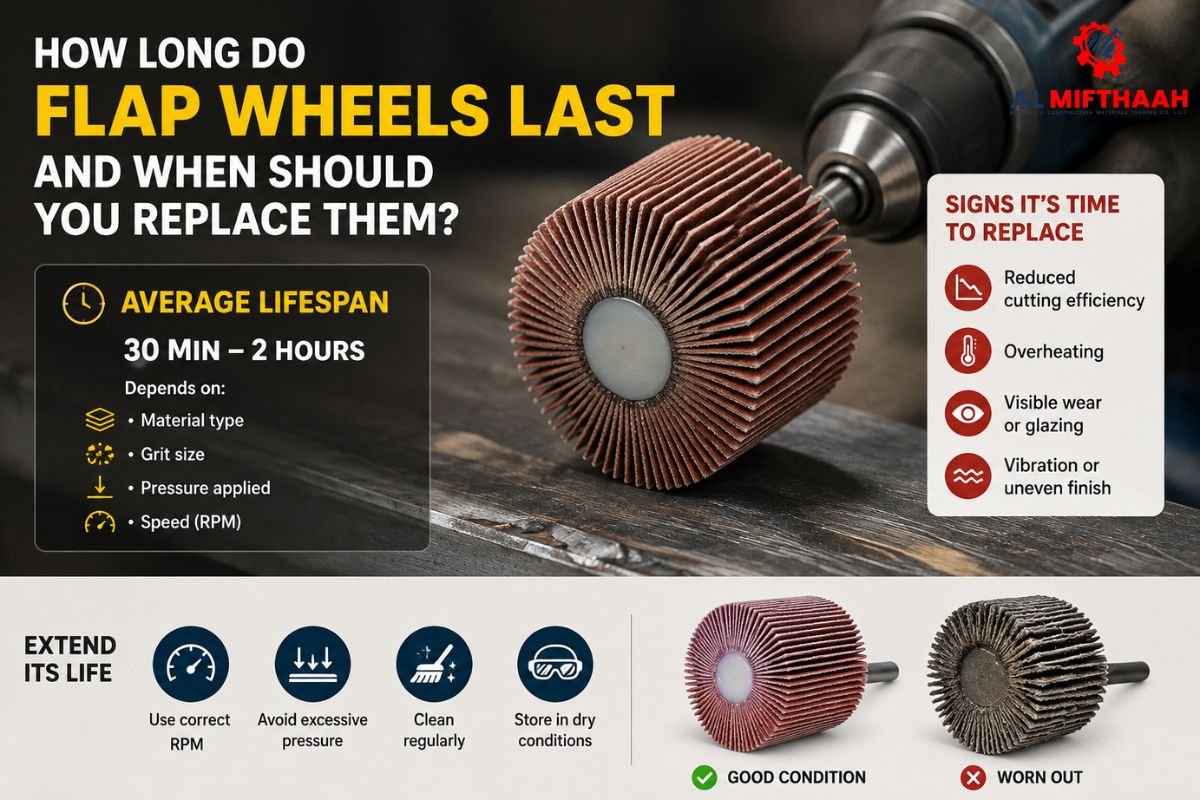
A flap wheel usually lasts somewhere between 20 and 80 hours of active grinding, though the honest answer is “it depends on what you’re doing with it.” A wheel used for light deburring on aluminum will outlast one running hard against cast iron all day, sometimes by three or four times over. If you want to know whether your wheel is still usable, begin by measuring the flap length. Once the flaps are reduced to approximately 50% of their original length, you’ll notice that the cutting speed is significantly reduced; in that case, you will know it is time to replace the wheel.
The range is wide since the lifespan of a flap wheel depends on the hardness of the material being worked, as well as its grit size, wheel speed and the force being applied. A workshop running these wheels daily on stainless steel welds will burn through them faster than one using them occasionally for wood finishing. This is one of the more common questions we hear from fabricators and metal shops across Dubai, and it usually comes down to wanting a straight answer instead of a sales pitch.
How long does a flap wheel typically last?
Most standard flap wheels give you somewhere between 20 and 80 working hours before performance drops enough to justify replacement. That’s a broad window, and the reason it’s broad is that “working hours” hides a lot of variables.
Moreover, coarse grit wheels (36–60 grit) tend to wear faster because they remove more material per pass, so more abrasive gets shed with every contact. Fine grit wheels (120 grit and up) used for polishing or light finishing work can last considerably longer, since they’re not being pushed to strip material aggressively.
Wheel diameter matters too. Because a 4-inch wheel has less abrasive material, it may wear out more quickly as compared to a 6-inch or a 7-inch wheel. When comparing claims of lifespan, it is always a good idea to ask suppliers what they mean by “lifespan.” It may stand for either operating hours or shelf life, which make a huge difference.
Warning signs it’s time to replace one
The clearest signal is a drop in cutting speed. If a task that used to take two minutes now takes five, the wheel has lost enough abrasive grain to slow down. Visual wear on the flaps is the second thing to check, and it’s usually obvious once you know what to look for.
A few practical signs worth watching for:
- The flaps are visibly shorter than when the wheel was new, often by close to half.
- The wheel feels smoother against your fingernail than it did at the start, which means the grit has dulled.
- Grinding produces more heat than usual, sometimes enough to discolor metal.
- The finish left behind is inconsistent, with some areas cutting deeper than others.
- Vibration increases, which can mean the flaps are wearing unevenly around the wheel.
Therefore, none of these on its own is a hard stop. But two or three together usually mean the wheel is past its useful life, and pushing it further just wastes labor time for a worse result.
What shortens flap wheel lifespan?
Pressure is the biggest factor most operators underestimate. Leaning hard on a flap wheel doesn’t speed up the job. It tears through the flaps faster while generating heat that can glaze the abrasive grains, making them cut less efficiently even before they’re physically worn down.
Material hardness plays a similar role. Hardened steel and stainless steel wear a wheel down faster than mild steel or aluminum, simply because there’s more resistance at the point of contact. Running a wheel at the wrong RPM for its rated speed also shortens its life, either by generating excess heat at too-high speeds or by causing the flaps to load up with material at speeds that are too low for efficient cutting.
Furthermore, contamination is another factor that gets overlooked. If a wheel used on stainless steel later gets used on carbon steel, embedded particles can cause uneven wear and, in some cases, contribute to surface contamination on stainless work. Keeping separate wheels for different materials is standard practice in most serious fabrication shops for this reason.
Flap wheels vs flap discs: Key differences
Often, flap disc and flap wheel are confused, even though these two have different uses. The flap wheel is designed to be used on a bench grinder or similar equipment. Its cylindrical form makes the flap wheel a perfect tool for curved surfaces and various contour shaping. Flap disc is used on an angle grinder and is better suited for flat surfaces.
| Feature | Flap Wheel | Flap Disc |
| Typical mounting | Bench grinder, arbor, shaft | Angle grinder |
| Best for | Contours, edges, deburring | Flat surfaces, welds, larger areas |
| Shape | Cylindrical | Flat, disc-shaped |
| Common grit range | 40–320 | 24–120 |
| Typical use case | Finishing, blending, polishing | Aggressive stock removal |
Anyone searching for a flap disc supplier in Dubai is often solving a slightly different problem than someone looking for flap wheels specifically. Both fall under the same abrasive family, but the tool they attach to and the shape of the work they’re suited for are different enough that mixing them up leads to buying the wrong product.
Picking the right grit for the job
Grit selection has more impact on wheel life than most buyers assume.
- Coarse grit (36-60): Good for removing a lot of material quickly, and ideal for heavy duty deburring and shaping techniques. It also wears fast and is not suitable for light finishing.
- Medium grit (80-120): A good compromise for general grinding, blending, and surface preparations.
- Fine grit (150+): More useful for polishing as well as preparing surfaces for painting rather than for heavy material removal.
Selecting a suitable grit improves finishing and the life span of the wheel.
This is where working with an experienced abrasive tools supplier Dubai businesses actually trust makes a practical difference, since getting grit recommendations wrong upfront often means buying the wrong product twice.
Storage and handling that extends life
Flap wheels can lose their reliability over time, even if they are not put to use. Their performance will suffer because of high moisture levels or the heat from the sun. As a result, it is vital to put them in a cool and dry space to avoid the adhesive from weakening before time.
Some good practices for preserving flap wheels include:
- Store them without putting anything heavy on top of them or stacking them on each other.
- Keep them in a dry place to avoid direct exposure to moisture because it can damage the backing.
- Prevent exposure to extreme temperatures, specifically the sun when having outdoor storage. This matters more in the UAE climate than in cooler markets.
- Check wheels for cracks or looseness in the flaps before mounting, even on unused stock.
Common mistakes workshops make
A very frequent error is applying flap wheels for extended lengths of time. A flap wheel that has been used too long may complete jobs much more slowly. In fact, many times replacing it is much cheaper than wasting the time of employees.
Another mistake is not cleaning flap wheels before using them on different materials. This may lead to an increase in wear and damage the finish of the next job. However, using correct wheels for each type of material improves performance and output. The third is buying on price alone without checking backing material quality. A poorly bonded wheel can shed flaps unevenly regardless of how good the abrasive grain itself is.
Where to source reliable flap wheels?
Consistency matters more than most buyers expect when it comes to abrasive wheels. Two wheels that look identical can perform very differently if the backing material or bonding process isn’t consistent between batches, which is why sourcing from an established supplier tends to save money over time even if the per-unit price looks similar.
Almifthaah works with fabrication shops, metal workshops, and industrial buyers across the UAE who need dependable abrasive products without guessing on quality. As one of the abrasive flap wheel suppliers in Dubai serving repeat industrial clients, Almifthaah stocks a range of grit sizes and wheel diameters suited to different grinding and finishing tasks. For shops comparing options, a High-Quality Flap Abrasive Wheels Supplier in Dubai like Almifthaah means fewer surprises in wheel consistency from one order to the next.
Therefore, buyers researching this category will also come across names like a flap disc supplier in Dubai or a Saif Precision tools supplier in UAE while comparing catalogs. It’s worth checking directly with each supplier on stock availability, minimum order quantities, and current pricing, since these details change often enough that they’re best confirmed at the time of purchase rather than assumed from an old listing.
Almifthaah works as an abrasive tools supplier Dubai workshops can rely on for both flap wheels and related grinding consumables, and as an abrasive flap wheel suppliers in Dubai name that fields regular technical questions, the team can also help match grit and wheel type to specific jobs rather than leaving buyers to guess. For shops that go through wheels regularly, having a Saif Precision tools supplier in UAE or Almifthaah as a direct contact for reorders tends to be more efficient than sourcing case by case.
Final thoughts
There is no fixed time for replacing a flap wheel. Rather, inspect its cutting performance and the length of the flaps periodically. When the wheel no longer cuts efficiently, or the flaps are too short, it’s time for a replacement. The right grit in the right place will also prolong the life of the wheel. Damage is prevented and the wheels are kept ready for use with proper storage. When you’re choosing abrasive flap wheel suppliers in Dubai, reach out to Almifthaah and discuss what type of grit you need and the type of wheel.
Frequently asked questions
The life of the most common types of flap wheels ranges from 20 to 80 working hours and varies with the different grits, material hardness and pressure applied during use.
It can, although switching wheels between materials will cause the wheels to wear faster and will lead to cross-contamination, so separate wheels per material work better.
Flap wheels are attached to bench grinders for contour grinding, and flap discs are attached to angle grinders to perform flat surface grinding and to remove stock at a faster rate.
It does. Coarse grits have longer wear time, remove more material, and fine grits have longer wear time but cut less aggressively.
Store flat or on a rack and keep out of moisture, direct sun and extremes of temperature to avoid the degradation of adhesive and backing.
If a wheel is worn, with damaged or loose flaps it can vibrate unevenly and should be replaced not pushed through the visible wear.
Overloading, incorrect RPM for the wheel’s rating and excessive use on hard materials such as stainless steel will cause wear.
Almifthaah provides a range of different grit and diameter sizes of flap wheels for industrial and workshop use throughout UAE with advice on selection.
How Long Do Mounted Points Last and When Should You Replace Them?
Everything You Need to Know About Tool Wear in Carbide Tipped Cutting Tools

1 Comment
Which Mounted Points Work Best on Hard Metals & Stainless steel
September 26, 2026 - 2:19 pm[…] amount of stock that needs to come off, instead of defaulting to whatever grit is already loaded. High-Quality Flap Abrasive Wheels Suppliers in Dubai are […]