- September 26, 2026
- by Almifthaah
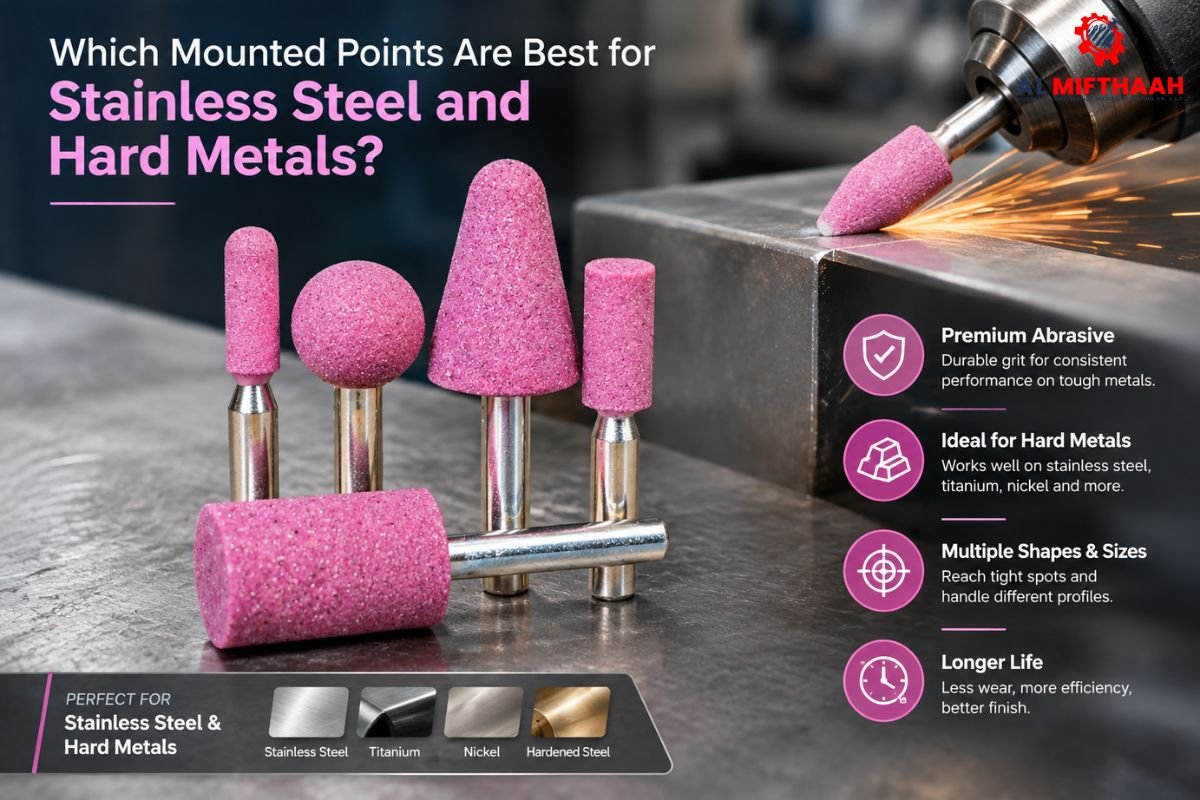
Which Mounted Points Are Best for Stainless Steel and Hard Metals?
For finishing stainless steel and hardened alloys, INOX-specific resin-bonded mounted points made with zirconia alumina or ceramic alumina grain, shaped as A-points or ball or cone profiles, give the cleanest results with the least heat buildup. A standard aluminium oxide point is fine on mild steel. Stainless needs a bond free of iron and sulphur, or you’re looking at rust staining and weld discoloration down the line. The rest comes down to the specific job: weld dressing, deburring castings, smoothing bores, and how hard the base metal actually is.
Table of Contents
ToggleKey takeaways
- INOX-rated mounted points with a chemically pure bond resist rusting and contamination.
- A-shaped and bullet-mounted points fit their respective surfaces, while W-shaped points easily remove heavy stock.
- Zirconia and ceramic alumina particles are cooler than conventional grinding materials and provide longer service life.
- Glazing, chatter, and premature wear of hard metals are caused by under-speed.
What do mounted points actually do?
A mounted point is a small abrasive wheel fixed permanently to a steel shank, made to chuck into a die grinder or straight grinder. Flap discs and angle grinder wheels cover the big flat surfaces. Mounted points handle what those can’t: inside corners, small bores, weld toes, the spots a flat wheel just won’t sit against.
Therefore, walk through most fabrication shops such as abrasive flap wheel suppliers in Dubai industrial zones, and you’ll find them on stainless tanks, railings, exhaust systems, and precision-machined parts, wherever a rough grind mark would ruin the finish. You give up speed for control, and on detailed work, that trade is usually worth it.
Shapes that matter (A, B, W, Ball, Cone)
Shape decides what geometry a point can actually reach, and how it wears down over time.
- A-shape (cone/point): general-purpose, works on flat and slightly contoured stainless surfaces, good for weld dressing on fillet welds.
- B-shape: smaller and tapered, made for light deburring in tight spots rather than heavy removal.
- W-shape (cylinder/ball nose): offhand grinding of medium to heavy stock, used where more material needs to come off before finishing starts.
- Ball and bullet points: backside deburring, bore edges, radii where a straight-sided point won’t sit flush.
Moreover, a shop mostly cutting thin stainless sheets reaches for A and B shapes more often. One working hardened tool steel or thick castings leans toward W-shapes instead.
Abrasive grain: which one suits stainless steel
The grain does the actual cutting, and it’s usually where “best mounted point” arguments start.
- Aluminium oxide: tough and affordable, fine for carbon steel and general alloys, but it dulls faster on stainless and can embed iron particles in the surface.
- Zirconia alumina: self-sharpening, holds up under heavy stock removal on stainless and superalloys.
- Ceramic alumina: cuts cooler at high speed, has the longest working life among the common grain types, and is worth the extra cost on production runs.
- Silicon carbide: sharp but brittle, better suited to non-ferrous metals, stone, and glass than to stainless.
Anyone sourcing through an abrasive tools supplier Dubai teams already work with should ask for INOX-rated zirconia or ceramic points specifically. Requesting a generic aluminium oxide point instead of naming the grain is the small detail that ends up changing the finish quality.
Bond type and why it changes the result
Bond is the glue holding the grain together, and on stainless it matters almost as much as the grain does.
- Resin bonds dominate here because they run cooler and flex slightly under pressure, cutting down the odds of the point cracking on impact. INOX-rated resin bonds go further still: they skip the iron, sulphur, and chlorine compounds that can transfer onto stainless and cause corrosion spots weeks or months later, which matters more in a humid coastal climate like Dubai’s.
- Vitrified and metal-bonded points exist too, mostly built for superabrasive grains like diamond or CBN, but they’re overkill for routine stainless finishing and cost a good deal more.
Best mounted points for stainless steel (INOX)
For stainless, look for points labelled INOX, in A-series or W-series, resin bond, with zirconia or cool-grinding aluminium oxide.
Typical uses:
- Dressing fillet welds on stainless tanks and railings
- Removing burrs on stainless castings
- Grinding chamfers before welding stainless profiles
- Smoothing bores and small holes on precision parts
Grinding at moderate cutting speeds, roughly 35 to 50 m/s depending on the point, keeps heat low enough that the metal doesn’t discolor or lose its corrosion resistance. That’s really the entire reason INOX bonds exist. Stainless loses its protective chromium oxide layer once it overheats during grinding, and no amount of polishing brings that back afterward.
Furthermore, workshops sourcing abrasive tools dealers in Dubai for INOX work should also ask about shank length and unsupported reach. Maximum RPM ratings are tied to a specific shank length, not the point’s full size.
Best mounted points for hardened and hard metals
Hardened tool steel, cast iron, and superalloys behave differently. Heat discoloration matters less here, but they’re much tougher on the abrasive itself.
This is where ceramic alumina and zirconia grains justify their price. A cheap aluminium oxide point glazes over quickly on hardened steel above roughly 38 HRC. Once that happens, it stops cutting and starts rubbing, which just makes more heat instead of less.
Unitized or non-woven mounted points, built from layered abrasive-impregnated fibre rather than solid grain, are worth a look for hardened parts too. They’re gentler, self-dressing as they wear, and suited to step-by-step fine grinding, contour work, and satin finishing on nickel-based and cobalt-based alloys.
Grit size guide
| Grit Range | Best For |
| 24–36 | Rough stock removal, weld dressing, casting burrs |
| 46–60 | General deburring and shaping |
| 80–120 | Pre-finish smoothing before polishing |
| 150+ | Fine finishing, satin or matte surface work |
Starting coarser than needed wastes material and risks gouging thin stainless sheets. Starting too fine on a heavy burr just wastes time. Most of the efficiency gets lost or gained at this step: matching grit to the actual amount of stock that needs to come off, instead of defaulting to whatever grit is already loaded. High-Quality Flap Abrasive Wheels Suppliers in Dubai are beneficial.
Speed, RPM, and safety
Every mounted point carries a maximum RPM rating, tied to the shank’s unsupported length rather than just the point’s size. Push past that limit and the point risks cracking apart at speed, which on a die grinder spinning tens of thousands of RPM is a real hazard, not a theoretical one.
A few things worth doing every time:
- Check the rated RPM on the point or its packaging before mounting it.
- Keep the unsupported shank length as short as the job allows. A longer overhang lowers the safe maximum speed.
- Wear eye and face protection. Points can shed fragments if they catch a hard edge unexpectedly.
- Let the point cut on its own. Forcing it into the metal raises both heat and the chance of breakage.
Common mistakes workshops make
- Using the same aluminium oxide point on stainless and mild steel, then wondering why the stainless starts corroding near the grind marks.
- Running a point well past its useful life instead of swapping it, which just polishes the surface without removing anything.
- Picking shape out of habit instead of looking at the part’s actual geometry.
- Ignoring shank overhang and running points faster than their real rated speed for that setup.
- Skipping a dedicated INOX point to save a few dirhams on a job that clearly needs one.
Choosing a reliable supplier
None of this matters much if the points themselves are inconsistent, poorly balanced, or mislabelled on grain type. A shop that regularly handles stainless fabrication does better sticking with one established abrasive tools supplier Dubai fabricators already trust for correctly graded, properly bonded points, rather than switching brands job to job.
Along with the INOX-rated mounted points, Almifthaah has a whole range of traditional grinding tools that shops can utilize when they work with both stainless steel and carbon steel jobs, thus avoiding two separate supply chains. Instead of relying solely on the photo in the catalogue, it is better to choose both types of wheels from the supplier that offers clarification regarding the grain and bond composition upon request, especially if one compares the offers from the best manufacturers of the Flap Abrasive Wheels.
When it comes to searching for the perfect supplier for a mixed-metal production line, buyers should make sure that they ask the same three questions each time: what kind of grain is used, what the bond is, and what the maximum rated RPM for the shank length used is. Those suppliers that are able to answer all those questions are normally very reliable. Almifthaah, working as a Saif Precision tools supplier in UAE, is one option fabrication shops in the region turn to for this kind of stock, though it’s still worth checking specs against the job at hand rather than assuming.
Bottom line
Getting the right mounted point comes down to three calls: the shape that fits the part’s geometry, the grain suited to the metal’s hardness, and a bond that won’t contaminate stainless if that’s what’s on the bench. Get those three right and grit size and speed settings sort themselves out. Get one wrong, and you’re looking at wasted points, discolored welds, or a surface that has to be redone.
Frequently asked questions
A-shape points are cone or bullet-profiled for general flat and contoured work. W-shape points are cylindrical and built for heavier offhand stock removal before finishing.
Yes, but it wears out more quickly and may leave behind iron particles, which will cause the surface to rust in the future. That’s not the case with INOX-rated points.
Standard bonds may contain iron, sulphur, or chlorine and transfer to the stainless and cause corrosion spots weeks after grinding.
Coarse grits (typically 24-36) remove the weld bead fast and then change to a finer grit for smoothing.
Ceramic alumina is more expensive but more durable than aluminium oxide or zirconia, above 38 HRC.
Look at the RPM rating on the point, and note that this is typically for a particular unsupported shank length and not the entire shank.
Mostly. They’re best at backside deburring, bore edges, and radii that flat-sided points can’t reach cleanly.
Not always. For light, occasional deburring, a standard aluminium oxide point does the job fine. Ceramic or zirconia points earn their cost mainly on stainless, hardened steel, or high-volume production work.

How Long Do Mounted Points Last and When Should You Replace Them?
Everything You Need to Know About Tool Wear in Carbide Tipped Cutting Tools