
- April 17, 2026
- by Almifthaah
How to Choose the Right Grit Size in Flap Wheels for Perfect Finish?
Table of Contents
ToggleKey takeaways
- Always select the size of grit for your work.
- Coarse grit is fast to remove material but leaves marks.
- Fine grit provides a smooth and polished finish.
- Do not omit grit levels when finishing.
- Test on a small surface prior to complete work.
- Choose high-quality flap wheels for best results
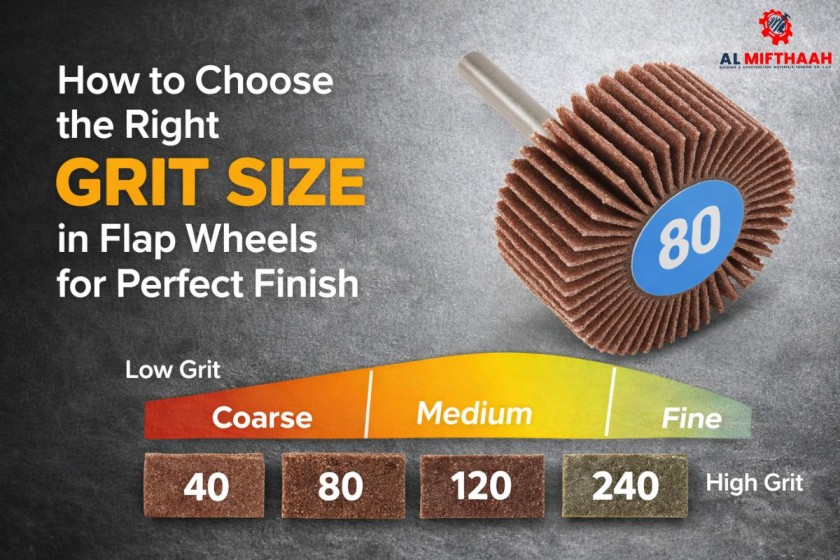
The selection of the appropriate grit size in flap wheels will be determined by your objective of work. When you require a heavy material removal, coarse grit (40-60) is the most suitable since it cuts fast and removes hard layers. Medium grit (80-120) is a good choice to use, as it provides a balance between cutting and finishing as far as general smoothing and surface preparation are concerned.
In finishing or polishing, fine grit (150-320) produces a clean surface with few marks. Therefore, the choice of the right grit will not only enhance the quality of the surface but also efficiency and minimum rework. It is always better to use the right grit at the right stage, and this will result in better and professional results.
What does grit size really mean?
Grit size is the number of abrasive particles per square inch on a flap wheel. Simply put, it informs you of the roughness or smoothness of the abrasive surface. The smaller the number, the bigger the particles, and the bigger the number, the smaller the particles.
- Coarse grit (40-60): Removes material rapidly.
- Medium grit (80-120): Flattens surfaces.
- Fine grit (150-320): Provides a smooth finish.
Hence, the first step to a flawless finish is to comprehend grit size. Many practitioners have confidence in brands such as Almifthaah since they have a uniform grit quality in all applications.
Additionally, the selection of the incorrect grit may ruin the surface or even slow down your work. That’s why it’s important to match grit size with your task.
How does grit affect surface finish?
The grit size will determine the appearance and feel of your final surface. A coarse grit cuts quicker but leaves scratches, and a fine grit cuts very little material and leaves a smooth finish.
This is the way it works:
- Coarse grit
- Fast cutting
- Rough surface finish
- Perfect to remove rust or welds.
- Medium grit
- Balanced shearing and polishing.
- Finish surface.
- Fine grit
- Slow cutting
- Clean and smooth surface.
- Perfect for polishing
But it is not advisable to jump to fine grit. It can cause uneven impressions. However, slow development is more successful.
When you are sourcing the tools with a trusted abrasive tools supplier Dubai, you should always ensure that the grit consistency is in line with your finishing requirements.
Which grit works for different materials?
The best finish on different materials requires different grit sizes. The incorrect grit may harm the surface or decrease the efficiency.
1. Metal (Steel, Stainless Steel)
- Begin with 40-60 heavy grinding.
- Adjust to 80-120 to smooth it.
- Finish with 150+ for polishing
2. Wood
- Use 80–100 for shaping.
- Transfer to 120-150 to smooth it.
- Final polish with 180-220.
3. Aluminum
- Initial work with 60-80.
- Very coarse grit should be avoided to avoid deep scratches.
4. Plastic or Soft Materials
- Always use fine grit (150–240).
- Eliminates melting and damage.
Therefore, it is important to deal with the appropriate supplier. Most professionals would wish to have abrasive flap wheel suppliers in Dubai that provide material-specific solutions to eliminate guesswork.
When should you move from coarse to fine?
The time to switch grit size is as important as the selection of the appropriate grit size.
You must change to the next grit when:
- Scratches of the former grit are removed.
- Even to the touch, the surface is smooth.
- No deep marks are left.
A simple workflow:
- Begin with coarse grit to shape.
- Change to medium grit to smooth it.
- Finish with fine grit for polishing
But shortcuts may result in shoddy work. Therefore, always follow a gradual process. Most abrasive tools dealers in Dubai advise that they should first test it on a small portion before applying it fully. This helps avoid mistakes and ensures better results.
Common mistakes to avoid
Even the experienced users commit mistakes when selecting grit size. These errors can be prevented to save time and enhance the quality of finish.
- Using very coarse grit for finishing
- Skipping grit levels
- Exerting excessive pressure.
- Using the wrong grit for the material
- Failure to check the condition of wheels.
Moreover, poor-quality flap wheels can give inconsistent results. This is the reason why professionals trust reputable brands such as Almifthaah to deliver quality performance.
Additionally, sourcing of hardware tools suppliers in Dubai with whom they have good relationships will guarantee durability and quality grit.
Practical grit selection guide
The following is a simple table that can enable you to quickly select the correct grit size:
| Task | Recommended Grit |
| Heavy grinding | 40–60 |
| Surface leveling | 80–100 |
| Smoothing | 120–150 |
| Fine finishing | 180–220 |
| Polishing | 240–320 |
This guide may assist beginners and experts in making fast decisions. Moreover, when doing precision work, you can select tools through a reputable Saif Precision tools supplier in UAE, which can enhance accuracy and quality of finishing.
Final verdict
The selection of the appropriate grit size in flap wheels is critical in obtaining a smooth and flawless finish. It assists in enhancing efficiency, minimizes working time, and provides high-quality surfaces. It is always advisable to use a gradual grit process, beginning with coarse and ending with fine, to achieve optimum results. High-quality tools also contribute significantly to performance and durability.
Reliable brands such as Almifthaah guarantee uniform outcomes in the various applications. Additionally, collaborating with a high-quality flap abrasive wheels supplier in Dubai can also boost your production by offering quality and well-produced products to use in professional finishing.
Frequently asked questions
The coarse grit of 40-60 is most effective and quick in removing rust.
No, it is recommended to use more than one grit to guarantee better surface finish and smoothness.
When scratches of the former grit are entirely removed from the surface, change grit.
Increased grit provides a smoother finish, but it is not able to remove heavy material.

How Long Do Mounted Points Last and When Should You Replace Them?
Everything You Need to Know About Tool Wear in Carbide Tipped Cutting Tools