

- October 9, 2026
- by Almifthaah
How Long Do Mounted Points Last and When Should You Replace Them?
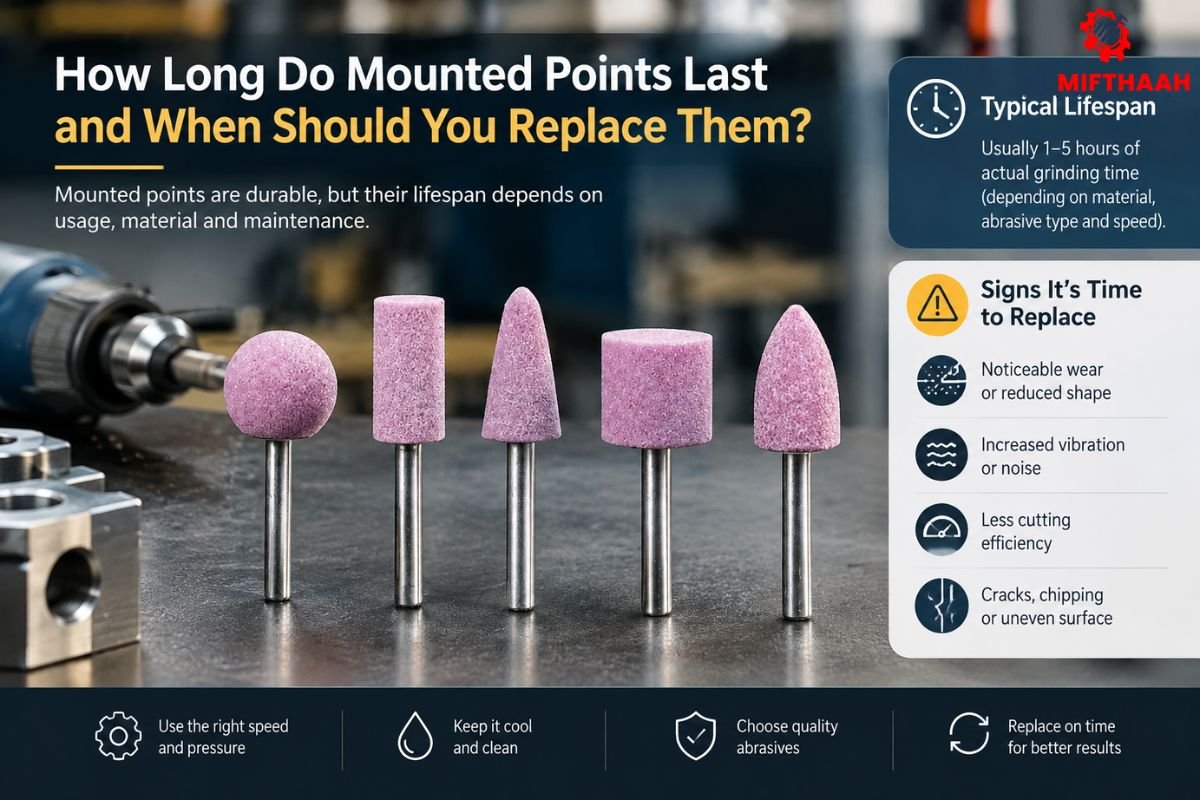
A mounted point will last as long as its cutting surface remains sharp, its shank stays rigid, and it operates at the proper speed. There is no specific lifespan, as many variables, such as materials involved, speed limits, pressure settings, and application method, determine how long the mounted point can serve efficiently. So it is necessary to replace your mounted point in case of observing cracks, chipping, excessive glazing, vibrations, or poor cutting performance even when it looks fine.
Table of Contents
ToggleKey takeaways
- Replace a mounted point when wear, damage, or glazing affects cutting performance.
- Observe the maximum operating speed marked on the pack or on the item.
- Apply light, even pressure, so that your tool is cooler and will not wear out as quickly.
- Store mounted points dry and apart so the cutting edges are protected.
What are mounted points?
Mounted points are tiny grinding or cutting tools with a back shank, also called a mandrel, and a shaped head at the front. The back shank, or mandrel, goes into a die grinder or rotary tool. The head may be abrasive, consisting of grains such as aluminium oxide, silicon carbide, ceramic or zirconia in a resin or vitrified bond, or it can be a solid tungsten carbide with cut teeth, known as a carbide burr by many.
Moreover, these are used by fabricators and maintenance teams for deburring castings, cleaning weld seams, and shaping internal corners or for finishing the metal. Woodworkers and mouldmakers use them as well. If you are buying these tools in the UAE, a good carbide burr supplier in Dubai UAE will be able to select the cut pattern and the head shape for your application, which is more important than most buyers realise.
How long do mounted points last?
No manufacturer can accurately provide a number of hours that would encompass all jobs, and anyone offering such a number is just guessing. A point set to a bench when heavy stock is running all day will last vastly less time than if set to a bench for a few quick touch-ups on soft material.
A mounted point will be worn out one of three ways: it will be ground back so the head is smaller than the size indicator, it will be cut or clogged so the work can’t be effectively cut, or it will be damaged by dropping, overspeeding, and bending the shank. The first two situations are expected -the head gets dulled or cut away by sanding. The last is caused by operator error. Abrasive tools supplier Dubai will give you the right advice to make this tool life extend.
What factors affect mounted point life?
Several variables decide how long a point stays useful. Most of them are within your control.
| Factor | How it affects service life |
| Material | Harder workpieces, such as hardened steel, wear the head faster than soft aluminium or wood. |
| Abrasive or cut type | The grain or tooth pattern must suit the material. A mismatch causes rapid loading or chipping. |
| Head size | Larger heads carry more load and usually need slower speeds. Small heads can overheat quickly. |
| Operating speed | Running above the rated speed increases heat, vibration, and the risk of the head breaking. |
| Pressure | Heavy pressure forces the head to wear fast, heats the tool, and can crack the bond or the carbide. |
| Application | Continuous stock removal wears a point faster than light finishing or deburring. |
| Storage | Moisture, impact, and contact with other tools damage edges and bonds before the tool is ever used. |
The two most common things people don’t think to consider are material and application. A point on mild steel may fail in a week if the speed and pressure remains the same on stainless steel. Abrasive tools dealers in Dubai will be beneficial.
What are the signs a mounted point needs replacing?
Always look for these signs before, during and after jobs. Others are obvious, others are not, but they will become apparent through the feel of the tool in your hand or high-quality flap abrasive wheels supplier in Dubai helps to know these signs.
- Excessive wear: head is visibly smaller, rounded or uneven. After the shape alteration, the point will erratically cut and may gouge the material.
- Cracks: If the point has hairline cracks in the abrasive bond or in the carbide head, it is no longer safe to use. Never use it, even if it is a short job.
- Glazing: The abrasive surface looks shiny and smooth because the grains have dulled and the bond has not released them. Glazed point rubs rather than cuts, and produces more heat.
- Vibration: If a point is wobbling, chattering, or rough, the shank is bent, the head is damaged, or the runout is not good. Stop and check it.
- Poor cutting performance: If you need more pressure than before to get the same result, the point is worn out or loaded.
- Overheating: Heat discolours the workpiece, smells of burning, or makes the tool too hot to hold comfortably. The following are indications of over pressure, improper speed or dull point.
- Damage: Chipped carbide teeth, bent or cracked shank, or a loose head should be replaced immediately.
How can you make this last longer?
Most premature failures are due to habits that are easy to change.
- Selecting the right point: Correlate the abrasive or cut pattern with the material, and the head size with the access required. Don’t assume anything, ask for the technical information of the product from your supplier.
- Mount it correctly: Do not use a chuck or collet with a shank that is less than or more than the diameter of the piece you are chucking. Full and tight, but not over-tight, the shank. A loose shank will wobble and can break, a forced shank can crack.
- Obey the speed limits: Look for the maximum speed on the packaging and on the product. Never run a point at a speed greater than this limit, and note that bigger heads tend to require slower running speeds.
- Apply light, controlled pressure: Leave the point to do the work. Harder pressure does not usually accelerate the job, but will tend to shorten the life of the tool.
- Store points properly: Store them separately in their original packaging, or in slots to prevent edges from rubbing together. Keep them safe from moisture that may cause abrasive bonds to deteriorate over time.
- Check before each use: Examine the head and shank and rotate the tool for a short period of time to observe if there is wobble. It is more cost effective to find a crack at the bench than in a work situation.
How often should this be inspected and replaced?
Inspection should happen every time you pick up a point, and after any drop or unexpected stall. This does not take more than seconds and most failures are avoided. For longer jobs, monitor the point periodically, and observe the point cutting.
Replacement timing is dependent on your type of work. Don’t follow a set schedule, just make a brief record for a few weeks. Record the material, job and an approximate duration before replacement for each of the points. This record will give you a realistic service life in your own workshop and it will be much more informative than any average service life.
When a point begins to exhibit one of the above warning signs, replace it, no matter how long it is in use. Avoid finishing a job with a damaged point as a way to save a few minutes; the risk to the operator and the workpiece is not worth it.
Where should you buy mounted points?
It makes sense to purchase from a supplier who has an understanding of tool specifications. There are many factors to consider when looking for a good speed rating, correct shank, and product that states the grain or cut type. If there is a point that isn’t a match, ask the supplier if they can help you determine what compromises are being made.
Almifthaah, provider of Saif Precision tools supplier in UAE of abrasive and cutting tools in UAE. In case you’re looking for a comparison, you might ask the abrasive tools dealers in Dubai about flap abrasive wheels and other consumables as numerous workshops purchase them together with mounted points. Regardless of the Dubai abrasive tools supplier you opt for, ask for the product data before purchasing, and ensure the speed rating aligns with your equipment.
Final thoughts
Mounted points have great value when selected correctly, operated at the correct speed and monitored before every use. Look for cracking, glazing, vibration, poor cut and overheating and discard that point as soon as it is noticed. A worn out tool actually costs more in time, quality and safety than a replacement so make a conscious effort to Monitor, Record and Store and your mounted points will serve you faithfully when required.
Frequently asked questions
No definite life span. The service life will vary according to the material, abrasive or cut type, speed, pressure, and frequency of use of the tool. Monitor jobs for self to get a true view of your jobs.
Excessive wear is the most common sign. If the head starts to look obviously misshapen or smaller, it needs to be replaced and cut is not acceptable.
If the point is heavily glazed, it is most likely worn, heavily loaded or running at the wrong speed or pressure. Check the cause first. If it remains shiny after cleaning, then replace the point.
No. Damage to the head or shank can cause fracture while being used and lead to the dispersion of fragments. Immediately removed from service.
The following are common causes: bent shank, damaged head, poor run out or loose collet. Stop, inspect, and replace if unable to correct.
No. Maximum speed is just a ceiling and not an expectation. The slower the pace the more control it will be and the less heat will be generated, especially for larger heads.

How Long Do Mounted Points Last and When Should You Replace Them?

Everything You Need to Know About Tool Wear in Carbide Tipped Cutting Tools