
- October 5, 2026
- by Almifthaah
How to Choose the Right Gear Cutter: Module, Tooth Count, and Pressure Angle Explained
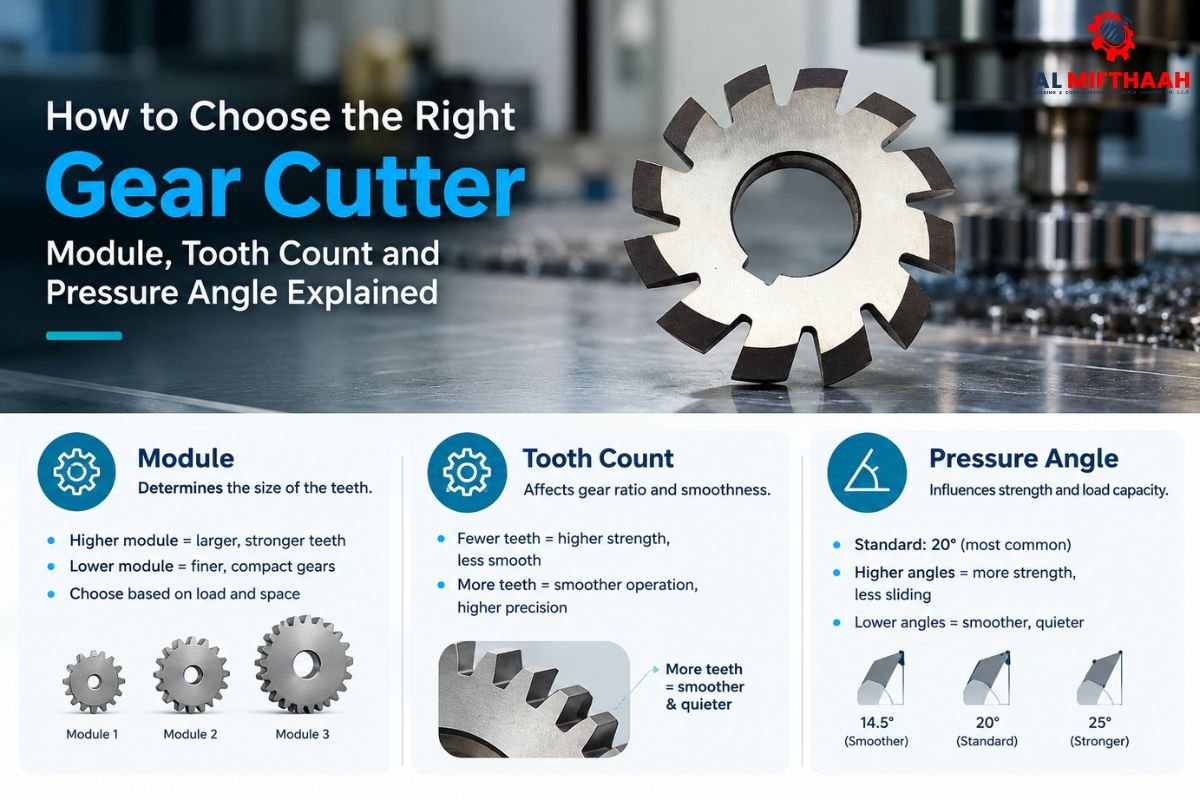
When selecting a gear cutter, there are three factors that must be related to the gear that is to be cut: module (or diametral pitch), pressure angle, and cutter number, with a range of teeth that includes the required number of teeth. The module and pressure angle must be exact. The tooth count must only fall in the printed range. Bore, material, and coating come next and depend on the machine and workpiece used.
Most errors in ordering can be traced back to poor measurements of a worn gear, or reading a cutter number without checking the numbering on the set itself. Neither is very difficult to avoid.
Table of Contents
ToggleKey takeaways
- Module (or DP) and pressure angle must match the gear precisely, without allowing for any tolerances.
- Tooth count must merely fit to any part of the range given by the particular cutter.
- Metric and inch sets number their cutters inversely, so make sure the range of teeth shown on the cutter is read, not just the number.
- Form milling cutters are appropriate for repairs and small amounts. Use a hobbing machine for large amounts.
Module: what the number tells you
Module is the pitch diameter in millimetres divided by the number of teeth. A 20-tooth gear with a 40 mm pitch diameter is module 2, and a larger module simply means larger teeth.
Two gears with different modules can’t mesh, because their teeth are spaced differently around the pitch circle. So the module is the first thing to pin down.
Inch-based gears use diametral pitch (DP) instead, which counts teeth per inch of pitch diameter. The conversion is module = 25.4 ÷ DP. A 10 DP gear comes out at module 2.54, which is close to module 2.5 but not the same thing.
For standard 20° full-depth teeth, you’ll use these formulas:
- Outside diameter = module × (teeth + 2)
- Tooth depth = 2.25 × module
- Root diameter = module × (teeth − 2.5)
However, reverse-engineering an old gear? Count the teeth, measure the outside diameter, and divide by (teeth + 2). Say a 42-tooth gear measures 88.2 mm. That gives 2.005, so it’s module 2. Wear can make the outside diameter read a little small, so snap the result to the nearest standard module rather than trusting the decimals.
Tooth count and cutter numbers
The involute curve changes shape as the tooth count changes. A 12-tooth pinion has a stubby, strongly curved tooth, while a rack has straight flanks. No single cutter is correct for both, so cutters are sold in sets of eight, each covering a band of tooth counts. Half-size sets add in-between cutters where you need finer accuracy.
| Teeth to cut | Inch (DP) set | Metric (module) set |
| 12 to 13 | No. 8 | No. 1 |
| 14 to 16 | No. 7 | No. 2 |
| 17 to 20 | No. 6 | No. 3 |
| 21 to 25 | No. 5 | No. 4 |
| 26 to 34 | No. 4 | No. 5 |
| 35 to 54 | No. 3 | No. 6 |
| 55 to 134 | No. 2 | No. 7 |
| 135 to rack | No. 1 | No. 8 |
Watch the numbering. In inch sets, No. 1 covers the largest gears. In metric sets, No. 1 covers the smallest. Confirm the tooth range on the listing or on the cutter itself before you pay.
Therefore, choose by the tooth count of the gear you’re cutting, not its mate. A 14-tooth pinion and a 60-tooth gear on the same drawing need two different cutters. Gears near the edge of a band also carry a bit more profile error than those in the middle.
Helical gears cut on a mill need a little extra care. Use the normal module, and pick the cutter by virtual tooth count: teeth ÷ cos³ of the helix angle.
Pressure angle: 14.5° or 20°?
Pressure angle is the angle at which force passes from one tooth to the next, measured against the tangent to the pitch circle. It sets the tooth’s shape and strength.
- 14.5° is the older standard. It runs smoother and quieter and puts less radial load on bearings, but the root is weaker, and undercutting starts sooner. You still find it on legacy machines and replacement gears.
- 20° is today’s default, with a broader root, a stronger tooth, and less undercutting.
- 25° shows up where strength matters, tooth counts are low, and some noise is acceptable.
Undercutting eats material from the root of a small pinion, right where the tooth carries its bending load. For full-depth teeth generated by a rack, the theoretical minimum pinion is about 17 teeth at 20° and about 32 at 14.5°. Mild undercut is usually tolerated slightly below that, around 14 and 27.
Furthermore, one rule has no exceptions: a 14.5° gear won’t mesh properly with a 20° gear. If you can’t tell which you have, measure across N and N+1 teeth with a disc micrometer. The difference equals π × module × cos(angle). At module 2, it comes to about 5.90 mm for 20° and 6.08 mm for 14.5°.
A worked example
Say a workshop needs a replacement gear for the gearbox of an imported lathe. The old gear has 28 teeth and measures 60.0 mm across the tips.
- Module = 60 ÷ (28 + 2) = 2.
- A span check points to 20°.
- 28 teeth sits in the 26 to 34 band, so the cutter is a module 2, 20° cutter, No. 5 in the metric set.
- Root diameter = 2 × (28 − 2.5) = 51 mm, and tooth depth = 4.5 mm.
- Mount the blank on an arbor, check runout (under about 0.025 mm), and set the dividing head for 28 divisions.
The 70-tooth mating gear needs a different cutter, No. 7 in the metric set.
Material, coating, and cutter size
High-speed steel (HSS) is the everyday choice for form cutters. Carbide is mostly reserved for abrasive materials and aluminium, and coated HSS (TiN is common) resists flank wear better. Grades differ between makers, so when you shop for cutting and milling tools Dubai suppliers offer, ask for the grade and coating in writing.
Cutter size needs checking too:
- Catalogue bores of 16, 22, and 32 mm are common.
- The outside diameter grows with the module, from about 50 mm at module 1.25 to about 100 mm at module 6.5.
- A module 6.5 tooth is about 14.6 mm deep, so it needs a rigid machine, a sturdy arbor, and a slow feed.
Check your mill’s arbor and spindle capacity before ordering a big cutter. Take speeds and feeds from the cutter maker’s data, and use plenty of coolant on steel.
Where do form cutters fall short?
Form milling is slow, and indexing the blank one tooth at a time leaves room for spacing errors. That’s fine for repairs, prototypes, and one-off replacements. Milling cutter dealers in Dubai can be helpful.
Volume work belongs on a hobbing machine. The blank indexes continuously there, so tooth spacing stays more consistent. Internal gears are usually shaped instead. If a job demands tight quality grades, a form cutter alone probably won’t get you there.
What to confirm before you order?
This is where specs tend to get lost. When you contact gear cutters suppliers in Dubai, put everything in one message:
- Module or DP, and the exact pressure angle
- Cutter number and the tooth range it covers
- Bore, keyway, outside diameter, and width
- Material and coating
- Single cutter or full set
- Lead time, since some sizes are made to order
Good gear cutter dealers in Dubai will ask about pressure angle on their own. If nobody does, double-check before paying. Sort out arbors and spacers in the same enquiry, since milling cutter dealers in Dubai can often supply them with the cutter.
Therefore, cost climbs with modules. Bigger cutters use more steel and take longer to make, and a full set of eight multiplies the spend. If your repair jobs keep landing on the same two or three modules, buy single cutters for the tooth ranges you actually see.
If you want a second opinion on a specification, Almifthaah, a Saif Precision tools supplier in UAE, is one place to send it.
Storing cutters in Dubai’s climate
Coastal humidity, plus the swing between air-conditioned tool rooms and hot workshop floors, is hard on bare steel. Cutting and milling tools Dubai workshops left bare on open racks can rust quickly.
- Wipe each cutter with light oil after use.
- Keep them in individual sleeves so the teeth don’t knock together.
- Sharpen by grinding the tooth face only. Grinding the outside diameter changes the profile.
- Clamp the blank and arbor rigidly, guard the cutter where the setup allows, and wear eye protection.
Common mistakes
- Reading a cutter number without checking which way the set is numbered
- Assuming a modern-looking gear is 20° when older imported equipment may be 14.5°
- Taking the module straight from a worn gear without rounding to a standard value
- Picking the cutter by the mating gear’s tooth count instead of the gear being cut
- Skipping the runout check on the arbor
Ordering by number alone gets its own warning. Give gear cutter suppliers in Dubai the tooth range and the numbering system, not just “No. 3”, because that label means different things in different sets.
Final thoughts
Keep a card in the tool room for every gear you repair. Write down the module or DP, pressure angle, tooth count, and the cutter number with its range. It saves a lot of reminiscing and heads off most wrong orders.
The next time an enquiry goes out to gear cutters dealers in Dubai , attach the card. If you also need arbors or related tooling, Almifthaah, as a Saif Precision tools supplier in UAE, can go on the same inquiry.
Frequently asked questions
Only when both gears in the mesh are new. Module 2.5 is close to 10 DP but not identical, so it won’t mesh cleanly with an existing DP gear.
The tooth profile comes out slightly wrong. A small mismatch may run acceptably at light loads, but a bigger one brings noise, uneven wear, and reduced contact.
Go with 20° unless you have to mate with an existing 14.5° gear. It gives a stronger tooth and less undercutting.
Measure span over N and N+1 teeth, then compare the result with π × module × cos(angle). A tooth gauge also works.
No. Each cutter covers a band, such as 26 to 34 teeth. Cutting outside it distorts the involute profile.
Confirm module or DP, pressure angle, tooth range, bore, coating, and lead time. If a dealer can’t state the tooth range for a listed cutter, follow up before you buy.
Yes. You need an arbor that matches the bore, spacers, and a dividing head or CNC rotary axis. Milling cutter dealers in Dubai can often supply the arbor and spacers with the cutter.
HSS covers most steel gear work. Carbide is mainly for abrasive materials and aluminium.

How Long Do Mounted Points Last and When Should You Replace Them?

Everything You Need to Know About Tool Wear in Carbide Tipped Cutting Tools