
- June 9, 2026
- by Almifthaah
Best Shim Stock Materials: Stainless Steel vs Brass vs Copper
Table of Contents
ToggleKey Takeaways
- For high-strength and heavy-duty applications, stainless steel is the best choice.
- Brass is a low cost and flexible material for general industrial applications.
- Copper is preferred for electrical and thermal conductivity.
- The selection of the correct shim material ensures overall equipment performance, accuracy, and longevity.
The selection of the correct shim stock material is dependent upon the application, operating environment, load requirements, and corrosion resistance. Each of these metals has its advantages in terms of strength and durability, ease of machineability, corrosion resistance, and electrical and thermal conductivities. Knowing these differences enables engineers, manufacturers, and maintenance professionals to make the right choice for long-term performance.
Shim stock is essential in precision alignment, machine calibration, spacing, and equipment maintenance. From industrial machinery to automotive systems, manufacturing equipment to precision instruments, choosing the right shim material can enhance accuracy and prolong the lifespan of your equipment.
Almifthaah is a trusted supplier for quality shim stock materials and precision engineering products for challenging applications for businesses.
What is shim stock?
A thin material that is used to fill gaps, for precise spacing, to align components, and to provide dimensional accuracy in mechanical assemblies is known as shim stock.
Common Applications
- Machine alignment
- Equipment maintenance
- Bearing adjustments
- The setup and calibration of the tool.
- Precision manufacturing
- Industrial assembly operations
Therefore, shim stock suppliers in Dubai can provide the precise thicknesses and material grades required for specific applications, which is essential for industries.
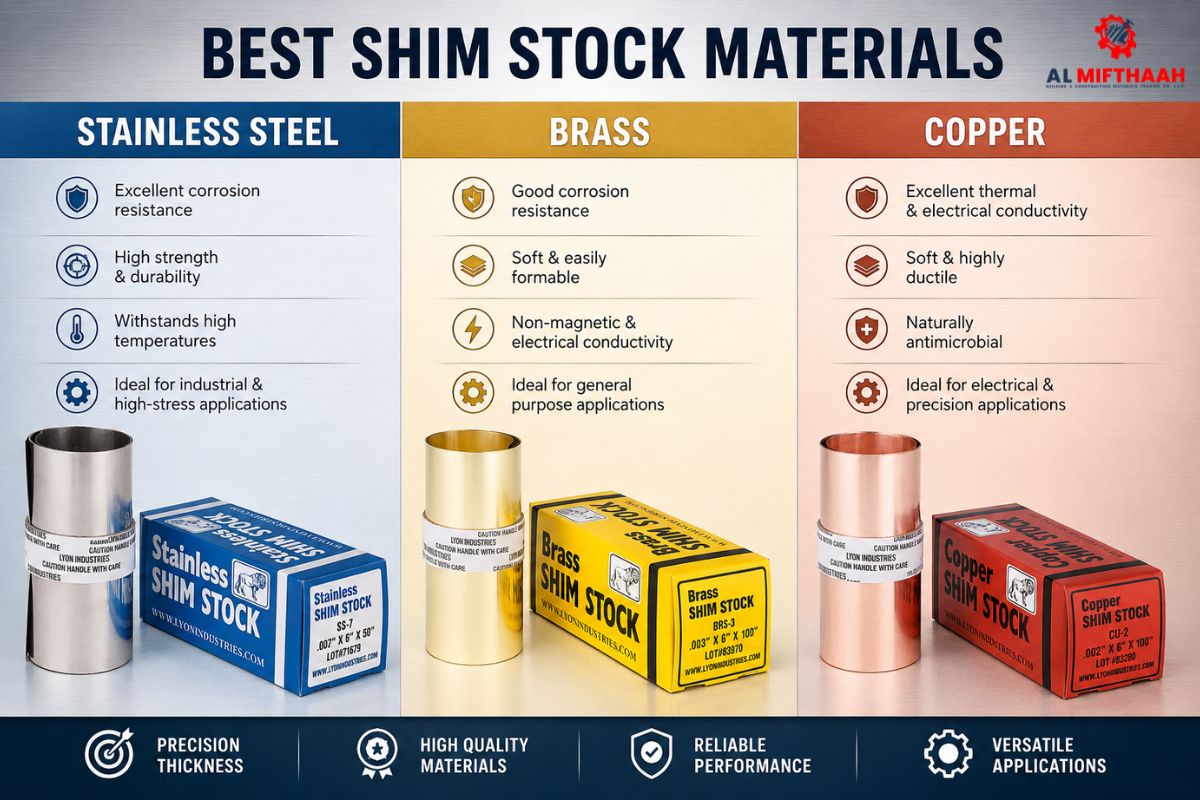
Stainless steel vs brass vs copper: quick comparison
| Feature | Stainless Steel | Brass | Copper |
| Strength | Excellent | Moderate | Moderate |
| Corrosion Resistance | Excellent | Very Good | Good |
| Electrical Conductivity | Low | Moderate | Excellent |
| Thermal Conductivity | Moderate | Good | Excellent |
| Wear Resistance | High | Moderate | Moderate |
| Machinability | Moderate | Excellent | Good |
| Best Use | Heavy-duty machinery | General industrial use | Electrical applications |
When to use stainless steel shim stock?
Ideal for high-strength applications
Due to the need for high durability and load-bearing capabilities, stainless steel shim stock is commonly employed in industrial applications.
Advantages
- High tensile strength
- Excellent corrosion resistance
- Long service life
- Suitable for harsh environments
- Resistant to wear and deformation
Ideal Applications
- Manufacturing equipment
- Heavy machinery
- Aerospace components
- Industrial pumps
- Precision measuring systems
Stainless steel shims are known to offer dimensional stability under pressure and temperature variations, making them the preferred choice for many businesses looking to find the best machine tools accessories in Dubai.
When to use brass shim stock?
Best for General Industrial Applications
Brass shim stock provides a good combination of strength, flexibility, and ease of fabrication.
Advantages
- Can be easily cut and molded
- Good corrosion resistance
- Non-magnetic properties
- Attractive finish
- Cost-effective solution
Ideal Applications
- Instrument calibration
- Mechanical assemblies
- Maintenance repairs
- Industrial tooling
Furthermore, technicians who use precision equipment frequently make use of brass because it can be easily altered without sacrificing performance.
When to use copper shim stock?
Best for Electrical and Thermal Applications
If conductivity is an important specification, copper shim stock is the best option.
Advantages
- Excellent electrical conductivity
- Superior heat transfer
- Good corrosion resistance
- Easy to form and flexible
Ideal Applications
- Electrical panels
- Transformers
- Power distribution systems
- Electronic equipment
- Heat management systems
Copper shims are a popular choice among precision instruments suppliers in Dubai when it comes to places where electrical efficiency and thermal control are of paramount importance.
Benefits of choosing the right shim material
There are various advantages of choosing the right material for shim stock.
1. Improved Equipment Accuracy
A proper shimming will ensure alignment and dimensional accuracy.
2. Reduced Maintenance Costs
The right material reduces wear and replacement frequency.
3. Better Equipment Performance
Reliability and efficiency of machines depend on the accuracy of spacing.
4. Longer Service Life
High-quality shim materials are able to endure the harsh conditions of operation.
5. Enhanced Safety
Proper alignment minimizes equipment failure risks and downtime.
Manufacturing companies that use machine measuring tools dealers in Dubai understand that even slight misalignments can have an effect on manufacturing precision and equipment life.
Industry insight example
A manufacturing company had a production machine that had been subject to repeated vibration problems following a number of maintenance efforts.
Based on detailed inspection, engineers found that the shim material used was not strong enough to meet the continuous heavy-duty requirement. The team replaced the shims with more load-capacity stainless steel shim stock.
As a result:
- The vibration of the machine was greatly reduced.
- Alignment accuracy improved.
- Maintenance periods were increased.
- Production efficiency increased.
This example illustrates the significance of material selection besides the thickness of shims. With the expertise of experienced suppliers like Almifthaah, customers can assess the requirements of their application and get the best material recommendation for shim stock.
Why does quality matter when buying shim stock?
There are several problems that can be caused by poor shim stock:
- Inconsistent thickness
- Poor alignment
- Faster wear
- Increased downtime
- Higher maintenance costs
Reliable Saif Precision tools supplier in UAE and trusted industrial suppliers such as Almifthaah guarantee uniformity in quality, tolerances, and performance.
Bottom line
The type of material used for the shim stock is dependent on the use. Stainless steel provides the highest strength and durability, brass provides a high level of versatility and is very easy to machine, and copper has outstanding electrical and thermal properties. By being aware of these differences, businesses can enhance equipment accuracy, minimize maintenance expenses, and boost the reliability of their operations.
Almifthaah offers reliable products and advice on how to choose the right shim stock material for your needs if you are looking for high-quality industrial solutions.
Frequently asked questions
The 3 materials have varying strengths and wear resistance, with stainless steel shim stock being the strongest and most wear-resistant.
Yes. Brass is very resistant to corrosion, and it is suitable for many industrial applications.
Copper would be the choice of the material if the need is to transfer electricity or heat.
Yes. Shim stock is commonly used to assemble industrial equipment, bearings, motors, and machinery.
Consider load needs, operating conditions, corrosion resistance, conductivity, and equipment specifications.

How Long Do Mounted Points Last and When Should You Replace Them?

Everything You Need to Know About Tool Wear in Carbide Tipped Cutting Tools