- September 15, 2026
- by Almifthaah
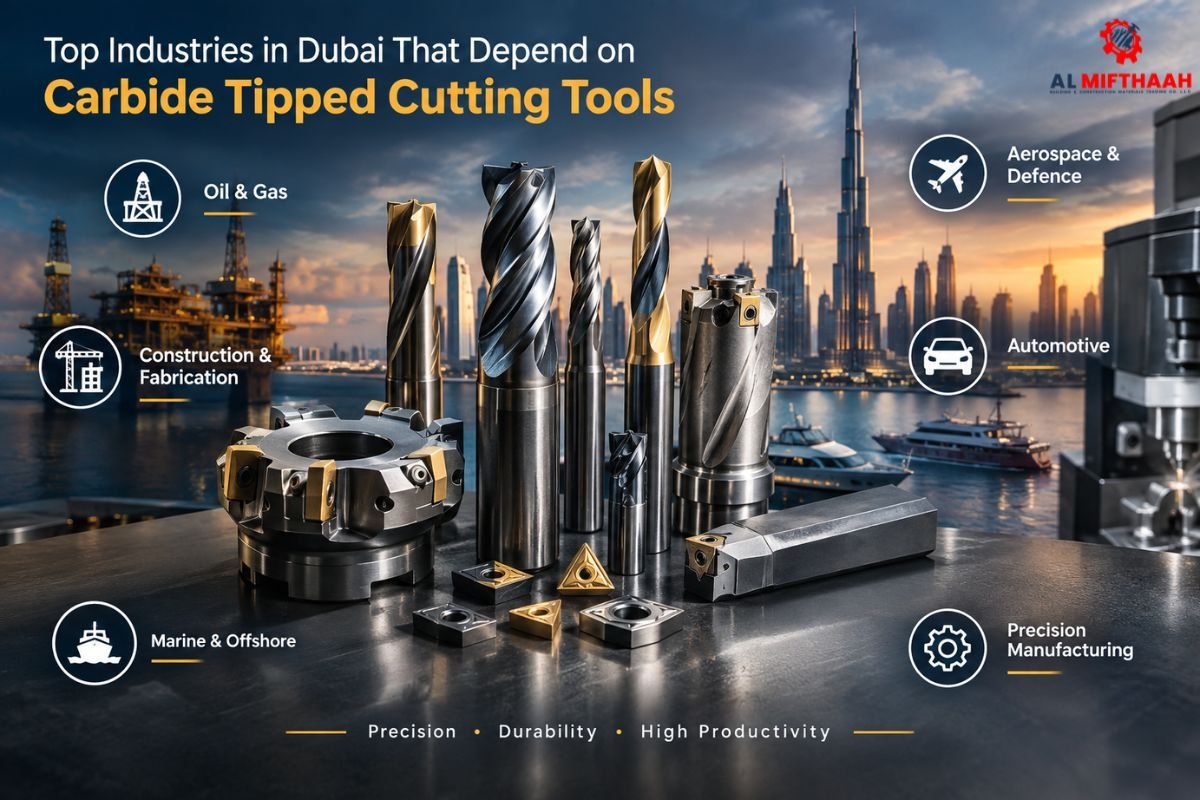
Top Industries in Dubai That Depend on Carbide Tipped Cutting Tools
Carbide-tipped cutting tools are used by many industries in Dubai, including aerospace, oil and gas, automotive, construction, and precision engineering, because regular steel tools can’t carve through titanium, stainless steel, and other hardened alloys. If you want to keep your machine shop profitable in that environment, you need to work with a reliable single-point tool supplier in Dubai. Here is information about the industries that rely on this type of tool, why carbide tools are a better option than the others, as well as what to pay attention to when looking for a supplier.
Table of Contents
ToggleKey takeaways
- Carbide holds its sharpness at temperatures that make high-speed steel lose its hardness quickly.
- Industries such as aerospace, oil, automobile, and construction work with hard metals that withstand corrosion every day.
- Good suppliers of carbide tools reduce downtime costs to much lower values than just the price of the tool.
- Local suppliers in the UAE, such as Almifthaah, reduce the wait time needed to import tools from overseas.
Why does Dubai’s industrial base lean on carbide tools?
Dubai doesn’t get thought of as an industrial city. Tourism and real estate take up all the airtime. But behind that, there’s a dense layer of workshops, fabrication yards, and precision shops feeding aviation, oil and gas, marine, and construction clients across the Gulf. The Dubai Industrial Strategy pushed this along by encouraging local production over pure imports, and that’s pulled more machining and fabrication work into the emirate rather than shipping it out.
Almost all of that work involves metal that fights back.
- Stainless steel
- Titanium alloys
- Inconel
- Hardened tool steel.
Regular high-speed steel wears out against these in a fraction of the runtime carbide manages. So across every industry below, carbide tooling isn’t optional. It’s what shows up on the tool rack by default. Carbide endmill suppliers in Dubai play an important role in such industries.
Aerospace and aviation maintenance
Dubai sits in the middle of one of the busiest aviation corridors anywhere, and that means a constant flow of maintenance, repair, and overhaul work. Emirates runs one of the largest wide-body fleets in the world, and its Engineering Centre handles heavy checks on aircraft built from titanium and nickel-based alloys throughout the airframe and engine components.
However, machining these parts is unforgiving. Titanium heats up fast and work-hardens the moment a tool dwells too long in the cut. A carbide-tipped single-point tool keeps its geometry and edge through that heat far longer than steel tooling does, which is why MRO facilities standardize on carbide for anything near structural or engine components. Tolerances are measured in microns here, and a tool that dulls mid-cut doesn’t just cost time. It can scrap a part worth more than the tool by a wide margin.
Oil, gas, and marine fabrication
Oil and gas still anchors a large piece of the UAE economy, and Dubai’s Jebel Ali and Jafza-adjacent industrial zones host fabrication yards building and repairing valves, flanges, pump housings, and pipeline fittings. Marine fabrication for the shipping and offshore fleets moving through Dubai’s ports runs on the same demands.
These parts are usually machined from duplex stainless steel or nickel alloys, chosen because they survive corrosive, high-pressure environments. The same metallurgy that gives them that resistance is what makes them hard on cutting tools. Therefore, shops in this line of work rely on cutting and milling tools Dubai suppliers who stock carbide grades matched to duplex and super-duplex stainless, not generic inserts that give out after a handful of parts.
Automotive repair and custom fabrication
Dubai’s automotive scene runs from routine dealership servicing to a sizable custom fabrication and modification trade, given how many high-performance and luxury vehicles are on the road. Brake rotor resurfacing, custom part machining, engine block work, and bodywork all lean on carbide tooling somewhere along the way.
Furthermore, this sector is a different animal from aerospace or oil and gas, because volume matters more than extreme precision on most jobs. A shop turning over dozens of vehicles a week needs tooling that holds up through repeated use without constant sharpening, since every tool swap is time a car spends on the lift instead of moving through the shop and out the door.
Construction and structural steel work
Dubai’s skyline didn’t build itself, and the structural steel and fabrication trade behind it still runs on cutting and drilling, day in and day out. Steel beam fabrication, rebar cutting, and connection plates all need tooling that handles mild steel in high volume without constant downtime.
Here the argument for carbide is about cost per part rather than metallurgical necessity. Mild steel doesn’t punish tooling the way titanium does, but a yard cutting hundreds of meters of steel a day still comes out ahead over a project’s life by using carbide-tipped blades and bits instead of cheaper tooling that needs swapping out every few shifts.
Precision engineering and machine shops
Underneath the headline industries sits a layer of general precision engineering shops serving all of them, plus electronics enclosures, industrial machinery parts, and custom tooling for other manufacturers. These are the shops actually running the lathes and mills every day, and their tooling choices ripple out to every client they touch.
For a shop like this, a carbide tip single point tool Dubai order isn’t a one-time purchase; it’s a recurring line item, and the supplier relationship ends up mattering as much as the spec sheet. A shop that finds a carbide endmill supplier in Dubai with consistent grade quality skips the frustrating problem of one batch of inserts working fine and the next batch chipping on identical material and identical settings.
Carbide vs HSS: why the switch matters
- Heat Tolerance and Cutting Speed
Carbide keeps its hardness at temperatures well above where HSS starts to soften, roughly 900 to 1000 degrees Celsius against 600 for steel. That gap lets a machinist run higher cutting speeds and feed rates without the tool losing its edge partway through a job, and that alone can shave real time off a production run.
- Tool Life in Abrasive Materials
Cast iron, hardened steel, and fiber-reinforced composites wear tools down through friction as much as heat. Carbide’s wear resistance in these conditions runs several times longer than HSS before it needs regrinding, and for a shop billing by the hour, that’s not a small difference.
- Where HSS Still Makes Sense
HSS isn’t obsolete. For low-volume work, softer materials, or jobs where tool cost outweighs cycle time, it’s cheaper and easier to regrind on-site. A good supplier will actually tell you when HSS fits better instead of steering every order toward carbide, because matching the tool to the job is what keeps a client coming back.
Choosing a supplier in the UAE
Availability matters more than most people realize until it costs them a job. A shop mid-project can’t afford to wait three weeks for tooling to clear customs. That’s the practical case for a local Carbide Tipped Single Point Tools supplier in Dubai over sourcing from abroad: faster replacement, easier returns, and a supplier who understands what the local heat and workload actually do to tooling.
Grade consistency is worth checking next. Ask a supplier what carbide grade and coating they’re putting on a given application, not just what shape the tool is. A vague answer is the tell. Almifthaah, known in the UAE as a Saif Precision tools supplier in the UAE, built its catalog around this kind of application-specific matching rather than generic stock, and that shows up in how long the tooling actually lasts on the floor.
Additionally, pricing is worth a direct conversation too. Bulk pricing on inserts and end mills changes the economics on a real project, and the brand’s standing as a regional carbide end mill supplier in Dubai means volume buyers get treated differently than one-off retail orders. Worth confirming that upfront rather than assuming it.
Bottom line
Carbide-tipped cutting tools aren’t a nice-to-have in Dubai’s industrial economy. They’re what keeps aerospace maintenance, oil and gas fabrication, automotive shops, and structural steel work moving, because the materials these industries cut would chew through ordinary steel tooling in no time. If you’re still deciding whether to switch, or which grade actually fits your application, talk to a supplier who’ll match the tool to the job instead of just reading off a catalog number.
Almifthaah, whether you know it as that or as a Saif Precision tools supplier in UAE, is a solid place to start that conversation for anyone sourcing a carbide tip single point tool Dubai shops can actually depend on.
Frequently asked questions
It is a cutting tool that is fitted with a carbide tip brazed or clamped into a steel body and is employed on the lathe turning table to cut steel, stainless, and cast iron materials with a single cutting edge and requires the ability to withstand wear.
It resists heat and abrasive wear, and the shops in Dubai that produce aircraft, oil and gas, and have high-volume auto assembly lines can’t afford to deal with unnecessary shutdowns due to frequent tool changes.
While nearly every MRO touches, directly or indirectly, through the use of aerospace MRO, oil and gas fabrication, marine repair, automotive workshops, and structural steel construction, these are the sectors that use the most.
Carbide is cost-effective for any job that requires cutting stainless, titanium, or hardened alloys, or high volume. It’s not always necessary for occasional low-volume work on soft metal.
Check the grade transparency, coating options, and stock of common sizes, and ask if they will actually recommend the right tool or just sell what is on the shelf.
Yes, per unit it does. However, typically over the entire production run, the higher tool life and fewer tool stoppages result in a lower cost per part with steel tools.
Some can, but only with a diamond wheel and equipment that some general shops do not have available, whereas HSS can be touched up on a typical bench grinder.
It reduces weeks to days, eliminates customs clearance delays, and ensures you receive a supplier who knows the local operating conditions rather than generic stock from anywhere that’s cheap.

How Thick Should Copper Shim Stock Be for Electrical Busbar Connections?

How to Select an Involute Gear Cutter by Module and Number of Teeth

Comments (2)
Common Carbide Tool Failures and How to Prevent Them
September 22, 2026 - 11:28 am[…] of tool quality is especially apparent in this case, which is why ordering tools from a reputable Carbide Tipped Single Point Tools supplier in Dubai with consistently good coating technology helps to eliminate this type of […]
Best Cutting Speeds and Feed Rates for Carbide Tipped Tools
October 14, 2026 - 6:30 pm[…] mill supplier in Dubai? Almifthaah can help you match tools to your materials and machines. As a Carbide Tipped Single Point Tools supplier in Dubai, they also cater to turning, boring, and milling operations across various industries. Need some […]