

- September 22, 2026
- by Almifthaah
Common Carbide Tool Failures and How to Prevent Them
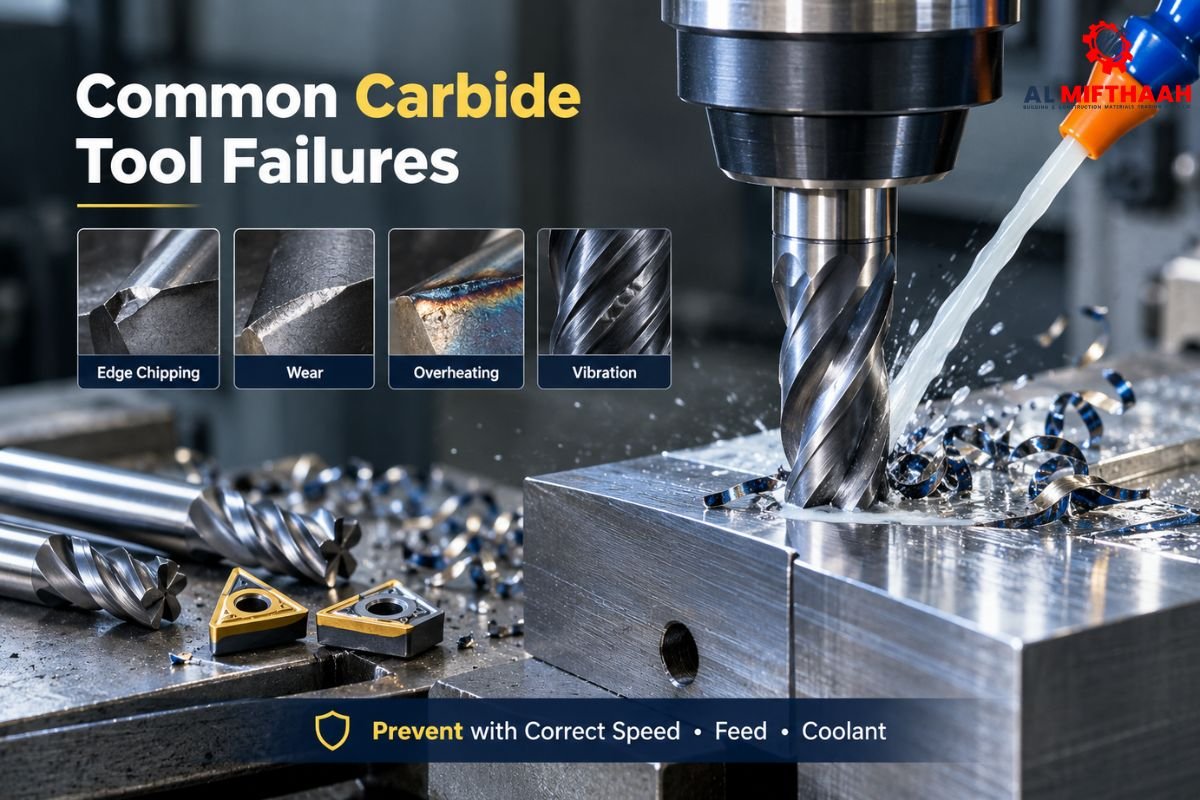
There are primarily four causes for a carbide tool failure, namely improper cutting parameters, improper tool selection for the specific material being cut, insufficient cooling or chip removal, and machine rigidity problems. Chipping, early wear, thermal cracks, and sudden breakage are the main types of failures faced by shops, which could be mostly avoided by proper cutting speeds and feeds, the right types of tools, and regular maintenance.
The possibility of cooperating with a reliable carbide end mill supplier in Dubai who has knowledge of the local conditions and the material needs massively affects the length of time tools should operate.
Table of Contents
ToggleKey takeaways
- Chipping and edge fracture usually occur due to excessive feed rates or interruptions of the milling process.
- Heat management plays a more important part than the speed of machining.
- Built-up edge happens when machining sticky materials but is often confused with actual damage to the tool.
- Carbide end mill UAE providers can minimize failures due to poor quality of end mills.
Why do carbide tools fail more often than expected?
Carbide is well-known for its heat resistance and hardness, but the very same advantages make it more brittle than high-speed steel. In fact, instead of simply losing its sharpness over time as HSS would, carbide can chip or shatter completely under certain circumstances. In the machine shops all over Dubai and in the UAE, which deal with processes that may involve the use of aluminum, stainless steel, and various hardened alloys on a single day, oftentimes tool failure is not a consequence of the tool’s manufacturing defect but rather a mistake in the setup or parameter settings.
Moreover, the manner in which the tool broke down is crucial, because it can determine the remedy that will yield favorable results. Considering all the failures as ones caused by the bad tool, one will simply keep buying new tools without any effect, whereas effective diagnosis will usually show that there are only one or two variables that need to be adjusted properly.
Chipping and edge fracture
Chipping happens when small sections of the cutting edge break away, leaving a rough, torn edge instead of a clean cut. It’s one of the most visible and most frequently reported failures.
Common causes:
- Feed rate too aggressive for the tool diameter or flute count
- Interrupted cuts on castings, weld seams, or uneven stock
- Insufficient edge preparation (a hone or chamfer that’s too sharp for the application)
- Vibration from an unstable setup or worn spindle bearings
Additionally, reducing feed slightly, adding a light edge hone, and checking workholding rigidity resolve the majority of chipping issues without needing to change tool grade. Single Flute Carbide Endmill UAE is beneficial.
Premature wear and flank breakdown
Flank wear is the gradual rounding of the cutting edge along the relief face. Some wear is normal. Premature wear, where a tool dulls in a fraction of its expected life, usually points to a mismatch between cutting speed and the workpiece material.
Running a tool too fast generates excess heat at the cutting zone, and that heat softens the carbide matrix and accelerates wear even though the tool itself never chips. This is especially common when shops reuse speed and feed charts across different alloys without adjusting for hardness variations. A carbide tip single point tool Dubai operator relies on for turning operations needs speed settings matched specifically to the alloy in front of them, not a generic default pulled from a chart.
Built-up edge formation
Built-up edge (BUE) occurs when material from the workpiece welds itself onto the cutting edge instead of shearing away cleanly. It’s most common with soft, ductile, or gummy materials like low-carbon steel, aluminum, and some stainless grades.
Furthermore, BUE looks like tool damage but is actually a material adhesion problem. Left unaddressed, it degrades surface finish and can eventually pull away, taking a piece of the cutting edge with it. Increasing cutting speed slightly, improving coolant delivery, or switching to a coating designed to reduce material adhesion typically resolves it.
Thermal cracking and heat damage
Thermal cracking shows up as fine, comb-like cracks running perpendicular to the cutting edge, usually caused by repeated heating and cooling cycles during interrupted cutting or inconsistent coolant application. Milling operations with intermittent chip contact are particularly prone to this.
Therefore, inconsistent coolant flow, where the tool alternates between flood cooling and dry contact during a single pass, is a leading cause. Steady, adequate coolant coverage throughout the cut, rather than intermittent flooding, prevents most thermal cracking before it starts.
Tool breakage during cutting
Outright breakage, as opposed to chipping, is usually mechanical: excessive stickout, a workholding failure, chip packing in a flute, or a tool path that asks the tool to do more than its geometry allows in one pass.
Additionally, long, unsupported tool stickout is one of the most overlooked causes. Every extra millimeter of stickout beyond what’s necessary reduces rigidity exponentially, not linearly. That’s why a tool that performed fine at a shorter length can suddenly snap once it’s extended for a deeper feature.
Coating failure and delamination
Coating materials like TiAlN, TiCN, and AlCrN have the potential of sustaining tools longer by lowering the friction and increasing the heat resistance but may fail due to other factors of tool base material. The phenomenon known as delamination (when the coating is either blistering or peeling off) is usually the result of insufficient adherence at the time of production or using tools at a temperature higher than expected.
However, once the coating fails, the exposed carbide part will wear off quicker compared to the rest of the coated material resulting in the pattern of wear being different from what could be expected if the substrate itself had the defect. The importance of tool quality is especially apparent in this case, which is why ordering tools from a reputable Carbide Tipped Single Point Tools supplier in Dubai with consistently good coating technology helps to eliminate this type of failure.
Choosing the right tool for the job
Tool selection errors cause failures that look like quality problems but aren’t. A few practical guidelines:
- Match flute count to material: Fewer flutes (single or two-flute) for softer, gummy materials that need better chip evacuation; more flutes for harder materials where chip load per tooth is smaller.
- Match coating to application: Uncoated or PVD-coated tools for aluminum, AlTiN-based coatings for hardened steels and higher-temperature cutting.
- Match geometry to the operation: A single-point tool built for turning shouldn’t be substituted into a milling application expecting the same tool life.
For shops running mixed production, working with a carbide endmill supplier in Dubai that stocks a range of flute counts and coatings, rather than a narrow generic catalog, makes it easier to match the tool to the actual job instead of forcing one tool type across every material.
Comparison: common failure modes at a glance
| Failure Type | Primary Cause | Quick Fix |
| Chipping | Excessive feed, interrupted cuts | Reduce feed, add edge hone |
| Premature wear | Speed too high for material | Match speed to alloy hardness |
| Built-up edge | Material adhesion on soft alloys | Increase speed, improve coolant |
| Thermal cracking | Inconsistent coolant application | Maintain steady coolant flow |
| Breakage | Excess stickout, workholding failure | Shorten stickout, secure setup |
| Coating delamination | Poor adhesion or overheating | Stay within rated temperature range |
Maintenance practices that extend tool life
Preventing failure is largely about steady habits rather than any single dramatic change:
- Inspect cutting edges under magnification between jobs, not just when a problem is already visible.
- Store carbide tools separately, ideally in individual slots, to prevent edge-to-edge contact damage.
- Keep a running log of tool life per job type to catch gradual parameter drift before it causes failures.
- Verify coolant concentration and flow rate periodically rather than assuming the setup hasn’t changed.
- Source tooling from one supplier, such as Almifthaah, so geometry and coating quality stay predictable across batches rather than shifting with each new tool lot.
Supplier consistency matters more than shops often assume. A vendor that switches carbide grades or coating processes between orders introduces variability that looks like a machining problem but is really a supply chain issue. This is where a dependable Saif Precision tools supplier in UAE relationship pays off, since predictable tool behavior lets a shop set its parameters once and keep them rather than re-adjusting for every new batch of tools.
Bottom line
Carbide tool damage rarely occurs by chance. Chipping, early wear, built-up edge, furnace burn, breakage, and peeling all have their own causes, which can usually be traced back to cutting conditions, coolant conditions, or choice of tools, rather than indicating any problems with the tools themselves. Knowing the basics, along with using suitable tools from a supplier that knows how local machine shop conditions affect the performance of cutting tools, can cut the number of tool failures to a minimum.
Therefore, for those machine shops in Dubai where quality of tool products and proper guidance on tool selection is important, Almifthaah is a useful provider of carbide end mills and single-point tools suitable for the actual production tasks.
Frequently asked questions
Excessive feed rate relative to tool diameter and flute count is the most frequent cause, often made worse by interrupted or uneven cuts on castings or weld seams.
Sometimes, after regrinding to remove the damaged section, though this reduces the tool’s overall diameter and remaining service life.
Usually because cutting speed is set too high for the material hardness. The excess heat softens the carbide and accelerates flank wear well before normal tool life is reached.
No. It’s a material adhesion issue common with soft or gummy alloys, and it’s typically fixed by adjusting speed or improving coolant delivery rather than replacing the tool.
Inconsistent coolant flow causes repeated heating and cooling cycles at the cutting edge, which is the primary driver of thermal cracking in interrupted milling operations.
Yes. Rigidity drops exponentially as stickout increases, so even a small increase in unsupported tool length can significantly raise breakage risk.
Not always. Coatings help with heat and friction in many applications, but some materials, aluminum in particular, often perform better with uncoated or specific PVD coatings.
Between jobs is ideal. Magnification catches early chipping or wear before it affects part quality or causes sudden failure.

Common Carbide Tool Failures and How to Prevent Them

Common Magnetic Drill Machine Problems and Solutions