

- October 22, 2026
- by Almifthaah
How Thick Should Copper Shim Stock Be for Electrical Busbar Connections?
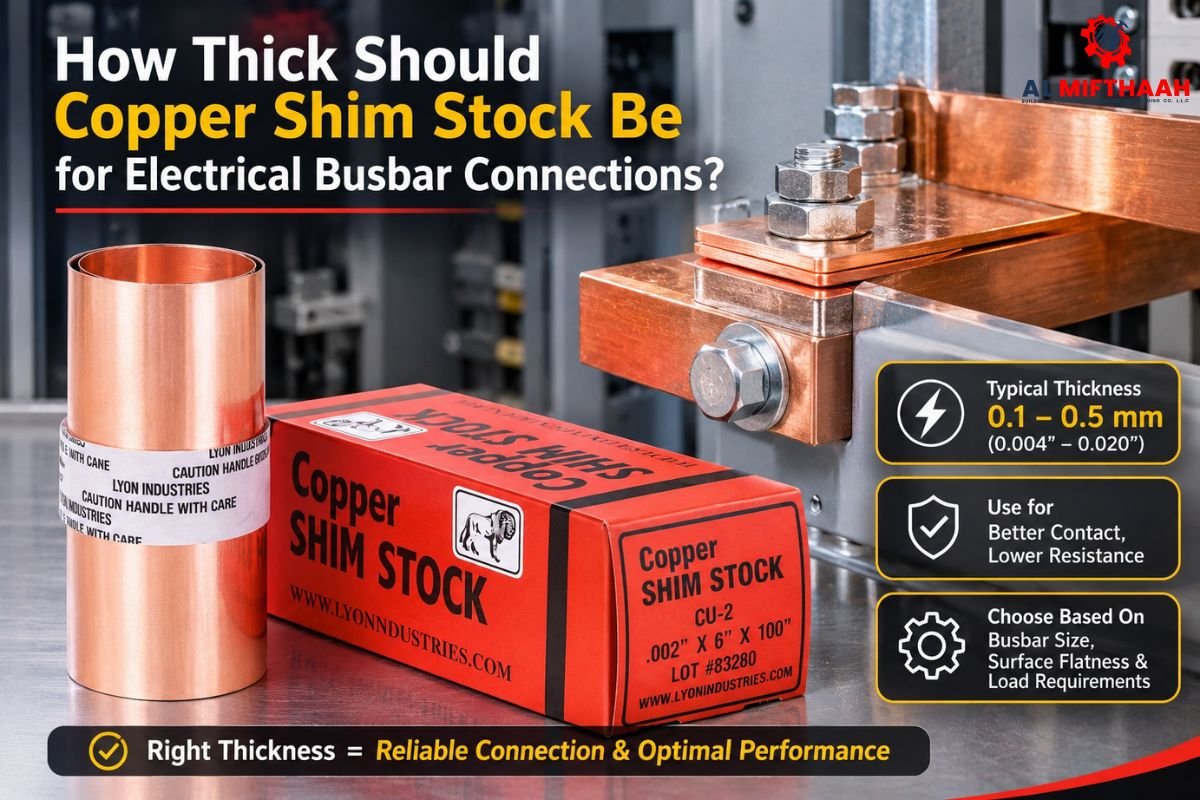
Copper shim stock 0.1 mm to 0.3 mm is sufficient for making up small gaps or small flatness differences at most electrical busbar connections. This is because thicker sheets (up to approximately 0.5 mm thick) are employed only when the gap measured is larger. It is dependent on the specifications of the busbar manufacturer, the torque of the bolts, and the surface condition. Never use shims as a substitute for good machining or realignment. When ordering material in the UAE, ensure that the grade of copper, temper, and thickness tolerance are confirmed before ordering.
Table of Contents
ToggleKey takeaways
- Usually, the thickness of copper shim stock is 0.05 mm to 0.5 mm, and the most widely used one is 0.1 mm to 0.3 mm, which is suitable for busbar joints.
- Start by measuring the largest gap at each of the bolt locations, and then the thickness of the shim should be set to the design specification.
- Check the grade of copper, thickness tolerance, and certification prior to purchase, particularly with new suppliers.
- Shims make adjustments to small variations only. If this is not done, large misalignment will be necessary for machining or redesign.
What is copper shim stock and why does it matter?
Copper shim stock is a thin flat strip of copper material which is applied to the purpose of filling small gaps or to correct minor misalignment between two surfaces. It is used by engineers when surfaces are not perfectly matched, but come close. It aids in providing uniform clamping pressure and contact surface on the joint in busbar work.
Busbars are conductors that carry heavy current from one piece of switchgear to another piece of switchgear or to a transformer or distribution panel. They only match up if there is good contact between mating surfaces. Any space can cause higher contact resistance, creating heat in the joint over time that can reduce the life of the joint, for a full picture of how busbars are sized before you select shims.
But shims are not a ‘one-size-fits-all’ solution. They are designed to make fine adjustments and will not correct an excessive misalignment of large magnitude; otherwise, they may cause uneven stress on the bolts and the insulators. Additionally, a poorly fitted shim can cause moisture or dirt to get caught at the joint, further hastening the corrosion process.
Shim stock is typically used for:
- Sealing off small gaps between the busbar and terminal
- Compensating for slight variation in flatness of machined surfaces
- Correct spacing in stacked bars.
- Ensuring that the clamping force of the bolts is the same on both sides of the joint
How do you measure the right shim thickness?
The correct thickness of shims corresponds to the gap between the busbar and mating surface. Use feeler gauges or a dial indicator to check at various spots. Please double-check the results with the drawing tolerance before ordering. Take measurements at every bolt hole, not just at the middle of the joint.
Follow these steps for an accurate measurement:
- Wipe both surfaces using a lint-free cloth and using approved contact cleaner.
- The busbar should be installed in its final location with bolts snug so that you can see the natural gap.
- Use feeler gauges to measure the clearance at each of the bolt locations.
- Write down the value of the largest reading and compare it to the design tolerance.
- Please choose the thickness of the shim to close the gap and not force the joint.
- Re-measure after final torque to ensure the joint is flat.
What gap measurement should you use?
Do not use the average as the reference; use the largest gap reading. The worst point must be filled with a shim, or the joint will not load evenly after the torque has been applied. Note the locations of the bolts with each measurement. Maintain your installation records, including the gap readings.
How many shim layers are acceptable?
The more thin layers that are stacked, the more likely there is to be slippage and inconsistent clamping of the material. Use one shim of the correct thickness, if possible. Where a number of layers cannot be avoided, be sure to keep a minimum number of layers and check with the busbar manufacturer for the configuration. When checking the stack, torque the bolts in place and then perform this check before final assembly, as a loose stack may move under thermal load.
Which shim thicknesses suit busbar connections?
Generally, 0.05 mm to 0.5 mm thick copper shims are used for most busbar connections, with thinner foils (0.05 mm to 0.1 mm) accommodating small tolerances or finish variations, and thicker foils (0.2 mm to 0.5 mm) being used for larger corrections. Check the thickness with the project specification prior to installation.
| Shim Thickness | Typical Use | Suitability Notes |
| 0.05 mm to 0.1 mm | Minor surface finish variation | Easy to handle, but fragile during installation |
| 0.1 mm to 0.3 mm | Small gaps and flatness correction | Most common range for busbar joints |
| 0.3 mm to 0.5 mm | Larger gaps needing correction | Check torque values and terminal stress |
| Above 0.5 mm | Generally not recommended | Redesign or machining is usually required |
The grade of the material is important as well as thickness. Electrolytic tough pitch copper is a commonly used electrical shim because of its high conductivity. As you inspect a shim sample, you will be checking for:
- Purity and conductivity grade.
- Tempered to either annealed or half-hard, depending on the application
- The certificate will be printed with the thickness tolerance.
- A surface that is free of burrs, scratches, and oxidation.
Should shims be tin-plated?
Some joints may be expected to be more corrosion resistant with the addition of tin plating, particularly in humid environments. It could, however, introduce contact resistance to some surfaces. Where possible, match the shim finish to the busbar finish. In the event that the busbar is tin-plated, it is most likely that a tin-plated shim will make sense. In such a case, a bare copper shim is generally a safer option if the busbar is bare copper.
What should you check when sourcing shim stock in Dubai?
In sourcing shim stock in Dubai, one should ensure that the material is certified, the thickness is within a particular tolerance, it is packaged properly, and the delivery timeline is not too long. A good supplier will offer mill test certificates and good size consistency from batch to batch. Request samples before bulk orders on critical electrical installations. This minimizes rework on critical electrical projects.
When looking for Dubai suppliers for Shim Stock, buyers should prioritize documentation and sample quality over the price. The low-cost shim that varies in thickness may be more expensive in terms of rework than a good quality shim at a fair price.
Where should you look for a reliable supplier?
In the UAE, a lot of projects purchase electrical consumables at the same time as they purchase the general supplies. When one requires a combination of hand tools, fasteners, and small electrical components, it is common to begin with the hardware tools suppliers in Dubai and verify that the shim material is suitable for the electrical requirements needed. Larger contractors tend to have industrial equipment dealers in Dubai for their maintenance components and busbar hardware, making purchasing for ongoing plant work easier.
What questions should you ask a supplier?
Before placing an order, put these questions to any supplier:
- Do you have copper certificates of grade for this lot?
- How thick do you want the fabric to be, and how is it measured?
- Can you make widths and lengths different or just standard sizes?
- What is the difference between the time spent on lead time for a stock item and custom order?
- Can you send samples for fit testing?
When the buyers are looking especially for a Lyon shim stock supplier and Saif Precision tools supplier in UAE, it is always important to check that the quality matches that of the busbar that it will connect to. Check the table below to compare suppliers.
| Criterion | Why It Matters | Strong Answer Looks Like |
| Material certification | Confirms conductivity and purity | Batch-specific certificate on request |
| Thickness tolerance | Affects joint flatness | Tolerance stated and consistent across samples |
| Surface quality | Impacts contact resistance | Clean, burr-free sheets with no visible oxidation |
| Lead time | Affects project scheduling | Clear timelines for stock and custom orders |
| Sample policy | Allows fit testing | Samples available before bulk purchase |
Common mistakes to avoid with copper shims
Many of the shim problems are the result of just a few avoidable errors. Look out for these while installing:
- Correcting major misalignment using shims rather than machining the surface to correct it.
- Installing copper shims between aluminum busbars without copper plating and manufacturer approval, which may result in galvanic corrosion.
- The surface has been neglected, and oxide and debris have been trapped at the joint.
- Bolting too much beyond the manufacturer’s torque specification
- Purchasing material from an unverified Lyon shim stock supplier in Dubai that has not been tested.
How does thermal cycling affect shim joints?
The clamping force may gradually be released due to the expansion and contraction of busbars caused by current loads. A properly torqued joint on day one might fall apart after several months with hot and cold weather. Plan torque tests for routine maintenance; document torque results.
Note the thickness of each shim and supplier batch used for each joint connection. This simplifies the future troubleshooting process. Small tools are commonly purchased from hardware tool suppliers in Dubai by teams for speed, and analog methods can be used to obtain re-torque tools from industrial equipment dealers in Dubai, ensuring the calibration accuracy of these tools.
Final thoughts
The selection of the appropriate thickness of a copper shim will help to prevent the busbar joint from overheating and corroding. Carefully determine dimensions; use the thinnest shim that will span the gap; verify material before installation. Then, when it’s time to purchase, enjoy the help of experienced shim stock suppliers in Dubai that can offer certified material and consistent sizing. Almifthaah can assist you in choosing options and matching thickness, grade, and quantity to your requirements.
Frequently asked questions
No, unless it is a plated shim or a shim that is compatible with copper or aluminum and is approved by the manufacturer.
The thickness of the shim in most cases ranges between 0.1 mm and 0.3 mm, depending on the gap measured and according to the project specification.
Yes. After initial loading and at scheduled maintenance, recheck torque, as thermal cycling can cause loss of clamping force over time.
Look for a supplier who provides certificates, as well as a small tolerance and timely delivery. Consider specialist electrical distributors versus the general industrial supplier.

How Thick Should Copper Shim Stock Be for Electrical Busbar Connections?

How to Select an Involute Gear Cutter by Module and Number of Teeth