
- August 11, 2026
- by Almifthaah
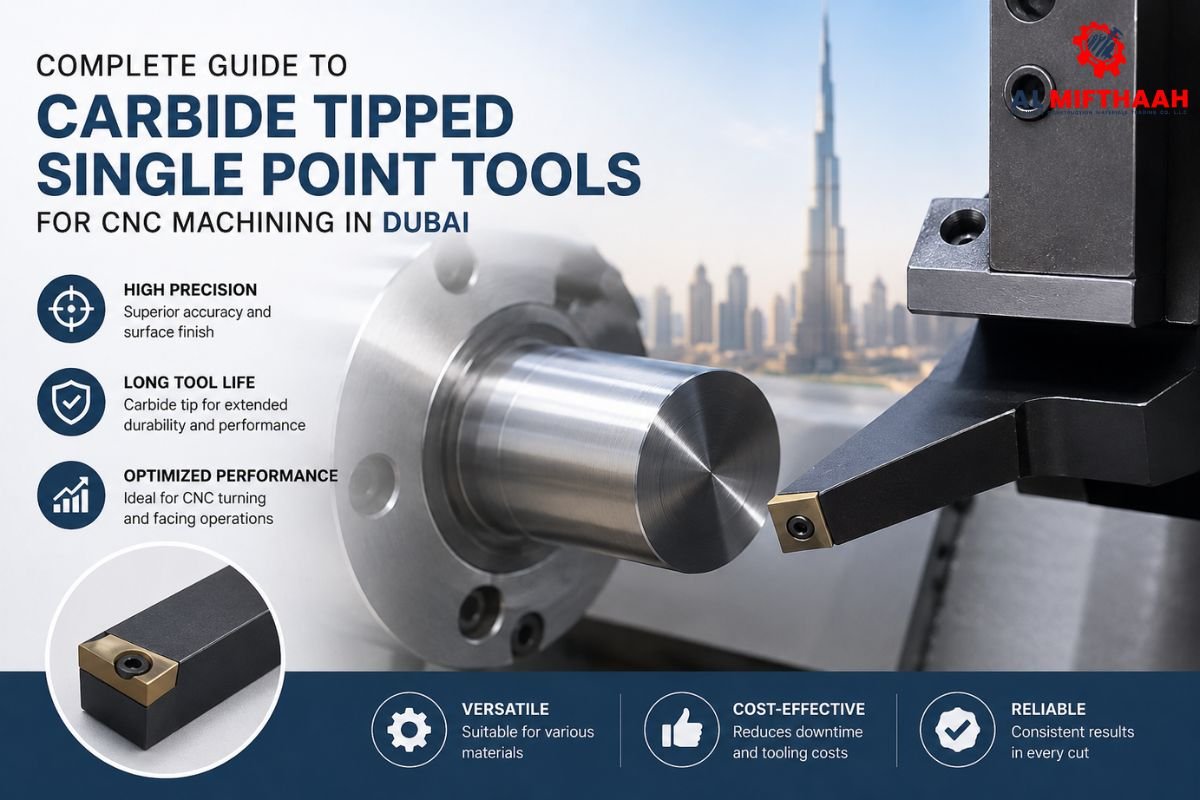
Complete Guide to Carbide Tipped Single Point Tools for CNC Machining in Dubai
Table of Contents
ToggleKey Takeaways
- Single point carbide tools use sturdy steel bodies with bonded carbide cutting edges.
- In any machining operation, the tool geometry must correspond to the type of material being cut, e.g. steel, aluminum or stainless steel.
- For all the manufacturers located in Dubai, the supplies of tools should be reliable and correct.
- Well-known supplier of Carbide Tipped Single Point Tools in Dubai facilitates the process of machining by reducing the idle time.
If your CNC lathe keeps chattering on a turning pass, or the finish keeps coming out rougher than spec allows, the tool is usually the first place to check. Single point carbide tipped tools can shape or create faces, grooves, and threads in metal items in practically all machine shops in Dubai. This blog describes what they are and explains how to choose the appropriate tools and also how to distinguish between a reliable supplier and another one that sells tools only to their own advantage.
What are carbide tipped single point tools?
A single point cutting tool has one cutting edge engaged with the workpiece at a time. That’s different from a milling cutter or drill, which uses several edges at once. A carbide insert is placed on a tool steel or alloy steel shank to produce a carbide tipped tool. Thus, by combining two materials, we have the benefit of both steel’s stiffness and carbide’s hardness at the same time.
Furthermore, carbide has superior heat and wear resistance compared to plain high-speed steel.That’s why these tools are still standard on lathes, shapers, and planers, even with insert-based tooling now common in a lot of shops. For smaller batch sizes or jobs that need custom grinding, brazed carbide tips still make sense financially.
How do single point cutting tools work in CNC machining?
On a CNC lathe, the tool stays fixed and the workpiece spins. The single point tool advances into the material and shears off a chip with each pass. The rake angle, clearance angle, and cutting edge angle decide how cleanly that chip separates and how much heat builds up at the tip.
Get the geometry wrong for the material and you’ll run into excessive tool wear, a rough surface finish, or built-up edge, where material welds onto the tip instead of shearing away cleanly. Picking “carbide” over “steel” isn’t the whole decision. Matching the tip grade and angle to the actual job is what actually determines the outcome.
However, a shop cutting mild steel uses a different geometry than one machining stainless or aluminum housings. Machinists who’ve been doing this a while tend to keep a small library of ground tools for repeat jobs instead of reordering standard stock every time.
Where are these tools used across Dubai’s industries?
Dubai’s industrial base is broader than people outside the region usually assume. It’s not just oil and gas fabrication. There’s a real spread of precision manufacturing sectors here, and all of them depend on reliable single point tooling.
- Automotive service and repair – machining shafts, bushings, and custom fasteners for vehicle repair work
- Signage and metal fabrication– turning mounting hardware and structural connectors
- Metal coating and finishing– pre-machining parts before they go through coating lines, where dimensional accuracy affects coating thickness
- Structural steel and PEB (pre-engineered building) work – producing bolts, pins, and connector components to spec
- Industrial machinery repair– reproducing worn shafts and custom parts that are no longer available from original manufacturers
Any facility sourcing a carbide tip single point tool Dubai workshops depends on the need to weigh turnaround time as heavily as tool quality. A supplier based locally in the UAE can shave weeks off the wait compared with importing every batch.
Choosing the right tool
Picking the right tool comes down to four questions worth asking before you order anything.
- What material are you cutting? Carbide grades are formulated differently for ferrous versus non-ferrous metals. Use the wrong grade on stainless and edge wear accelerates fast.
- What surface finish do you need? Roughing tools and finishing tools have different nose radii and edge geometry. A finishing pass needs a tighter nose radius to leave a smoother result.
- How rigid is your machine, and what’s its horsepower? Older or lighter machines can’t always take aggressive cutting depths, which changes the tool angle you should be using.
- What’s your production volume? High-volume repeat work often justifies indexable insert tooling. Low-volume or prototype work tends to be more economical with brazed carbide tips that can be reground.
Get these four right before you order, and you skip the usual cycle of buying tools, testing them, and reordering a different spec two weeks later.
Carbide tipped vs solid carbide vs HSS tools: Key differences
| Feature | HSS (High-Speed Steel) | Carbide Tipped | Solid Carbide |
| Heat resistance | Moderate | High | Very high |
| Cost | Low | Moderate | High |
| Regrindable | Yes, easily | Yes, at the tip | Limited |
| Best for | Slow-speed, low-volume jobs | General purpose turning, mixed batch sizes | High-speed, high-precision production |
| Brittleness | Low | Moderate | Higher, more prone to chipping on shock loads |
For most general machine shops in Dubai, carbide tipped tools sit in a practical middle ground: tougher than HSS, more affordable and repairable than solid carbide.
Common mistakes buyers make
Buying purely on price. A cheaper tip that wears out in half the tool life isn’t actually cheaper once you count downtime and rework.
- Skipping grade certification. Some suppliers won’t disclose the actual carbide grade or brazing quality. Ask directly. If they can’t answer, that’s worth noting.
- Overlooking after-sales support. Regrinding services, technical advice on angle selection, and responsive replacement stock matter more over a year of production than what the invoice says on day one.
- Treating cutting and milling tools Dubai suppliers offer as interchangeable. Milling tools and single point turning tools do different jobs entirely, and lumping them into one generic order usually means someone on the shop floor ends up with the wrong spec.
- Ignoring lead time on custom grinds. Standard geometries ship fast. Custom profiles for unusual jobs need to go in well ahead of the production date.
Maintenance and handling tips
Carbide is hard, but it’s also brittle. A dropped tool or a sudden interrupted cut can chip the edge in an instant. A few habits go a long way toward extending tool life:
- Store tools in a rack instead of loose in a drawer, where edges knock against each other
- Check for micro-chipping under magnification before a production run, not after a bad part comes off the machine
- Match coolant flow to cutting speed, since inconsistent cooling causes thermal cracking at the tip
- Regrind at the first sign of dulling instead of pushing a worn edge; a dull tool increases cutting forces and can damage the workpiece surface
Why saif precision tools supplier matters for quality sourcing?
Sourcing decisions in the UAE machining sector usually come down to trust built over repeat orders, not a single transaction. A recognized Saif Precision tools supplier in UAE brings consistency: the same grade, the same tolerance, batch after batch. That matters a lot when a shop is running production against a fixed spec.
That consistency is really what separates a supplier relationship that works from one that becomes a headache. When tool geometry shifts slightly between orders, operators end up re-adjusting feeds and speeds every time. It’s the kind of thing that rarely shows up on a purchase order but shows up clearly in monthly output numbers.
A note from the shop floor
Machinists who’ve worked with both imported and regionally sourced tooling tend to notice one thing pretty quickly: suppliers who stock UAE-specific demand patterns carry the geometries local shops actually use, rather than a generic international catalog. It’s a small thing, but it matters when you need a replacement tool the same week instead of the same month.
Final thoughts
Carbide tipped single point tools hold up as a practical, dependable choice across Dubai’s machining sector, whether you’re running an automotive repair bay or a structural fabrication line. It is a lot easier to save on downtime by addressing the grade, geometry, and supplier relationship issues at the start than paying for them later on. When your organization is looking for a Carbide Tipped Single Point Tools supplier in Dubai, Almifthaah has the best grades and geometries of tools that the workshops in the UAE use and can easily assist you choose the right tool for your project.
Frequently asked questions
A single point tool has a fixed carbide tip brazed to the shank. Insert tools use replaceable indexable inserts clamped into a holder. Single point tools are usually the more economical choice for lower-volume work.
The life of the tool is determined by the material and cutting parameters, but a well maintained carbide tip can have the potential to perform through many production cycles without regrinding, particularly when using the appropriate coolant.
Yes. The majority of the brazed carbide tips can be reground more than once until the carbide becomes too thin to be safely used.
Whereas mild steel and aluminum carbide edges last longer, these high alloy steels and stainless steel generate more heat and work harden rapidly, which wears out carbide edges faster.
Yes, depending on the rake angle and having a polished edge finish. Cuts aluminum cleanly and will not have a built up edge, better than HSS.
When the part requires a tight radius, special grooves, or angles that are not standard items in the catalog, a custom grind is typically the solution.
Common causes are interrupted cuts, improper feeding rates, and handling the tool and dropping it.
Generally speaking, water-soluble coolants will cool quicker than oil-based types, making this a more important consideration on high-speed steel cuts rather than low-speed carbide cuts. Regular flow is the most important factor both ways.
Low speed, interrupted cuts can be processed by HSS. Higher speeds and longer production runs, carbide tipped tools usually pay for themselves.
Local stock cuts machine downtime, and regionally based suppliers tend to already understand the tool geometries UAE workshops need.

How Long Do Mounted Points Last and When Should You Replace Them?

Everything You Need to Know About Tool Wear in Carbide Tipped Cutting Tools


Comments (3)
Latest Innovations in Carbide Tipped Single Point Tools in 2026
August 26, 2026 - 4:28 pm[…] The tip handles the wear, the shank absorbs the shock and keeps the unit cost down. Any decent carbide tip single point tool Dubai machinists specify for general turning follows this same basic design. The real differences […]
Carbide Tipped Single Point Tool Life: How Long Do They Last?
September 29, 2026 - 1:08 pm[…] materials regularly, so it can advise on which one suits your application. When you contact any Carbide Tipped Single Point Tools supplier in Dubai, ask these […]
How to Reduce Wear in Carbide Tipped Cutting Tools
October 7, 2026 - 5:19 pm[…] you evaluate a Carbide Tipped Single Point Tools supplier in Dubai, ask which grades suit your material and whether they can explain the geometry options. You can […]