- August 26, 2026
- by Almifthaah
Latest Innovations in Carbide Tipped Single Point Tools in 2026
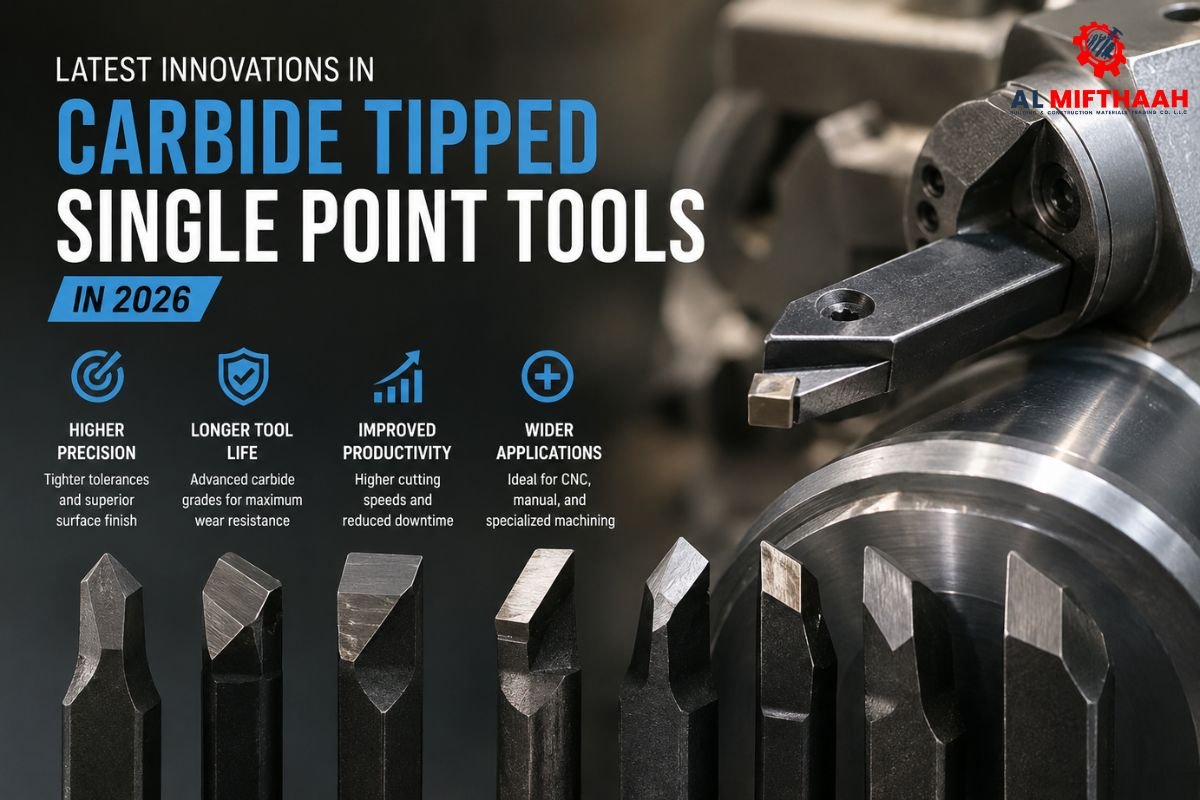
As a carbide tip single point tool Dubai traders believe nowadays features a tungsten carbide tip attached through brazing on the shank, making the tool efficient in cutting metal with fast speed. In 2026, the major innovations are in coatings and cutting geometries, not in the material itself. Each producer uses thinner and harder PVD and CVD coatings able to provide heat resistance above 900 degrees and tighter nose angles that eliminate vibrations when working on lathe machines. In the United Arab Emirates, it means a longer tool life between regrinds, fewer tool replacements, and improved surface quality of stainless steel and cast iron products while the customers do not need to pay additional money to have all these innovations.
Table of Contents
ToggleKey Takeaways
- In 2026, technological progress using multilayer PVD/CVD has made possible an increased lifespan of tools.
- High-precision nose radius and angle of rake lessen vibrations and increase the quality of high-speed processing.
- In matters of selecting grade rather than brand name, choose one whose hardness corresponds to that of the workpiece.
- Suppliers of Dubai carbide-tipped single-point tools decrease product lead time for testing.
What does a single point tool actually do?
A single-point tool has one cutting edge doing all the work. No multiple flutes to share the load. That’s what makes it the default choice for lathe turning, facing, boring, and threading across UAE machine shops, from automotive parts rework to structural steel fabrication.
The carbide tip is brazed onto a tool steel shank because solid carbide would be brittle and expensive at that size. The tip handles the wear, the shank absorbs the shock and keeps the unit cost down. Any decent carbide tip single point tool Dubai machinists specify for general turning follows this same basic design. The real differences show up in the grade, the coating, and how the edge is ground.
Coating technology driving 2026 gains
This is where most of the actual innovation sits. PVD and CVD coatings applied in layered structures, often titanium aluminum nitride combined with a secondary layer, push heat tolerance well beyond what uncoated carbide can handle.
However, the practical effect: a coated tip runs at higher cutting speeds before the edge starts to soften, which shortens cycle time on production runs. Shops that switch from uncoated to multi-layer coated tips generally see fewer regrinds per batch, though how much fewer depends a lot on the material and the coolant setup. Worth testing on your own floor rather than taking a spec sheet’s word for it.
A few coating types worth knowing:
| Coating Type | Heat Resistance | Best Use Case |
| TiN (Titanium Nitride) | Moderate | Light general-purpose turning |
| TiAlN (Titanium Aluminum Nitride) | High (up to ~900°C) | Dry or high-speed machining |
| CVD Multi-layer | Very High | Continuous cuts on hardened steel |
| DLC (Diamond-Like Carbon) | High, low friction | Non-ferrous metals, aluminum |
Geometry changes that extend tool life
Coatings get the attention, but the grinding on the tip matters just as much. Suppliers have been refining nose radius and rake angle to cut the vibration that causes chatter marks and premature chipping.
A slightly larger nose radius spreads cutting force over more of the edge, which helps on interrupted cuts, machining a keyway, say, or a part with an uneven surface. Negative rake angles are showing up more often on tougher materials too, because they push cutting force into the tool body instead of the edge, so the tip is less likely to snap off mid-cut.
Therefore, none of it is flashy. It’s incremental grinding precision. But it adds up on the shop floor.
Carbide grades: matching hardness to material
Carbide tools are graded by ISO classification: P, M, K, N, S, and H, each suited to a different material family. Getting this wrong is probably the single most common reason a tool fails early.
- P grade: steel and steel alloys, general turning
- K grade: cast iron and non-ferrous metals
- M grade: stainless steel and mixed production
- N grade: aluminum and other soft non-ferrous metals
A shop cutting mostly stainless will burn through P-grade tips fast if that’s what got sent by mistake. It happens more often than you’d think. That’s why a supplier who actually asks what material you’re running, instead of just shipping whatever’s on the shelf, saves you money over a year of orders.
Comparing carbide tools with HSS welded bits
Not every job needs carbiding. High Speed Steel welded tool bits still earn their keep, particularly for lower-volume work or softer materials where carbide’s extra hardness isn’t worth the added cost.
| Factor | Carbide Tipped | HSS Welded |
| Cutting speed | Higher | Lower |
| Heat resistance | Excellent | Moderate |
| Cost per unit | Higher | Lower |
| Best for | High-volume, hard materials | Short runs, softer metals |
| Regrind frequency | Less frequent | More frequent |
Shops running mixed jobs usually keep both on hand. A reliable HSS Welded Tool Bit supplier in Dubai can bundle both product lines, which beats juggling two separate vendors for what’s essentially one procurement task.
Common mistakes buyers make
- Buying on price alone- A cheaper tip that chips twice as often isn’t actually cheaper once you count the downtime.
- Ignoring coolant compatibility- Some coatings perform worse with certain coolant chemistries. Check before switching brands.
- Wrong grade for the job- Covered above, and still the fastest route to short tool life.
- Skipping regrind scheduling- Run a tip past its edge life, and you risk surface defects that only show up after the part is off the machine.
Sourcing the right supplier in the UAE
When you’re evaluating a Carbide Tipped Single Point Tools supplier in Dubai, skip the glossy catalog and look at what actually affects your week-to-week: is inventory stocked so you’re not waiting on a reorder, will they advise on grade selection instead of just taking the order, and is quality consistent batch to batch. A supplier that gets one of these right and misses the other two isn’t much use.
Almifthaah has built its stock around those three points, carrying a broad range of carbide grades and coatings alongside HSS, so workshops don’t have to split orders across multiple vendors just to cover both product types. If you’re also sourcing precision measuring or cutting equipment, keeping that relationship close to your Saif Precision tools supplier in UAE tends to make quality control across the whole machining process a lot less of a headache.
Expert insights for workshop owners
A few things that don’t usually make it into a catalog description. Tool life claims from manufacturers assume ideal conditions: clean coolant, correct speed and feed, a rigid setup. Real shop-floor numbers run lower than that, and that’s normal, not a sign anything’s wrong. Track your own regrind intervals by job type instead of trusting the spec sheet on its own.
Moreover, don’t assume the pricier coating always wins. On soft aluminum, a basic uncoated or DLC-coated tip will often outperform a heavy-duty TiAlN tip built for hardened steel. The extra hardness isn’t doing anything useful on aluminum, and it can actually make the built-up edge worse.
Wrapping it up
The real change in 2026 isn’t a new carbide material. It’s refinement: better coatings, more careful geometry, grade-matching that actually accounts for what you’re cutting. None of that is complicated, but it does need a supplier paying attention to the details instead of shipping whatever’s generic and in stock.
If you’re sourcing tooling for a Dubai-based workshop, Almifthaah carries the carbide grades, coatings, and HSS options covered here. Worth a conversation before your next bulk order.
Frequently asked questions
Primarily, the lathe is used for turning, facing, boring, and similar operations, during which a single hardened cutting edge is used to form metal materials into precise shapes and sizes.
It would depend on material and speed, but coated tips last much longer than uncoated tips, with regrinds under similar conditions.
No. Carbide suits high volume, harder material. For shorter runs or softer metals, which are not to be hardened to extreme degrees, HSS is still cost-effective.
These categorize carbide material to be used: P for steel, M for stainless, K for cast iron and non-ferrous metals to ensure proper tool selection.
Typically, the grade is not adequate for the material, the feed rate is too fast, or cuts are not continuous, so there is not enough nose radius to support the edge.
Yes. Brazed carbide tips can be used over a cutting cycle, and then placed back into a tool grinder for regrinding and re-use, for many cycles.
Thinner, lower-temperature coatings are good for sharp edges with PVD. CVD creates thick, high-temperature-resistant layers ideal for high temperatures and continuous cutting operations.
It can provide different grades and coatings of carbide as per the requirement, which is also available with local suppliers with lesser lead time than importing from abroad.
Yes. According to industry reports, the global carbide tools market is projected to exceed $12 billion by 2025, expanding at a rate of 5 to 7 percent annually, reaching the early 2030s.
Do a comparative analysis on Stocked stock, Grading range, Technical support, and batch-to-batch consistency. The actual downtime cost is often camouflaged by the unit price.

How Long Do Mounted Points Last and When Should You Replace Them?

Everything You Need to Know About Tool Wear in Carbide Tipped Cutting Tools