- June 20, 2026
- by Almifthaah
Indexable Milling Cutter vs Solid End Mill: Which One Should You Choose?
Table of Contents
ToggleKey Takeaways
- Indexable milling cutters are suitable for high-speed mass production and economical.
- Solid end mills offer greater accuracy and surface quality.
- There are several manufacturers that employ both tools in roughing and finishing.
- Businesses can rely on the Almifthaah to select the most suitable milling solution for their machining needs.
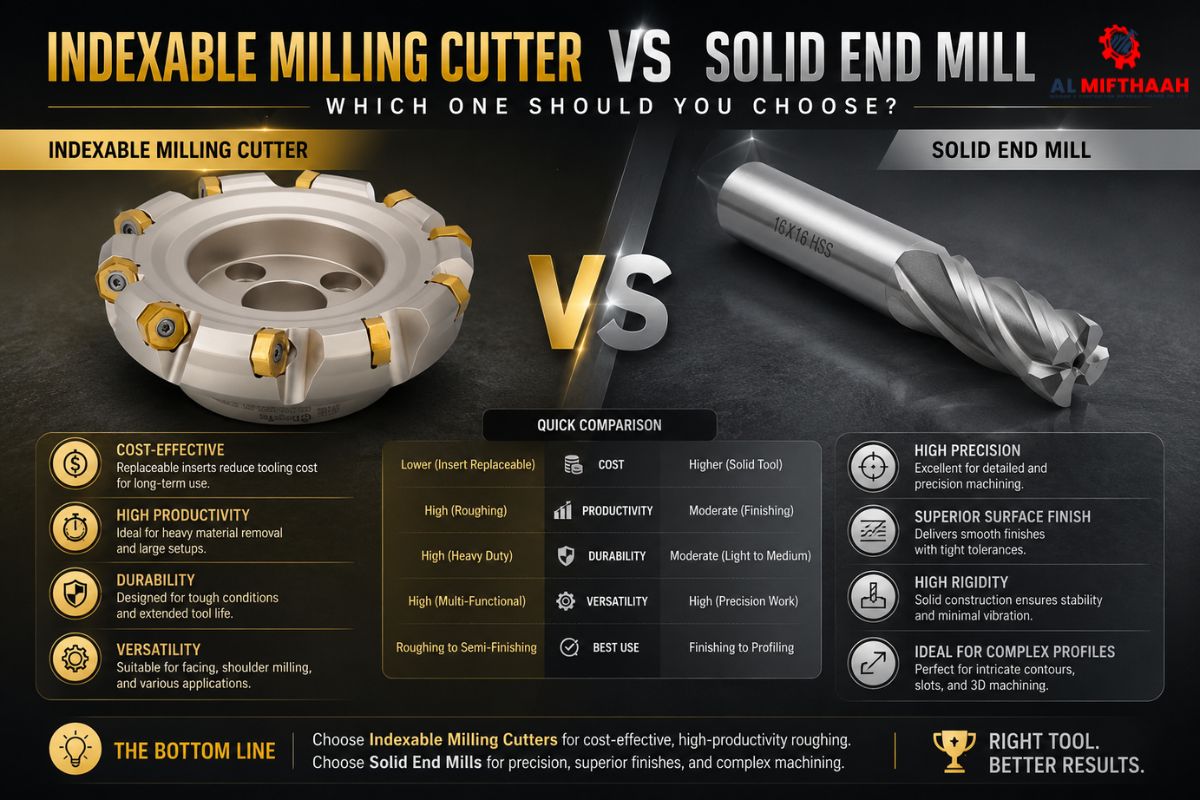
An indexable milling cutter will generally be more desirable if high material removal rates and reduced tooling costs are required. But when accuracy, fine finishes, and detailed machining are the need, a solid end mill may be the go-to choice. The right choice depends on the type of material, type of machining application, production volume, and budget.
In today’s manufacturing industry, selecting the right milling tools has a direct impact on manufacturing productivity, tool life, surface quality, and manufacturing costs. If you’re buying from an indexable milling cutter supplier in Dubai, or even if you’re in search of superior machining options throughout the UAE, knowing the distinction between these pieces of equipment can assist you in making a savvier investment.
What is an indexable milling cutter?
An indexable milling cutter is a cutting tool that uses replaceable carbide inserts instead of a solid cutting body. Whether worn or not, an insert is rotated or replaced in place and not replaced as a whole insert.
Key Features
- Replaceable cutting inserts
- Reduce long-term tooling expenses.
- Suitable for high-volume production
- High rates of metal removal.
- Reduced machine downtime
However, in large-scale production, requiring high efficiency and cost control, many manufacturers choose an indexable milling cutter UAE solution.
What is a solid end mill?
A solid end mill is manufactured from a single piece of carbide or high-speed steel. The cutting edges are bonded to the body of the tool.
They are popular for precision machining, slotting, contouring, and finishing applications.
Key Features
- Excellent dimensional accuracy
- Superior surface finish
- Best suited for complicated shapes.
- Ideal for small and medium-sized production quantities.
- Comes in a variety of flute patterns
In special applications, a Single Flute Carbide Endmill UAE is frequently utilized for aluminum, plastics, and non-ferrous materials.
Key differences at a glance
| Feature | Indexable Milling Cutter | Solid End Mill |
| Cutting Edge | Replaceable inserts | Integral cutting edges |
| Initial Cost | Higher | Lower |
| Maintenance Cost | Lower | Higher |
| Surface Finish | Good | Excellent |
| Precision | Moderate | High |
| Material Removal Rate | Very high | Moderate |
| Tool Life Management | Easy insert replacement | Full tool replacement |
| Best For | Mass production | Precision machining |
When to choose an indexable milling cutter?
Select an indexable milling cutter when:
- Quality production is essential
Machining is speeded up, and downtime is minimized for large manufacturing facilities.
- Cost Efficiency Matters
Inserts are more inexpensive to replace than a tool.
- Roughing Operations
These cutters can cut great amounts of material at a fast speed.
- Tough Materials
Indexable tools are highly suitable for steel, cast iron, and hard-to-machine alloys.
Furthermore, many of the cutting and milling tools Dubai choose indexable cutters for their heavy-duty industrial applications.
When to choose a solid end mill?
Select a solid end mill when:
- Precision is critical
Some of the industries that demand tight tolerances include aerospace and medical manufacturing.
- Fine Surface Finish Is Needed
Smooth finishes are usually achieved with solid end mills.
- Complex Profiles
Solid end mills are easier to use for intricate shapes, slots, and contours.
- Small Batch Production
In the case of lower-volume jobs, solid tools may be more valuable.
Benefits of each tool
Benefits of Indexable Milling Cutters
- Reduce tooling costs in the long term.
- Faster insert replacement
- Increased machine uptime
- Excellent productivity
- Consistent cutting performance
Benefits of Solid End Mills
- Higher machining accuracy
- Better surface quality
- Greater versatility
- A cost-effective option for high-precision parts
- Vibration reduction in numerous applications
Moreover, there are leading suppliers like Almifthaah, which can guide manufacturers to make the right choice according to production requirements and machining conditions.
Manufacturing efficiency example
Suppose a metalworking firm manufactures several hundred steel parts every day. The company started with solid end mills in its roughing operations. Despite the accuracy of the results, the rate of tool wear was high and production was reduced because of frequent tool changes.
However, switching to an indexable milling cutter system increased material removal rates substantially, insert replacement was quicker, and overall production costs were reduced.
The company still used solid end mills for finishing operations to ensure surface quality and precision.
This method is well-recommended by machining experts and suppliers such as Almifthaah, as it helps in achieving efficiency and quality.
How to select the right tool?
Here are some questions to ask before buying:
1. What is your current production level?
- Low volume → Taper end milling cutter
- Medium volume → Good end mill
2. What is the desired finish?
- Standard finish → Indexable cutter
- Premium finish → Solid end mill
3. What Material Are You Machining?
- Tough metals → Indexable cutter
- Aluminum and precision parts → Solid end mill
4. What Is Your Budget?
- Long-term cost savings → Indexable cutter
- Lower initial investment → Solid end mill
Therefore, a knowledgeable Saif Precision tools supplier in UAE can assist you in determining which option will prove to be the most economical option for your machining setting.
Conclusion
There is no single winner in the comparison between indexable milling cutters and solid end mills. The best choice depends on your machining objectives.
If productivity, decreased tooling expenses, and a high material-removing rate are vital to you, an indexable milling cutter supplier in Dubai can supply solutions that enhance manufacturing effectiveness. For greater precision, surface finish, and fine machining, a solid end mill is the best choice.
Whether you are seeking quality milling tools, industry-specific advice, or a dedicated team to support your needs, Almifthaah is dedicated to meeting your expectations. Choosing an appropriate tool for a particular operation will enable the manufacturer to reach higher productivity, lower costs, and better machining results.
Frequently asked questions
An indexable milling cutter is a cutter with replaceable inserts; a solid end mill is a cutter that is created from one solid piece of cutting material.
Indexable milling cutters can have an extended life since worn-out inserts can be changed without changing the tool body.
Yes. Solid end mills will generally offer greater precision and surface finishes.
Indexable milling cutters are generally more suitable to high-volume production because of faster machining and less downtime.
Yes. Many manufacturers use the following cutters: Indexable cutters for roughing and solid end mills for finishing.
How Long Do Mounted Points Last and When Should You Replace Them?
Everything You Need to Know About Tool Wear in Carbide Tipped Cutting Tools