- November 3, 2026
- by Almifthaah
Why Does Stainless Steel Shim Stock Corrode Despite Its Rust Resistance?
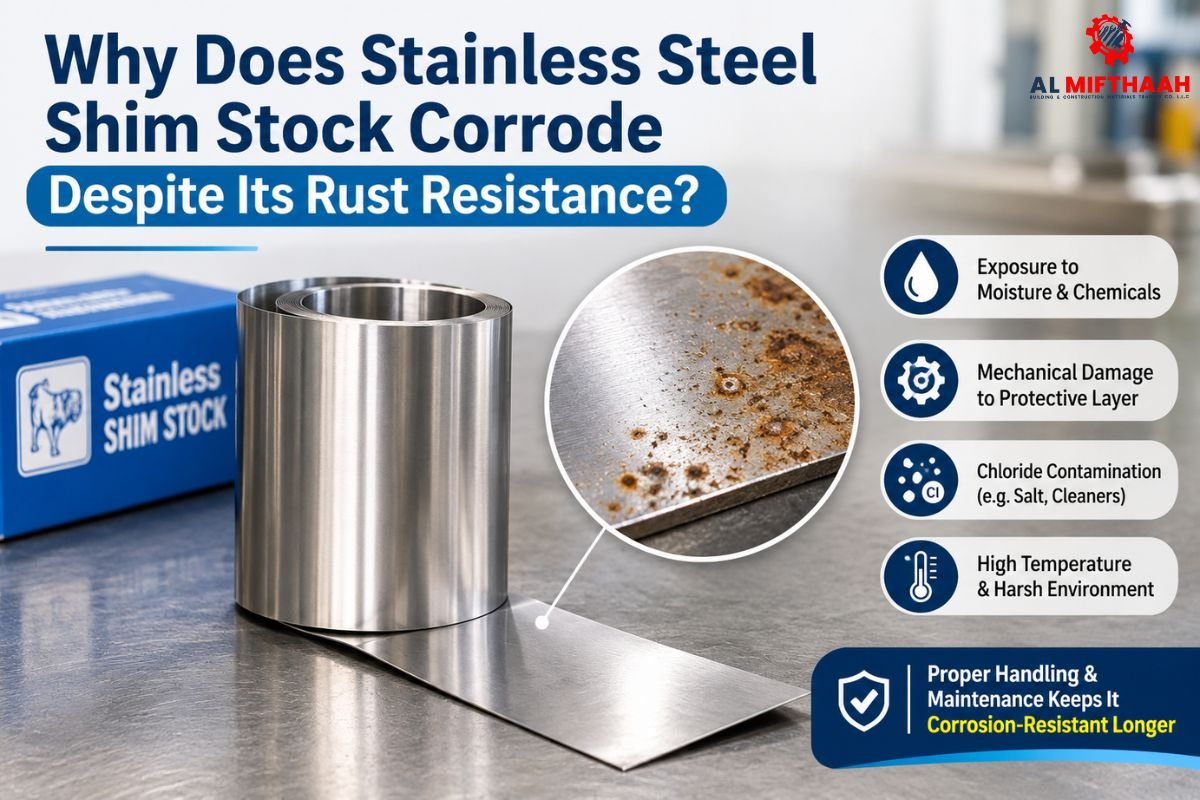
Stainless steel shim stock is rust-resistant because of a thin layer of chromium oxide that forms on it. This layer protects, but is not impervious to damage. Corrosion can be caused by several factors, including chloride in humid air, moisture trapped between stacked shims, metal particles from cutting tools used, breaks in the protective coating, and incorrect alloy.
The humid and coastal climate of Dubai increases the chances of corrosion happening. The good news is that corrosion of shims can usually be avoided. The guide explains each factor contributing to corrosion and ways of protecting shims.
Table of Contents
ToggleKey takeaways
- The protective chromium oxide film on stainless steel shim stock can be damaged, so it is not rust-proof; it is rust-resistant.
- The primary sources of corrosion are chlorides, crevice gaps, free iron contamination, scratches and galvanic contact.
- Typically 316 is the better choice for Dubai’s warm, salty climate and 304 for dry, controlled environments.
- Most shim corrosion issues are avoided by using dry storage methods, clean dedicated tools and verified supplier documentation.
What does rust resistance mean in stainless steel?
The rust protection in stainless steel is obtained by the formation of a thin, invisible oxide film on the surface from a reaction between chromium and oxygen. This passive layer self-heals in a clean and oxygen-rich environment when scratched. It renders the metal anti-rust, but not immune. The film can fail when chlorides, moisture, or contamination interfere.
This is why stainless steel is said to be rust-resistant, not rust-proof. The film is only a few nanometres thick, so it depends on the environment, surface finish, and handling of the metal. A very thin foil of Shim stock is typically used and is particularly susceptible to corrosion, which may take a significant percentage of its thickness.
Therefore, grades used for shim stock are austenitic grades, such as 304 or 316, with grade 301 being selected when springiness is required. These are available from Almifthaah and are available in its shim stock range, which is recommended for review prior to deciding on a grade.
Why does stainless steel shim stock still rust?
Stainless steel shim stock rusts when the surface is contaminated, or the protective film on the surface is damaged. Most typically, chlorides, gaps or crevices, free iron from carbon steel, damage from mechanical contact, and galvanic contact with dissimilar metals are the primary causes. All of them are controllable if they are properly selected and handled.
Often several factors come together in practice. Failure is typically a sequence of events, not one event.
- Chloride Attack on the Passive Layer
The chloride ion is the most destructive corrosive agent of stainless steel. These can penetrate the passive film at points of weakness and lead to pitting, which manifests itself as small pits that grow in size over time. Grade 316 has molybdenum to provide it with extra protection from chloride pitting when compared to grade 304.
However, the risk can be compounded by salt-laden air, sea spray, and some cleaning products that contain chlorides. Shallow pitting can have a significant effect on the dimensional accuracy of shim stock due to its thinness.
- Crevice Corrosion Between Stacked Shims
Shims form tight spaces that moisture and dirt get trapped in. Oxygen can be depleted within these gaps, chlorides accumulate, and the passive film is destroyed between them. Corrosion can begin where you can’t see it, and the outside may appear to be in good condition, but the inside may be damaged.
After cleaning, the workshops that test shim thickness can identify small changes early through measuring tools before they impact alignment.
- Free Iron Contamination
One of the most neglected causes of shim rust is free iron. In the case of carbon steel grinding, wire brushes, bench surfaces, and machine chips can leave particles on the stainless shims, which can start to rust. The result is orange spots that make the stainless “failed. The result is orange spots creating an illusion that the stainless is failing. This is often referred to as “tramp iron” and is typically a cleaning issue and not a metallurgy issue.
Its removal requires special stainless steamer tools and cleaning, which are explained later in this guide.
- Mechanical Damage and Scratches
Surface film can be damaged, leaving the underlying metal exposed, by scratching, burring, denting, and abrasive wear. This is particularly likely to occur on rough surfaces or surfaces with sharp edges where shims are dragged. After the film is fractured, the area must be cleaned and oxygenated in order to heal, a process that is unlikely to occur in a closed stack.
- Galvanic Contact With Dissimilar Metals
In the case of stainless shim stock and carbon steel, which are in contact with one another in the presence of moisture, galvanic corrosion may take place. The less noble metal, which is basically the housing (carbon steel) or the bolts, corrodes first. A rust stain from steel can also show up on the stainless surface and sometimes can be confused with stainless corrosion.
How does Dubai’s climate affect shim stock?
The climate of Dubai is hot, humid, and coastal, which enhances the risk of corrosion as moisture, dust, and condensation are transported into the workshops through air currents carrying with them salt particles. Condensation can form on cold metal surfaces from temperature fluctuations between air-conditioned rooms and outdoor temperatures. These conditions are counteracted by careful storage and regular inspections.
Fine salt particles are found in the coastal air and adhere to surfaces and dissolve in any moisture that is on the surface. This contamination can be picked up by shims stored near doors or loading bays where they may be exposed to it. Humidity may suddenly increase and result in a thin layer of moisture on uncovered metal.
Furthermore, one specific problem to be considered when cold stock is transported from an air-conditioned store to a hot, wet area is condensation. The metal surfaces cool down below the dew point, and water condenses rapidly. If packs can be warmed to room temperature before opening, this becomes a problem to a lesser extent. A good gauge range with regular checks also ensures detection of changes in dimension at an early stage.
Which stainless grade resists corrosion best?
The passive film is strengthened by molybdenum, and grade 316 is more resistant to chloride corrosion than grade 304 in general. 316 is generally more corrosion resistant than 301, which provides higher strength and higher springiness. Choose the grade based on the environment, load, and thickness requirements.
Buyers would be better off knowing that grade selection is a factor more important in Dubai than they realize. For shims located near the sea, 316 is probably an appropriate choice because of the humidity in the area and the amount of salt in the air. 304 may be appropriate for dry, controlled environment machine shops. A good Lyon stock supplier in Dubai will be able to attest to the alloy of each batch, with stainless foils sometimes being the same on the bench in the workshop.
| Grade | Typical Use | Chloride Resistance | Practical Note |
| 304 | General machine shop alignment | Good in mild conditions, weaker against salt | Most common and cost-effective |
| 316 | Coastal, humid or chemically exposed areas | Better, thanks to molybdenum | Preferred for Dubai’s salty air |
| 301 | Spring-type shims needing firmness | Moderate | Work hardens and gains strength |
Actual performance will vary with each finish, thickness, and handling, so refer to the supplier’s datasheet, and Lyon shim stock supplier in Dubai can help to make this. Here are some basic guidelines for selection:
- Select 316 in environments where shims are exposed to moisture, salt, or chemicals.
- Use 304 for dry indoor environments with controlled handling and where cost is a primary concern.
- Use 301 only where the properties of spring are a required function of the application.
How can you prevent shim stock from corroding?
Keep corrosion out by choosing the proper alloy, store shims dry and sealed, use clean tools for handling, and clean or passivate stainless parts as necessary. Inspect stacks regularly. Most failures are due to a series of small mistakes, not one big mistake.
Most prevention is routine. The habits below encompass the primary risks and are easy to implement.
Store shims in dry, protected conditions
The first line of defence will be storage. Continue to have these practices:
- Keep packs in a dry, controlled environment, out of direct sunlight and humidity extremes.
- Store shims in their original wrapping or in vapour corrosion inhibitor paper for longer storage.
- Ensure that stock is not stored near acids, cutting fluids, or salt-laden air, as this can accelerate contamination.
Workshops and racks are used in workshops to prevent shims from becoming mixed together and being damaged.
Handle shims with clean, dedicated tools
The surface film is protected by clean handling. Only use stainless steel only tweezers, plastic or nylon tools and use clean gloves not tools that have come in contact with carbon steel. Most of the workshops purchase stainless dedicated tools from reputable Hardware tools suppliers in Dubai and mark them accordingly so that they don’t get mixed with the ordinary tools.
Prevent shims from sliding across benches, as this will cause scratches. In the vicinity of drilling or grinding processes, there is a risk of iron particles being emitted, so make arrangements to clean up around these processes and ensure that work areas for stainless steel are kept separated.
Clean and passivate when needed
Use clean, lint-free cloths, and mild, chloride-free solvents to clean shims. Don’t use carbon steel brushes and only use stainless steel brushes when the job calls for it.
Passivation will remove free iron and assist in the re-passivation of fabricated stainless parts. The common methods are nitric or citric acid solutions. The process should be carried out according to the relevant specification and the safety information for the chemicals used.
How should Dubai buyers choose a supplier?
Look for a supplier that offers alloy grade information, batch documentation, thickness tolerance, and good storage practices. Request datasheets, take samples for fit testing, and ensure stock is clean and dry. Good documentation helps eliminate chances of getting mixed or mislabeled material.
Precision shims are not a standard product, and quality is unevenly distributed. If you are looking for shim stock suppliers in Dubai, pay attention to the documents they have along with the price of each pack. Low price may mask mixed grades, poor storage, or inconsistent thickness; these issues can lead to costly rework.
Checking Supplier Credentials
If you ask the right questions, it is easy to verify. Almifthaah is based in Dubai Deira and offers most abrasives, shim stock, milling and drilling tools, and measuring devices, which allows customers who require multiple items to order from a single source. If you wish to get the Saif Precision tools supplier in UAE, you have to check the About page and the contact details prior to ordering.
Questions to Ask Before Ordering
Before you buy, put these questions to any supplier:
- Which alloy grade is provided and can you give certificate for the batch?
- What is the acceptable thickness range (tolerance) and how is it defined?
- How stock is stored and packed to minimise moisture and contamination?
- Do you have samples for testing fit before ordering in quantity?
- Are the related items like milling tools and cutting tools available together?
Closing line
The surface layer of stainless steel shim stock is rust-proof, but it can be destroyed by chlorides, moisture that is trapped, contamination from iron, and physical damage. Due to the climate of Dubai, these risks are more apparent and careful grade selection and handling is important.
An alloy record and storage system from a reliable Shim Stock supplier in Dubai assures the best opportunity for accurate long-lasting shims. To get more workshop support, check out the Almifthaah blog or connect with the team and discuss your needs.
Frequently asked questions
Yes, primarily in a humid coastal air or when contaminated by carbon steel. The risk is significantly lowered by dry store and clean handling.
Grade 316 is generally more resistant to chlorides due to its molybdenum content. The Lyon shim stock supplier in Dubai can provide alloy certificates.
In the case of carbon steel tools, iron particles from the steel tools get rust on the stainless surface, but in the case of dedicated tools from Hardware tools suppliers in Dubai, this is prevented.
Yes. A Saif Precision tools supplier in UAE must offer the documentation of the alloy, batch information and storage.

What Is Pressure Angle in Gear Cutters? 14.5° vs 20° Explained
Why Does Stainless Steel Shim Stock Corrode Despite Its Rust Resistance?