

- November 5, 2026
- by Almifthaah
What Is Pressure Angle in Gear Cutters? 14.5° vs 20° Explained
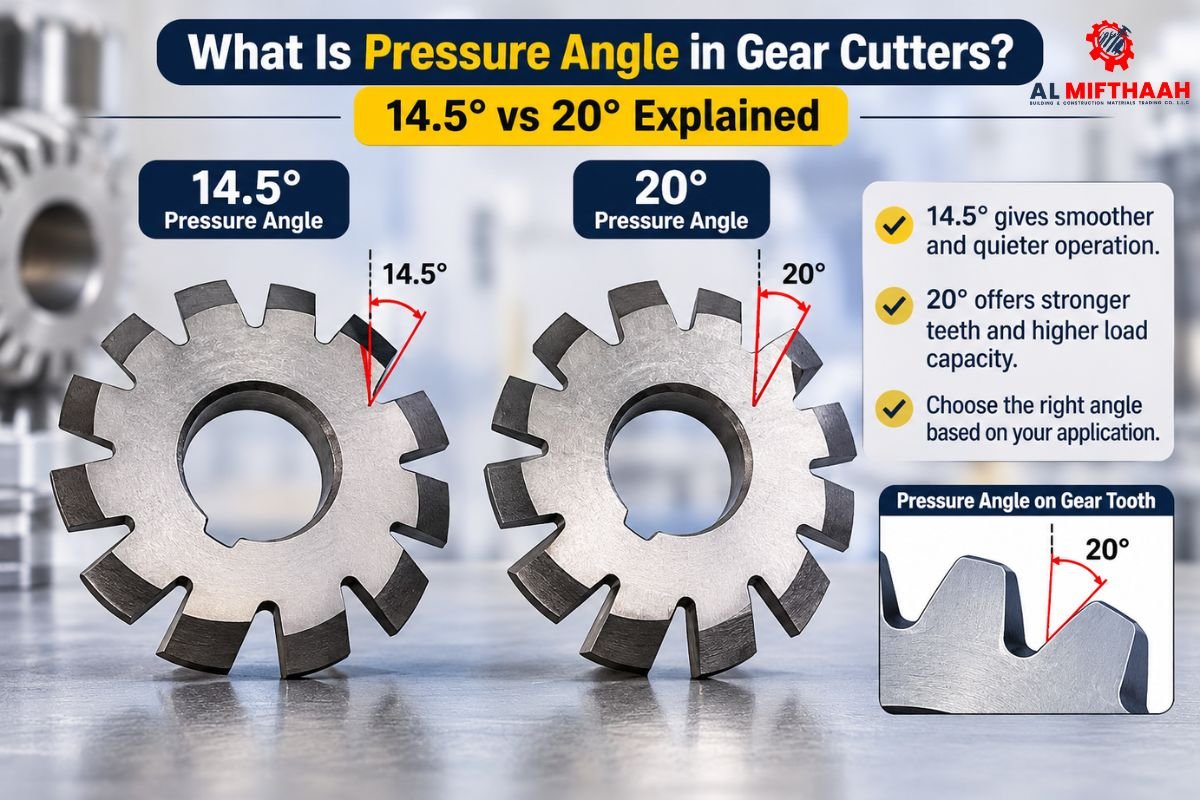
The pressure angle of gear cutters affects the design of the tooth profile of the cutter. The pressure angle can be described as the angle between the line along which gears are in motion and the line that is tangent to the pitch radius. Standard pressure angles range from about 14.5° to 20°. The tooth profile made using a 14.5° angle can be described as slender, since it has less separating force but is weak at the base and undercuts small-sized gears.
The gear profile made with the 20° angle is more robust than that produced with 14.5°, as it is also able to resist undercutting. Choosing an angle will depend on various factors, which include tooth count, load capacity, and the type of mating gear.
Table of Contents
ToggleKey takeaways
- The pressure angle determines the tooth profile and the strength of roots for each gear produced by a cutter.
- The 14.5° angle is suitable for legacy designs as it has a lower bearing load; however, it weakens teeth and undercuts small gears.
- The 20° angle provides better tooth strength for handling small pinions but requires about 40% more separation force.
- Cutter’s angle, module, and tooth count match drawing supplier verification is required before order placement, including options from Saif Precision Tools Suppliers of UAE.
What is the pressure angle in gear cutters?
The angle made by the line of action and the line tangent to the pitch circles is the pressure angle of the gear cutters. This angle is transferred to the gear tooth by the cutter’s profile, and must be matched to the mating gear. Standard values are 14.5° and 20°.
The surface of each gear tooth is curved, known as an involute. A line of action exists between two teeth that are meshing, and it is the path along which the force is transferred from one tooth to the next. This angle between the line and a perpendicular to the line connecting the two gear centres is called the pressure angle. The involute flank is formed from a base circle, and the amount of curve in the flank and tooth thickness at the root are affected by the pressure angle.
However, this angle is present on the cutting edges of gear cutters. If the cutter used to create a 20° shape is used to cut a 20° flank into the blank, then the flank it produces will match a 20° flank of the same module at the correct position, and the cutter will produce a correct 20° shape. This is why cutters are identified by pressure angle, module or diametral pitch, and range of the number of teeth. Users should not presume that two cutters manufactured from the same module are interchangeable. For a 20° job, a 14.5° cutter will provide teeth that bind, vibrate, and wear rapidly.
Why does the angle matter at the tooth surface?
The angle has three effects. It determines the thickness of the tooth at the base of the gear, the radial force that pushes the gears apart, and the minimum number of teeth that the cutter can make without undercutting. The larger the angle, the wider and shorter the tooth will be, and the thicker the root. The smaller the angle, the sharper and flatter the tooth, and the less separating force it will have, but the more bending strength.
Furthermore, every option has a compromise. That is why the angle is deliberately specified by the engineer, depending on the load that the gear has to support and the machine that it is to operate within. The wrong choice is frequently the one that’s made on a habit basis.
A brief history of the 14.5° and 20° standards
14.5° profiles were extensively used in early industrial gearing. This angle was used in many machines constructed in the first half of the twentieth century, and in drawings, spares catalogues and workshop practice. It was a good compromise for smooth running and manufacturability at the time with the loads the engineers were attempting to deal with.
As machines increased in strength, the designers started to recognize the limitations of the slimmer tooth. Teeth were cut at 14.5°, which caused bending fatigue at the tooth root, and small pinions were hard to cut without material loss at the base. As time went on, 20° was developed as an optimum value to give a good tooth form with the same module, and to allow the use of smaller pinions.
The angle 20° is most commonly specified for spur and helical gears in general industrial machinery today. It is used as a default in many international practices. But the 14.5° angle remains. It stays in legacy equipment, and gears for older equipment will still have to be the same geometry to use. That is why it is always a good idea for a supplier to ask what the angle of your current gears is before giving a quote for a cutter.
14.5° vs 20°: key differences at a glance
When compared side by side, the two angles are clearly seen to be distinct. The table below summarises the main differences for full-depth involute gears. Values are representative and may be different depending on profile shift, tooth count, and module.
| Feature | 14.5° Pressure Angle | 20° Pressure Angle |
| Tooth shape | Slim and pointed | Broader and more robust |
| Tooth root strength | Lower | Higher |
| Minimum teeth before undercutting (full depth) | About 32 | About 18 |
| Radial (separating) force | Lower, tan 14.5° ≈ 0.259 | Higher, tan 20° ≈ 0.364 |
| Contact ratio | Generally higher | Generally lower but adequate |
| Typical application | Legacy and older designs | Most modern industrial gearing |
From a mathematics point of view, a 20° gear has approximately 40% more separating force than a 14.5° gear when transmitting the same load. This is the main cost of the stronger tooth and should be taken into account when designing bearings and housings.
How does a 14.5° pressure angle perform?
The 14.5° angle is still useful in some applications, but it is also a drawback for current loads. Knowing both sides will help you determine if it is still applicable to your application.
Advantages of a 14.5° Angle
- Reduced separating force: Bearings and shafts endure less radial load, which may be ideal for lightweight mechanisms and minimal space envelopes.
- Legacy compatibility: Replacement gears must be compatible with existing drawings, and many older machines rely on this profile.
- Increased contact ratio: Greater number of teeth in contact at one time for light, smooth-running drives.
Limitations of a 14.5° Angle
- Undercutting on small pinions: Gears with less than approximately 32 teeth may have material removed from the tooth during the cutting operation, in a location where maximum stresses are occurring.
- Weaker tooth base: This is more susceptible to bending fatigue and shock load cracking.
- Limited heavy-duty capacity: The 20° tooth is normally used for high torque applications.
Moreover, if designers have to work with a 14.5° set, they can remedy this by either using a larger module or more teeth. Each change does make the gear up, though, and may not fit in a tight setup. The most basic long-term answer is to also change the design to 20 degrees, where possible, as long as the rest of the system is changed accordingly.
Why has 20° become the standard?
A new standard for spur and helical gears is now 20° pressure angle. It’s popular because of its superior strength, more uniform cut, and the availability of cutters and ready-cut gears.
- Stronger Teeth and Better Load Distribution
A 20° flank will have a wider tooth base, which will withstand bending stress better than a 14.5° tooth. The root is thicker, which means that the tooth is able to withstand shock loads and more torque than would be the case otherwise before getting fatigued. The wide base also permits smaller-sized pinions to be cut without undercutting, thus maintaining small gear trains.
This is indeed the practical case – less shock in the shop. A 20° gear has a more forgiving profile for the small amount of deviation it can withstand and has less tendency to crack when handling different loads.
- Trade-Offs in Bearing Load and Noise
With the same tangential load, the high angle provides an additional 40 percent of radial load. Bearings, shafts, and housings need to be sized accordingly. The angle isn’t the only factor that affects noise and vibration, however: a gear with an angle of 20° can be mounted incorrectly, poorly lubricated, or unaligned, and still produce vibration.
Machines working on these gears also get their benefits from long-lasting machine tool accessories that keep spindles, arbors, and fixtures on one line during cutting.
How does pressure angle affect cutter selection?
Choosing a gear cutter should start with the gear drawing, and only proceed to the catalogue. The pressure angle, module, and number of teeth are the three numbers that will determine the cutter that will produce an accurate tooth. Do this in the following sequence.
- Check the pressure angle from the drawing or mating gear.
- Write the gear’s module or diametral pitch.
- Identify the number of teeth on the gear or check the design file.
- Find the cutter number that is used for that range of tooth count.
- Check the sharpness and damage of the cutter before cutting.
These are some steps that are often overlooked, which can result in the loss of blanks. Special consideration should be given to Step 4, as a cutter that is correct in one tooth range may create an inaccuracy in another.
Gear Cutter Types and Their Uses
There are a few types of tools that can be used to cut gear teeth; each one works for a different machine and volume:
- On a milling machine, spur and helical gears are cut in disc form; one cutter for each range of teeth.
- Gear hobs are continuously cut and are suitable for high-volume production of spur and helical gears.
- Gear shaping machines are used with shaper cutters for internal gears and for gears near shoulders.
- End mill gear cutters are ideal for small quantities, prototypes, and repair operations on standard milling machines.
Therefore, when ordering the gear cutting and threaded parts kit, you should also consider ordering the tools to thread, as jobs that require a combination of cutting the gears and threading the parts may also require the threading tools.
Tooth Count and the Undercut Limit
A quick check can be done based on the formula N = 2 / sin²(φ), where φ is the pressure angle. At this temperature of 20°, the number of teeth is approximately 17, and 18 is the minimum number of teeth used in full depth. The same formula yields approximately 32 for 14.5°. The same formula produces approximately 32 for 14.5°.
Suppose you have a 16-tooth spur gear which is being cut with a standard 20° cutter. The number of teeth is less than the minimum; the root will undercut. There are two practical choices: The first is profile shifting, which is accomplished by moving the cutter a bit outward to thicken the root area and prevent undercut. The second is to add more teeth, which alters the gear ratio and will impact design. In either case, the decision should be made prior to ordering the cutter, not after it has ruined a blank.
Our cutting and milling tools Dubai include those for bore preparation on blanks before gear cutting, for typical hole sizes and finishes.
Common mistakes when choosing gear cutters
Most of the gear-cutting problems are due to some common mistakes that can be avoided. The earlier you can recognize them, the sooner you will save time and material.
- If the modules are equal: Two gears of equal module but different pressure angles will not mesh properly. Be sure to also double-check the angle.
- Undercut and weak tooth roots: A small pinion that is cut with a cutter designed for large gears results in undercut and weak tooth roots.
- Purchase for the price only: A less expensive cutter that has a less accurate profile may result in more scrap than a more expensive cutter from a reliable source.
- Forgetting the finish: Tools worn or chipped at the edge change the tooth profile even when the angle is correct.
- Lack of documentation: If tool data is not recorded, then it is hard to repeat the job or identify and troubleshoot issues later.
How to choose gear cutters in Dubai?
There is a need for reliable sources of gear cutting tools for both maintenance and production in workshops and manufacturers across the emirates. The selection of the correct supplier is as critical as selecting the correct angle, as the best specification is not much good if the tool cannot be supplied, supported, and replaced when it is required.
One of the most common reasons why gear cutter suppliers in Dubai are in constant demand among machine shops, repair workshops, and industrial manufacturers is because of local demand. Make sure to compare technical support, the range of stock, and delivery time before making a purchase. A good supplier confirms specifications in writing and assists in gear matching the cutter. Many buyers also look for gear cutters dealers in Dubai to find dealers who have a lot of profiles, but not only the most common ones.
Cutting and milling tools Dubai are often required in workpieces that involve cutting gears, which can be done in the following steps: setting up, roughing, and finishing. When ordering from one source, it is easier to order, decreases the risk of mismatching tooling, and keeps track of the items sent per job.
What to check before you order?
- Pressure angle is clearly marked on the workpiece, either as 14.5° or 20°.
- Matching your gear drawing in module or diametral pitch.
- The range of teeth and number of cutters that correspond to the gear’s tooth count.
- A suitable material, like high-speed steel or carbide, for the workpiece.
- Documentation that contains dimensional information and any quality records.
Where to source quality gear tools?
When looking for a Saif Precision tools supplier in UAE, you will find a number of local choices available for you; so consider specifications and not just price. Inquire about the pressure angle in writing, request samples if available, and find out if the supplier will be able to regrind or replace it later. When a production run is already in place, consistent support is most important.
Almifthaah provides a variety of tools that are used in the gear and gear manufacturing process, including abrasive tools for finishing and surface preparation. For more information on our company and product focus, check our company page. If you have any particular queries regarding a gear cutter, you can contact our team through the contact page.
Practical machining tips for each pressure angle
Correct cutting of gears is dependent on setup, as well as geometry. These are tips for both 14.5° and 20° cutters.
- Inspect the height and alignment of the cutter centre and the index head before making the first cut.
- Check the thickness of the teeth on a test blank with a pin measurement or Gear Tooth Vernier.
- Optimize feed rates for the material and the diameter of the cutter to prevent chatter and poor surface finish.
- For steel and stainless alloys, ensure that cutting fluid is used appropriately for the material.
- Use dull cutters at a young age, because even if the angle is correct, the edges will become worn and the tooth profile will change.
The results are also influenced by heat treatment. Where accuracy is important, gears cut prior to hardening should be distortion-tolerant, and the final profile should be checked after hardening. Easy tooth-thickness tests using a gauge can detect issues early, before an entire batch is compromised.
Shops that operate multiple jobs simultaneously usually purchase cutting and milling tools Dubai equipped for both roughing and finishing processes. With this, the setup time is minimized, and tool geometry remains uniform throughout the whole operation.
Working with trustworthy gear cutters suppliers in Dubai allows you to calculate when you will need to buy replacements for your tools. The supplier can also recommend an optimal reorder point for a certain tool number.
Final thoughts
The pressure angle affects tooth strength, bearing loads, and machining performance due to being an important aspect of its design process. While 14.5° remains relevant to older gear designs, 20° is preferred by most people today due to its strength and versatility. Choosing an appropriate cutter involves selecting the correct cutting angle, module size, and tooth count before procuring it from a reliable supplier for doing work on site up to final inspection.
To get help from a local store owner for buying equipment cutter supplier Dubai and speaking to an Almifthaah representative via their contact page. Additionally, you may go through the Almifthaah website for more information about their products.
Frequently asked questions
No. The mating gear requires a constant pressure angle and tooth profile; otherwise, it may have binding issues due to uneven wear, leading to premature failure of its teeth.
A 20° angle works well on small gears as it prevents undercutting while keeping tooth roots strong.
Yes, indirectly. The higher angle of incidence affects both the contact ratio and force; therefore, it is influenced by accuracy, lubricity, and mount positioning.
Select an authorized gear cutter dealer of Dubai that verifies specs, provides technical assistance and has track record on tools’ information.
What Is Pressure Angle in Gear Cutters? 14.5° vs 20° Explained

Why Does Stainless Steel Shim Stock Corrode Despite Its Rust Resistance?