- November 14, 2026
- by Almifthaah
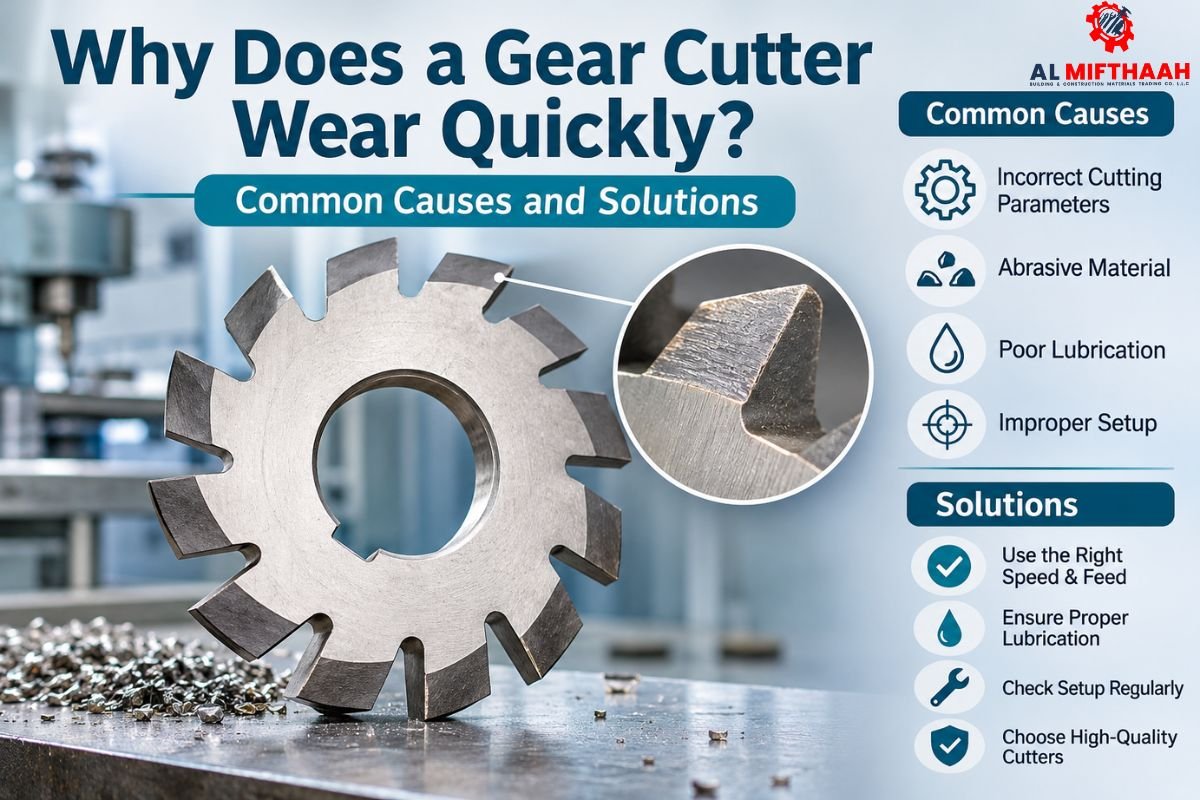
Why Does a Gear Cutter Wear Quickly? Common Causes and Solutions
A gear cutter generally wears out quickly due to operating under conditions for which it was not made. Typical reasons are excessive heat at the cutting tip, incorrect speed and feed, inadequate or nonexistent cooling, inappropriate tool material for the workpiece, and issues with machines such as vibration and misalignment. Each of these leads to quicker dulling, chipping, and failure of the cutting edge. Most of the issues are resolvable with a more careful setup and regular maintenance.
This guide describes each reason and its solution and helps you find trustworthy suppliers of gear cutters in Dubai in case replacement is inevitable.
Table of Contents
ToggleKey takeaways
- The biggest contributors to rapid tool wear are: heat, wrong speeds and feeds, poor coolant flow, and poor selection of the tool material.
- Vibration, misalignment, and weak clamping can ruin a tool even if the right type of tool was chosen.
- Correct choice of material and coating of the cutter maximally improves its life.
- Frequent checking of coolant conditions, regulation of coolant flow, and timely regrinding of tools minimize scrap production and downtime.
What is a gear cutter and why does wear matter?
A precision cutting tool used to make teeth cuts on gears, splines, etc., is known as a gear cutter. It can be a hob, a shaper cutter, a gear shaper cutter, a broach, or a form milling cutter, depending on the process. The profile on each design is precisely ground, and the profile is what dictates the finished tooth shape, pitch, and surface finish.
Wear is a concern since the tooth profile is the product. As the cutting edge dulls or the geometry is altered, the gears exiting the machine may not pass inspection. Tooth thickness errors, poor surface finish, noise in the finished gear train, and higher scrap rates are potential problems with worn tools. The slightest wear can make an income-making job into an expensive rework one.
Another indirect impact on cost is tool wear. Each cut made with a worn cutter will take longer, thereby increasing the cycle time. It also places a greater strain on the machine spindle, causing the life of other parts to be shortened. While many shops are only concerned with the cost of a new cutter, the true cost may be the wasted time and scrap associated with a cutter that was allowed to wear out too far.
However, the first step to reducing wear is to understand its cause. Knowing the causes of these issues, you can modify your process rather than changing the cutters more often than you should. This type of “root cause analysis” is often used by many shops that operate cutting and milling tools in Dubai to ensure that tool costs are controlled.
What are the main causes of gear cutter wear?
Gear cutter wear is typically attributable to multiple issues rather than one main issue. Nevertheless, there are four major reasons for the premature failure of tools in practical workshops: cutting parameters, coolant usage, heat, and tool material. The most efficient way to lower tool cost is to determine which one is suitable for your operation.
- Heat Buildup at the Cutting Edge
When cutting, heat is produced and is best expelled in the form of chips. Heat remains within the tool when cutting speeds are too high, or the edge becomes dull. High temps soften the cutting edge, decrease hardness, and accelerate crater wear on the rake face. The softened edge will wear away even further, resulting in more heat. In a short time, this cycle can bring a cutter to its knees.
The signs of heat damage are often blue or straw coloured discoloration on the cutter teeth. If you see this, there is a problem with how hot the tool is. The remedy is to reduce cutting speed, increase coolant flow, or use a coating more suitable for high-temperature cutting.
- Incorrect Cutting Speed and Feed
The amount of material removed and how quickly it is removed depends on speed and feed. Excessive velocity results in heat and excessive edge wear. The cutter can also overrun and cause damage to the material if it is running too slowly. Friction heat and work hardening from rubbing are harsh on the cutting edge.
Feed rate is also important. Excessive feeding may cause edge fracture or chipping, particularly of each tooth. Slow speeds can also lead to rubbing – but so can very light feeds. The proper setting is dependent on the diameter of the cutter, its number of starts or flutes, the type of material to be cut, and the rigidity of the machine. Always use the manufacturer’s recommended values for the cutter and tweak as necessary based on actual results.
In good practice, it should be recorded what parameters you are using for each job. If tool life decreases, the set can be compared to your records, and you can easily see the changes.
- Poor Coolant Use
Coolant is not only for cooling the cut. It also removes chips, lubricates the cutting edge, and greatly minimizes friction. When the amount of coolant is not sufficient, the chips re-cut, pack material into gullets, and drastically raise the heat. Incorrect concentration or type of coolant can also present issues, for example, inadequate lubrication or bubbles that hinder coolant from flowing to the cutting area.
Therefore, make sure the coolant is fed to the location of the tooth, not just to the general area. Regularly clean the filters and change the coolant when it deteriorates. Once coolants are delivered back to the correct locations, many premature wear issues go away.
- Wrong Tool Material for the Workpiece
Not all the cutters are appropriate for all the workpieces. High-speed steel (HSS) is tough and inexpensive and is suitable for a number of general-purpose applications. If the material is harder, a cobalt-alloyed HSS is used, which is usually referred to as HSS-E or HSS-Co. Carbide cutters can operate at much higher speeds, but are brittle and require a rigid machine set-up.
Rapid wear will occur if the material is harder or more abrasive than the cutter was designed to handle. Typical causes of this problem are stainless steel, alloy steels, and heat-treated components. One of the best ways to prolong tool life is to select the material to be used for the application.
How do machine and setup problems speed up wear?
The machine’s ability to maintain a steady cutting speed is important, even if the cutter is properly selected. Too many hard shops say that the tool is to blame when it is actually the machine or how the workpiece is held. Always thoroughly inspect the machine condition and setup before changing the cutters.
- Vibration and Chatter
Vibration is caused by a lack of rigidity among the cutter, the piece to be cut, and the machine. The wavy surface, uneven loading of each tooth, and repeated impact of chatter result in chips at the cutting edge. Common problems are worn bearings, loose spindle parts, backlash in the feed system, and long tool overhangs.
In many cases, a problem with chatter can be easily heard by the welder before it is a real issue. If the sounds are different, if the gear surface is rough, or if a pattern is visible on the teeth, something is amiss. Oftentimes, it is possible to solve the problem without changing any of the other parameters by reducing overhang, improving work-holding, and checking machine bearings.
- Misalignment and Poor Fixturing
The effectiveness of gear cutters is contingent upon the proper alignment between the cutter and the workpiece. When there is a slight misalignment of either the hob or the cutter in relation to the workpiece, the load on one side will be greater than that on the other side. In economic terms, misalignment leads to uneven wear and failure of the cutter, which will result in premature wear. It may also create gears with defective tooth shapes.
Fixtures are also important because any shifting of the workpiece during cutting will affect the load on the cutter. Proper clamping force and adherence to the specification on both faces should be maintained. The runout should be checked regularly with a dial indicator, and any changes made in the cutting tool should be analyzed afterward.
How does workpiece material affect tool life?
The workpiece is one of the most important factors that affect the life of the tool. Different properties such as hardness, toughness, chemical composition, and heat treatment have an impact on how the way the cutter behaves. It is possible that a tool that works well with mild steel fails on hardened alloy steel in just a few minutes. Hence, knowledge of the differences between these materials will allow you to create the appropriate expectations and select the proper cutter for each task.
Hardness is an essential factor, to begin with. The harder a material, the more the cutting edge has to overcome resistance and produce heat in the process. Toughness also plays a role in the efficiency of the cutting tool because tough materials create long, thin chips that may cause recutting. Additionally, you need to remember that some materials have abrasive properties that will gradually wear the cutting edge.
The table below summarizes the influence of workpiece materials on the wear of gear cutting tools. Actual findings may vary due to the type of your equipment, working conditions, and the type of coolant used, so use this information as a general recommendation.
| Workpiece Material | Typical Wear Level | Main Wear Concern | Recommended Approach |
| Mild steel | Low to moderate | Built-up edge | Sharp HSS cutter, steady coolant |
| Medium carbon steel | Moderate | Heat and crater wear | Cobalt HSS or coated HSS |
| Alloy steel | Moderate to high | Edge chipping and heat | Coated HSS-E, lower speeds |
| Stainless steel | High | Work hardening and galling | Cobalt HSS or carbide, strong coolant |
| Hardened steel | Very high | Rapid edge breakdown | Carbide, rigid setup, light cuts |
| Cast iron | Moderate | Abrasive wear | Coated carbide, dry or light coolant |
Stainless steel is the focus of discussion. Is liable to work hardening, or becoming harder when cut. Passes can be made easier or harder each time, particularly if the cutter is dull or rubbing rather than cutting. There is a significant difference between using sharp tools, an adequate coolant, and consistent feed rates.
Cast iron is another challenge. It is not as hard as steel, but it wears out cutters gradually through the graphite in it and the abrasive silicon particles. Coated carbide can be a good choice for this application, as long as the machine can handle it.
Which solutions help extend gear cutter life?
Once the causes are known, there are solutions that can be applied to address the problem at its source. The best method is to use the correct cutting material and coating, establish the proper cutting parameters, consistently practice good coolant use, and maintain the cutting machine regularly. The easiest way to improve is to change one area at a time; the greatest results are achieved by changing multiple areas.
- Choose the Right Gear Cutter Material and Coating
The first thing to do is make sure the cutter material is matched to the workpiece. A good HSS cutter or Co (cobalt) HSS cutter is often the most cost-effective choice for general steel cutting. Carbide or coated cutters may last for a much longer period of time, albeit at a higher initial price, for harder or more challenging materials.
Coatings can be used to achieve a much longer tool life. The surface hardness and friction are reduced by the addition of titanium nitride (TiN). Titanium aluminum nitride (TiAlN) is good for dry cutting or high-speed cutting, and is capable of working at higher temperatures. Some stores that deal with stainless steel opt for coatings that are resistant to built-up edges. When comparing, consider the type of coating, the underlying material, and applications recommended by the manufacturer.
In high-end applications, many customers will seek advice from Saif Precision tools supplier in UAE regarding the selection of the cutter, as sometimes it can take more money to match the right cutter than to purchase the cheapest one.
- Set Correct Speeds, Feeds, and Coolant
Start with the cutter manufacturer’s recommended speeds and feeds. Once, make small changes, one at a time, and observe the results. Check the color, appearance, sound, and condition of the tools following each change. The right combination of tool, material, and machine can be pinpointed with a consistent, well-documented process.
Coolant should be directly pressure-fed into the cutting area at a suitable rate and pressure. Use a refractometer to monitor the concentration on a regular basis; remove and replace the filters and change the coolant if it becomes contaminated or unstable. If cutting is dry or near dry, ensure that the tool coating and machine setup are appropriate.
- Regrinding and Maintenance
Dull cutters should be resharpened before they become really dull. Regrinding restores the cutting edge and will increase the total life of the tool, but only by a qualified service provider who is aware of the tooth profile. Poor regrinding can alter the geometry and create new issues. Please consult your supplier to see if they will regrind and what tolerances they can hold.
A regular maintenance program is also beneficial. Check cutters before and after each task; note the wear of the cutter; clean tool holders and tool arbors; and store cutters carefully to avoid damage to their edges. Many shops also record the tool’s life per job and parts, allowing them to more easily schedule replacements and identify issues early.
When looking around the different service capabilities, turnaround time, and tool specifications, the best milling tools dealers UAE, can give you a guide if you want to know how to regrind or what options you have to choose from when it comes to services.
Where can you buy reliable cutting tools in Dubai?
Selecting a good source for the gear cutters is as important as making the right selection of the cutter. A good supplier will be able to match your tooling to your materials, will be able to clearly explain your specifications, and will support you post-sale. A substandard supplier might supply cutters that appear fine, but actually end up failing prematurely, resulting in wasted material and lost time.
Many people use a search for gear cutters dealers in Dubai when they require a fast way to get tools. The point of it all is to locate a partner that understands the product and your application regardless of which path you take.
Consider the scope of products offered, technical support quality, and experience in your industry when evaluating a supplier. Inquire about certifications, material traceability, and the ability to provide replacement parts or regrinding services. A good supplier will be pleased to answer detailed questions on the geometry, coating, and recommended parameters.
The table below lists the factors worth checking when comparing suppliers.
| Evaluation Factor | What to Look For | Why It Matters |
| Product range | HSS, cobalt, and carbide options | Covers different materials and budgets |
| Technical support | Help with speeds, feeds, and selection | Reduces trial-and-error costs |
| Stock availability | Common sizes ready for dispatch | Limits machine downtime |
| Regrinding service | Accurate tooth profile restoration | Extends cutter life |
| Documentation | Specifications and material data | Supports quality control |
| Local presence | Quick response in Dubai and the UAE | Speeds up urgent orders |
When looking into the website of the cutting and milling tools Dubai, compare what you see in detail, not the headline price. If a slightly higher-priced cutter will cut twice as long, then the cost per part may be lower. If available, request tool life information from suppliers or case studies of similar applications.
One place to start a comparison is Almifthaah, which is located at almifthaah.com. Read the product description thoroughly, seek advice on application, and ensure that important information like tooth profile, module or pitch, and coating is correct before placing your order. Many buyers maintain a short list of two or three suppliers which they can compare quotes, lead times, and technical responses against side by side.
It also aids in matching your supplier to the number of jobs. For fast-paced stores, it’s essential to have a steady supply and quick delivery. Technical information and custom grinding might be more important if you are involved in specialized or small-batch work. When you’re reaching out to the right supplier, they will be able to help you find the right solution if you’re able to clearly communicate about your materials, machines, and tolerances.
Bottom line
It is uncommon for gear cutter wear to occur due to a single issue. Errors happen due to multiple parameters like heat, cutting speeds, coolant usage, condition of the machine, and type of material used for the tool. This is to emphasize the need for a systematic approach to maximize the benefits. Start by looking at what type of wear is present in the available tools first, and investigate the parameters such as speed and feed before buying new tools. Changes will be small, but they will lead to significant enhancement in the tool life.
Furthermore, when it comes to purchasing new or replacement tools, opt for the supplier that provides assistance along with the product. Compare the services and product options to find out the one that will cost you less in the future. It does not matter if you examine the gear cutters suppliers in Dubai or trusted local suppliers in the area; a good tool and good process will ensure accuracy of gears.
Frequently asked questions
This is typically caused by too much heat at the cutting edge. It is frequently caused by high cutting speeds, dull cutting surfaces, or inadequate cutting lubricant, and coolant supply.
Check for dull or chipped teeth, blue discoloration, rough surface finish, and gears that don’t pass inspection. Other warning signs include changes in cutting sound or increased cycle time.
Yes, most gear cutters can be re-ground by a proper gear grinding service. Regrinding should recapture the proper tooth contour, and make sure to select a provider that has the necessary equipment and experience.
No. While carbide can be used when working at high speeds in heavy-duty operations, high-speed steel or cobalt high-speed steel often provides better performance when dealing with lighter machines and difficult interrupted cuts.

How to Identify the Correct Gear Cutter When the Markings Are Missing
Carbide Tool Maintenance Tips Every Machinist Should Know