
- August 19, 2026
- by Almifthaah
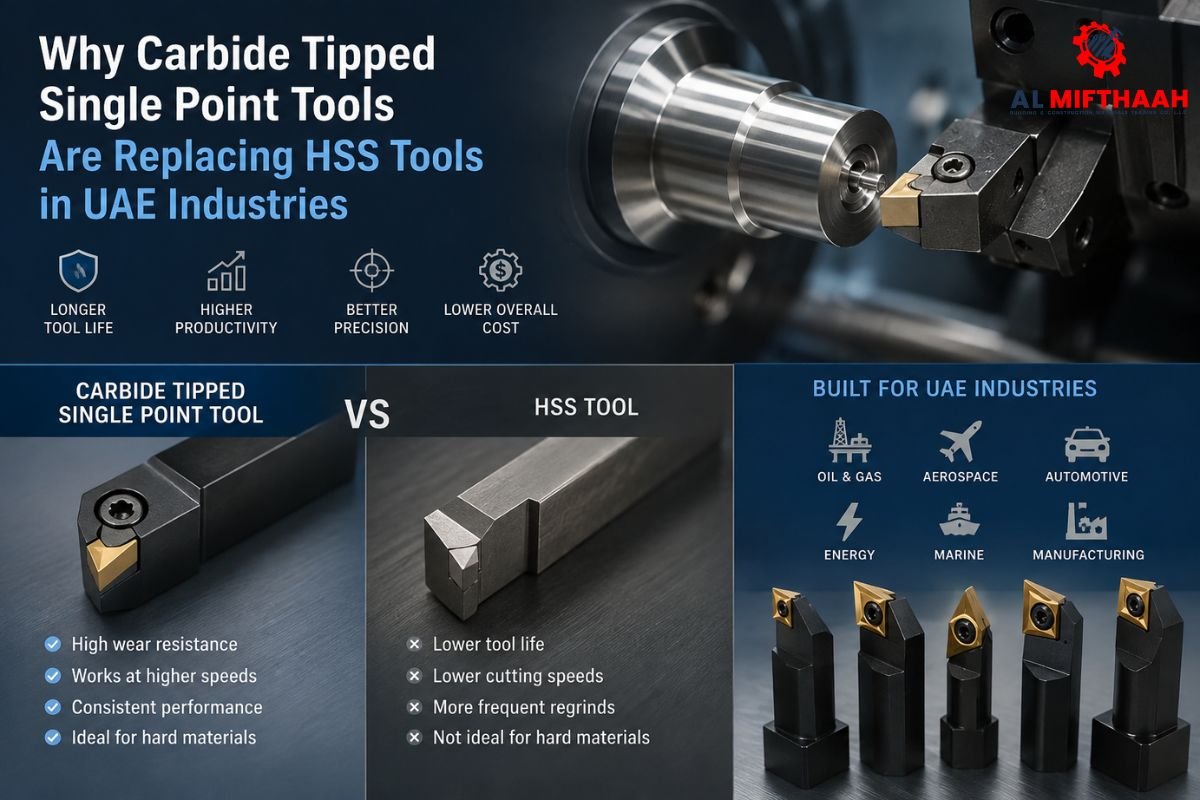
Why Carbide Tipped Single Point Tools Are Replacing HSS Tools in UAE Industries
Across UAE industries, carbide tipped single point tools are being used instead of HSS tools because tungsten carbide has hardness ratings of 89 to 95 HRA while HSS has hardness ratings of 62 to 68 HRC, and it hardly gets softer under conditions of heat, losing only about 10% of its hardness at 800 degrees Celsius which is the temperature where HSS gets irreparably damaged at around 600 degrees Celsius. Practically, it means cutting speeds that are 2 to 6 times faster than HSS regardless of the specifics of a turning or milling job, fewer tool changes, and lower costs per part produced despite higher initial costs.
Moreover, the machine tool market in the UAE was worth around AED 690 million (USD 187 million to 190 million) in 2024 and is projected to grow at a rate of 6.11% per year until 2030, making companies that utilize HSS tools outdated. As a supplier of carbide-tipped single-point tools in Dubai, we have observed this process unfold over time until it rapidly escalated recently.
Table of Contents
ToggleKey takeaways
- Carbide is capable of working more quickly compared to HSS, and therefore leads to lower cycle time in CNC and manual lathes.
- HSS is popular for being cheap, has a shock-resistance trait, and also can be sharpened very simply, making it convenient for the manufacturing of low-volume products.
- Transitioning to carbide requires proper adjustments of rigidity, coolant, and feed rate.
- A trustworthy carbide-tipped single-point tool supplier in Dubai can offer various grades.
What single point tools actually do?
Single point tools utilize one cutting edge to perform work regardless of what operation is being done – turning on a lathe or cutting a groove. By contrast, milling tools and drills use several teeth to perform manufacturing processes. As single-point tools are limited to one sharp edge, all the decisions regarding the speed of the spindle rotation, service life of the cutting edge, and the surface quality of the final product are made according to the properties of this high-speed cutting sharp edge.
For many years, high-speed tools were made of high-speed steel; the latter is not only a durable and forgiving material, but also one that can be easily sharpened by any machinist using a grinder. Carbide does not replace high-speed steel; it just makes it the most preferred tool material.
Why did HSS dominate UAE workshops for decades?
Al Quoz and some industrial areas located in Sharjah still have many of the older workshop machines that were formerly powered by High-Speed Steel (HSS) technology. However, their choice of technology has been a practical decision rather than sentimental.
HSS costs less to use as, by using HSS, machinists are able to regrind their used tools rather than having to toss them away, and this is important at times when a tool profile is not readily available. HSS is known to be more shock-resistant. It withstands shocks caused by rough cuts without breaking.
Therefore, HSS is still being used today by form tools, small-diameter drilling tools, as well as any other equipment that might have problems with rigidity. An old manual lathe with an imperfect tailstock will wear down carbide tools very quickly but will continue to work with HSS for years.
The carbide shift: what changed
Three things pushed UAE industries toward carbide, and none of them are marketing talk.
- Material demands got harder- Structural steel detailing, precast components, and automotive parts increasingly involve alloys and hardened surfaces that dull HSS edges fast. A HSS drill bit sits around 62–66 HRC. Standard tungsten carbide runs 89–95 HRA, which converts to roughly 69–81 HRC. That gap shows up directly in how many parts you finish before the edge gives out.
- CNC adoption raised the ceiling- HSS tops out around 100 SFM in most common materials. Carbide comfortably runs several times that in the same cut. On a manual lathe you’d barely notice. On a CNC machine running 16 or 20 hours a day, that difference rewrites the whole production schedule.
- Heat is the real story- Machining generates heat at the cutting edge, and heat is what actually kills a tool, not friction on its own. HSS starts softening noticeably around 600°C. Carbide loses only about 10% of its hardness even at 800°C, which is why it holds an edge through cuts that would round off an HSS tip in minutes. That single property is behind most of the calls we get at Almifthaah from shops cutting stainless steel, titanium, and hardened castings, and it’s a big reason demand for a carbide tipped single point tools supplier in Dubai keeps growing.
The National Industrial Strategy 2030 and Cabinet Resolution No. 16 of 2023 in the UAE promote the use of CNC automation and quicker production.
Despite these regulations not mandating the use of carbide tools by manufacturers, it is clear that the use of HSS tools in automated processes leads to decreased manufacturing efficacy at a higher rate of production.
Carbide vs HSS: A direct comparison
| Factor | Carbide Tipped Tools | HSS Tools |
| Hardness | 89–95 HRA (≈69–81 HRC) | 62–68 HRC |
| Heat resistance | Loses ~10% hardness at 800°C | Softens noticeably above 600°C |
| Cutting speed | 2–6x faster in most operations | Baseline, lower SFM range |
| Tool life | Longer between changes | Shorter, wears faster |
| Resharpening | Difficult, rarely worth it | Easy, extends life cheaply |
| Shock resistance | Brittle, chips under impact | Tougher, handles interrupted cuts |
| Upfront cost | 3–5x higher per tool | Lower initial investment |
| Best for | CNC, high volume, hard materials | Low volume, form tools, older machines |
Neither tool wins outright. The right call depends on the machine, the material, and the batch size, which is exactly what a good cutting and milling tools Dubai supplier should help you work through before you place an order, not after a batch of tips has already chipped.
Where UAE industries are feeling the difference?
Automotive service centers doing brake rotor resurfacing and engine component work have mostly moved to carbide for anything touching hardened steel. Structural steel detailing shops, particularly ones supplying precast and PEB manufacturers, lean on carbide for the volume and consistency it gives on long runs. Metal coating and fabrication workshops that used to run HSS for general turning are switching selectively, keeping HSS for maintenance jobs and short runs while carbide handles the CNC lines.
Furthermore, one thing we see over and over: shops that switch to carbide wholesale, without touching machine rigidity or coolant delivery, often end up worse off than they were with HSS. The tool material only pays off if the rest of the setup can actually support it.
Common mistakes when switching to carbide
- Running carbide on machines with excessive play- Carbide is brittle. A machine that tolerated HSS’s forgiveness for years will chip carbide tips fast the moment there’s vibration or backlash in the slides.
- Ignoring feed rate adjustments- Carbide performs best at higher speeds paired with the right feed, not just higher speed alone. Run it like an HSS tool, and you waste most of what makes it worth buying.
- Buying the wrong grade for the material- Not all carbide behaves the same. A grade built for cast iron won’t act the same way under stainless steel or aluminum, and the wrong pick shortens tool life fast.
- Underestimating coolant needs- Some carbide operations run dry on purpose, but others need steady coolant to manage thermal shock. Inconsistent flow cracks tips.
- Writing off HSS entirely- Keeping an HSS welded tool bit supplier in Dubai on speed dial still makes sense for form tools, prototyping, and any machine that can’t handle carbide’s rigidity demands.
How to choose the right supplier?
A supplier’s catalog matters less than whether they ask what you’re cutting before recommending a grade. A few things worth checking:
- Stock for both carbide and HSS, since most shops run both depending on the job
- Technical support that can explain grade selection instead of just reading off SKUs
- A track record in the region, the kind you get from a Saif Precision tools supplier in UAE relationship many workshops already trust
- Fast turnaround, because a stalled line waiting on tooling costs more than the tools themselves ever will
Therefore, Almifthaah has worked with enough UAE fabrication and engineering shops to know the “best” tool is the one matched to the job, not the most expensive one on the shelf.
Conclusion
Carbide tip single point tools Dubai are becoming increasingly popular due to the changing face of manufacturing in the UAE. Companies are starting to work with tougher materials, higher production volumes, and rapidly working CNC machines. In such circumstances, the benefits of carbide are appealing in terms of speed and heat resistance.
Nevertheless, HSS tools also have their benefits, being effective for particular jobs and easier to sharpen. Therefore, having both types of tools available at the shop gives the shop an opportunity to choose the most appropriate one depending on the task.
In case you need to change your tools or order reliable tooling, Almifthaah is here to assist you with choosing the necessary grade for your material and devices.
Frequently asked questions
No. Carbide wins on speed and heat resistance, but HSS handles interrupted cuts and shock better, and costs less upfront for low-volume or custom form-tool work.
Typically 2 to 6 times faster depending on material and operation, though some sources put it at 4 to 7 times under ideal conditions.
Technically yes, using diamond wheels, but it’s costly and rarely practical compared to HSS. Most shops just replace the carbide tip instead.
Carbide inserts typically run 3 to 5 times the price of comparable HSS tools, reflecting the harder material and more complex manufacturing behind them.
Only if the machine is rigid enough. Excessive vibration or backlash chips carbide fast, so HSS often stays the safer choice on worn equipment.
Stainless steel, titanium, hardened castings, and other abrasive or high-hardness materials benefit most, since carbide holds its edge where HSS dulls quickly.
No. Cabinet Resolution No. 16 of 2023 pushes advanced manufacturing broadly, but doesn’t mandate carbide directly, it just favors the faster, CNC-driven processes carbide supports.
Yes. Most experienced shops keep both, running HSS for form tools, prototyping, and interrupted cuts, and carbide for volume production on rigid CNC machines.

How Long Do Mounted Points Last and When Should You Replace Them?

Everything You Need to Know About Tool Wear in Carbide Tipped Cutting Tools