
- September 5, 2026
- by Almifthaah
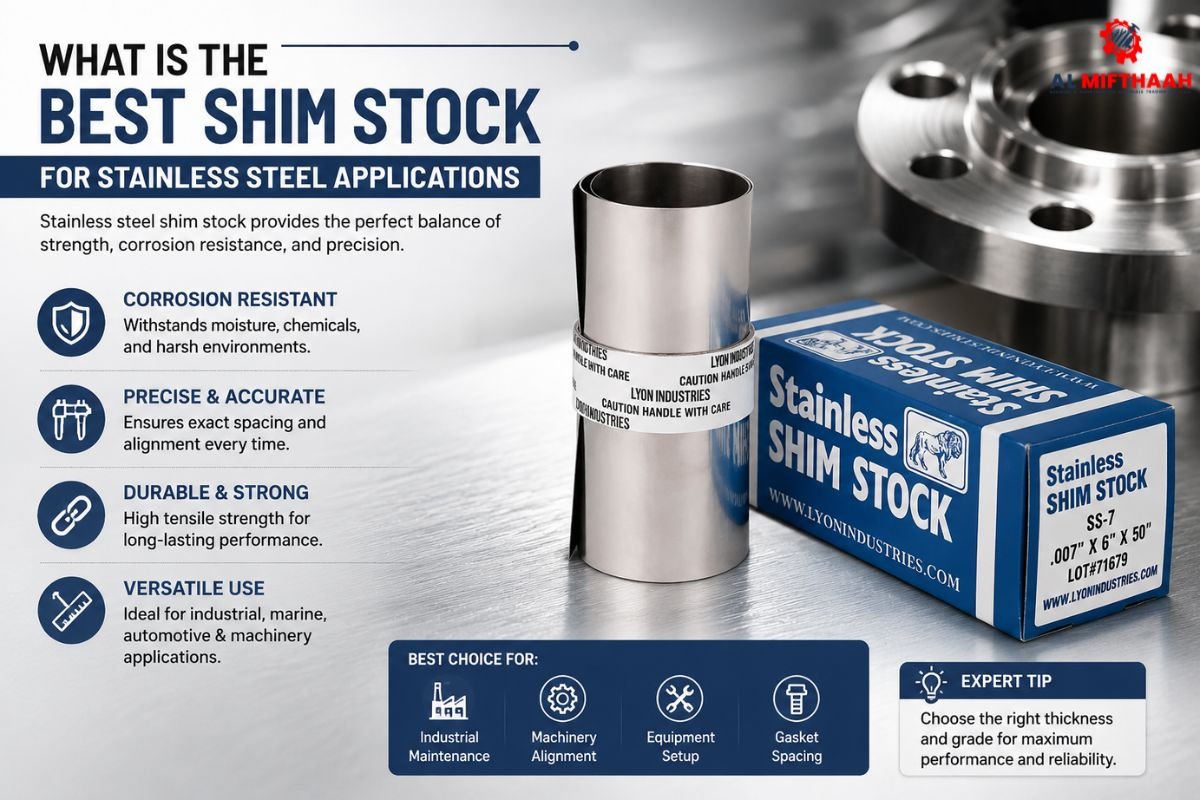
What Is the Best Shim Stock for Stainless Steel Applications?
The best shim stock material for stainless steel jobs is pre-rolled 300 series steels, such as 302, 304, or 316 steels, depending on the corrosion resistance and size of the load to be fixed. For usual industrial, shipping, or food work, 304 steel offers the right combination of strength, corrosion resistance, and cost-effectiveness.
In cases where there are high-chlorine levels or where the work is being carried out near the sea, it is better to opt for 316 steel, which contains molybdenum. What is as important as choosing the right steel grade is where to order it. This is why all engineers and buyers in the UAE keep going back to the same few firms.
Key takeaways
- 304 stainless steel is suitable for common usage; 316 reacts well to corrosive and marine environments.
- The thickness tolerance is important for determining the shim effectiveness in load situations.
- Trustworthy Shim Stock distributors in Dubai carry standard grades in stock.
- Local hardware suppliers in Dubai have faster service than imported ones.
Table of Contents
ToggleUnderstanding shim stock and why grade selection matters
Shim stock refers to a slim metal sheet which has been rolled to an accurate thickness for the purpose of filling gaps, aligning components, and adjusting spacing. It may sound unimportant to use shim stock until you consider the fact that it does most of the work involved here. Stainless steel shim stock has corrosion resistance, stability during repeated compression usage, and uniform thickness across the entire surface. Such uniformity means a lot in cases when the gap is within the thousands of an inch range.
Stainless isn’t always necessary for jobs like this. Brass and carbon steel shims work perfectly fine for indoor use in environments without humidity or harsh chemicals. Putting a carbon steel shim in a saltwater location, for example, cleaning products, or the outdoors will have that shim pitting within a few months. So that’s how stainless fits into the gap of use cases and contributes to the reason procurement managers in the area rely on specialized Shim Stock suppliers in Dubai instead of just adding shim stock to an existing order for something else.
However, choosing the right grade matters a lot. Get it wrong, and you either pay for not needed corrosion resistance, or you will replace the shims every few months because they can’t withstand their current environment.
Stainless steel shim stock grades compared
Here’s how the three most common stainless shim stock grades compare:
| Grade | Corrosion Resistance | Typical Use | Relative Cost |
| 302 | Good | General machinery, indoor equipment | Lower |
| 304 | Very good | Food processing, HVAC, general industrial | Moderate |
| 316 | Excellent | Marine, chemical plants, coastal installations | Higher |
- 302 stainless is often where buyers start. It has decent spring properties and handles moderate exposure without complaint, which makes it reasonable for indoor machinery that isn’t dealing with harsh chemicals.
- 304 does most of the heavy lifting. It turns up in food processing equipment, HVAC systems, and general fabrication because it resists rust, cleans up easily, and doesn’t react with most things it touches. When in doubt, 304 is the safe default.
- 316 costs more because of the added molybdenum, but that extra cost buys real protection in chloride-heavy environments. Dubai’s coastal climate and salty air push a lot of local buyers toward 316, particularly for equipment near the water or inside desalination and marine facilities.
How does thickness affect performance?
Grade gets most of the attention, but thickness tolerance is where shim stock quietly fails. A shim meant to be 0.05mm that drifts by even a hundredth of a millimeter across the sheet can throw off an entire alignment job, especially in precision machinery or aerospace-adjacent work.
Standard stainless shim stock typically comes in these ranges:
- 0.025mm to 0.05mm, for fine adjustments in delicate assemblies
- 0.1mm to 0.5mm, for general mechanical shimming
- 0.5mm to 1.5mm, for heavier load-bearing gaps
If your tolerances are tight, ask the supplier directly about their rolling tolerance specs. Don’t assume two sheets labeled the same thickness will behave the same way. This is one area where the reputation of your Shim Stock suppliers in Dubai actually shows up on the shop floor, because inconsistent rolling turns into measurable alignment problems fast.
Where is stainless shim stock used?
Stainless shim stock shows up in more places than people expect once they start paying attention:
- Machine alignment: adjusting bearing housings, motor mounts, and gearbox spacing
- HVAC systems: sealing gaps and adjusting duct connections in humid conditions
- Automotive and marine repair: filling clearance gaps where corrosion resistance isn’t optional
- Food and beverage processing: meeting hygiene standards through regular washdowns
- Precision instrumentation: fine-tuning gaps in optical and measurement equipment
- Construction and structural work: leveling steel plates and adjusting bolt-hole clearances
Buyers sourcing shim stock for these jobs rarely order it on its own. Most also need related items from industrial equipment dealers in Dubai, since shim stock, fasteners, gaskets, and abrasives tend to land on the same purchase order. A supplier that stocks the full range saves buyers from juggling three or four vendors for what should be one procurement trip.
Choosing between local and international suppliers
Importing from Europe or East Asia can make sense for unusual alloys or highly specialized gauges. For standard 302, 304, and 316 stainless shim stock, though, local sourcing usually wins once you factor in shipping delays and customs.
A well-known lyon shim stock supplier in Dubai brings European rolling standards into the local market, which appeals to buyers who want documented material certifications without waiting on direct import from Europe. That said, not every project needs a European name attached to it. Plenty of UAE-based hardware tools suppliers in Dubai carry equivalent quality at a lower price, especially for standard industrial work rather than aerospace or medical-grade applications.
Furthermore, the practical rule: match the supplier to the job. Save premium imported brands for work where certification and traceability are contractually required, and lean on trusted regional suppliers for everything else.
Common mistakes when buying shim stock
A handful of errors keep showing up in procurement conversations:
- Ordering by thickness alone, ignoring grade. Two shims of identical thickness can behave completely differently depending on the alloy.
- Assuming all 304 is the same. Rolling quality and surface finish vary between mills, even within the same grade.
- Buying in bulk without testing a sample first. A small test order catches fit and finish problems before they turn into a warehouse full of unusable stock.
- Overlooking lead times. Custom gauges can take weeks from one supplier and days from another.
- Ignoring surface finish requirements. Some applications need a mirror finish for proper sealing; plenty of others don’t care.
Most of these come down to asking the right questions before placing the order, not troubleshooting after delivery. Hardware tools suppliers in Dubai will provide the right tools.
Why is Almifthaah a trusted name for precision tools?
The reputation of Almifthaah in the UAE stems from its range of products, particularly precision instruments, abrasives, industrial tools, and now shim stock. Choosing a supplier who already has extensive knowledge of stainless steel types, tolerances, and industrial applications eliminates the inconvenience and despair associated with working with a general hardware store.
Almifthaah also acts as the Saif Precision tools supplier in UAE. The fact that Almifthaah provides not only the precision components but also their availability facilitates the work of the clients. It does not matter whether a client needs a certain type of stainless steel or a specific thickness; with only one point of contact, the order processing becomes easier.
For teams that already work with Saif Precision tools supplier and other precision hardware products, it is usually more efficient to order folding shim stock in the same order, rather than signing a contract with a new supplier for a particular product line.
Bottom line
Knowing and selecting the right grade of stainless steel shim stock is matching the material grade to working conditions. The proper thickness tolerance is also required. Not everything of least cost or easiest is best. 304 stainless steel is suitable for most general industrial use. But, the stainless steel 316 is more suitable for marine environments and highly corrosive environments since it has more corrosion resistance.
Additionally, it is crucial to select a good supplier. The trusted suppliers of Shim Stock in Dubai can supply the correct thickness and size. This minimizes the risk of ordering errors and helps to keep projects timely.
If you’re thinking of ordering in bulk, try ordering a sample first. It allows you to preview the quality and fit before you buy it. It’s a straightforward step that can help avoid expensive complications down the road.
Frequently asked questions
316 has molybdenum which enables it to have greater resistance to chlorides and saltwater. 304 is good for general industrial use but is more prone to corrosion in marine environments.
Yes. Most suppliers can cater to the need to provide shim stock in custom shapes either by laser cutting or precision shearing depending on the necessary tolerances.
Usually yes, however, the difference in price shrinks for thinner gauges. Corrosion resistance tends to pay for itself in the lifetime of the equipment.
Most machine alignment work uses shims between 0.1mm and 0.5mm, though heavier applications can need up to 1.5mm.
Both are common. Rolls suit high-volume production, while pre-cut sheets work better for smaller maintenance jobs.
Indoors with minimal chemical exposure, 304 usually works. Marine, coastal, or chemical-heavy environments call for 316.
Sometimes. If it isn’t deformed or corroded, it can go back in, though most technicians prefer fresh stock for critical alignments since replacement is cheap.
Most established suppliers carry both, since the UAE market serves clients working to European, American, and Asian equipment standards.
How Thick Should Copper Shim Stock Be for Electrical Busbar Connections?

How to Select an Involute Gear Cutter by Module and Number of Teeth