- October 3, 2026
- by Almifthaah
Top Features to Look for Before Buying a Magnetic Drill Machine
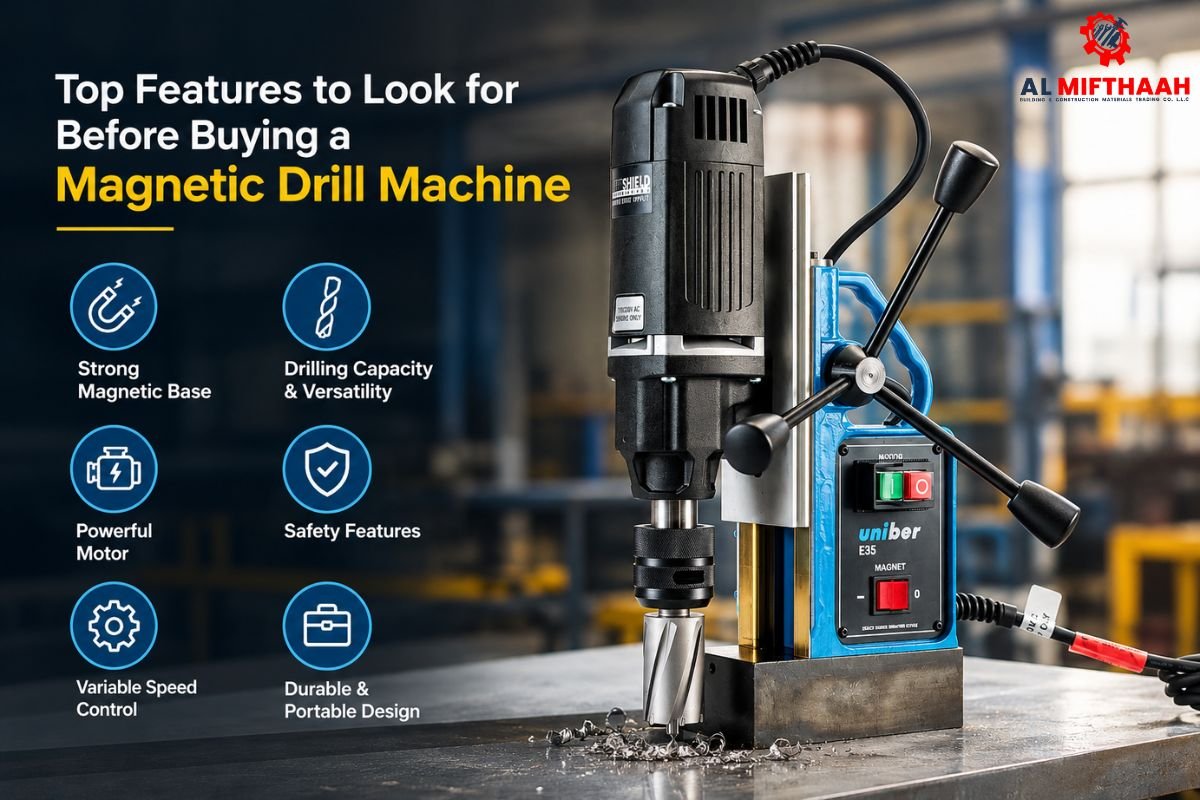
There are seven things to be mindful of before purchasing a magnetic drill machine: magnetic holding force, drilling capacity, power of the motor, speed control, shape of the annular cutter and fit of the arbor, safety features, and the warranty or support. You need to start with your own work. Write down the maximum thickness of the steel you drill, the largest hole you cut, and whether your job is done at the shop or at the structure.
Now you will be able to find the machine that fits the mentioned limits instead of getting the largest one in the store. If you compare magnetic drill machine dealers in Dubai, the checklist given in this article will help you to learn how to ask questions correctly and how to read a specifications sheet properly.
Table of Contents
ToggleKey takeaways
- The exposure of magnetic force and the thickness of the plate are interconnected. A potent magnet placed on thin or contaminated steel might still slide.
- The machine should be proportioned based on the largest hole that you commonly drill rather than a sporadic occurrence.
- The arbor determines which tools fit into it and thus decides on your manufacturing cost.
- Interlocks and other provisions, such as coolant and local service, play a role just as much as motor power.
What features matter most in a magnetic drill machine?
Each feature below affects one of two things: how well the machine does the job on the day, and how long it keeps doing it. The table gives the short version.
| Feature | What to check | Who needs it most |
| Magnetic holding force | Rated force (kg, N or lbs) and minimum plate thickness | Overhead, vertical and structural work |
| Drilling capacity | Max annular cutter diameter, cutting depth, twist drill size | Fabricators and contractors |
| Motor power | Watts or amps, speed under load, duty rating | Heavy fabrication, repeat holes |
| RPM and speed control | Variable or multi-speed, reverse function | Shops drilling mixed materials |
| Arbor and cutter fit | Weldon 19 mm, universal or taper, chuck size | Anyone buying cutters regularly |
| Weight | Machine weight, carry handle, case | Site crews and maintenance teams |
| Safety features | Magnet interlock, overload protection, strap, guard | Every user |
| Cooling | Coolant bottle or feed through the arbor | Production drilling, thick steel |
| Warranty and service | Warranty length, spare parts, local support | Industrial buyers |
How strong should the magnetic holding force be?
The magnetic base has two jobs. It keeps the machine on the steel, and it resists the twisting force of the cutter. When the base slips mid-cut, the cutter can jam or snap, and the operator can get hurt.
Specific sheets quote holding force in kilograms, newtons, or pounds. Compact machines often land between about 800 and 1,300 kg, and heavier ones go past 1,400 kg. Those are rated figures on clean, flat, thick steel. They are not a promise for every surface you will meet.
Check these before you buy:
- Minimum plate thickness- Most machines need roughly 10 to 13 mm of steel for full force, and thinner plate cuts the grip noticeably.
- Surface condition- Rust, paint, mill scale, oil, and swarf all weaken contact.
- Holes under the base- Drilling close to an existing hole shrinks the contact area.
- Base size and flatness- A larger flat base sits steadier on beams and columns.
However, if you drill overhead or on vertical columns, put this feature at the top of your list. Site contractors and structural fabricators fall in that group. The magnetic drilling machine dealers in Dubai are useful.
What drilling capacity do you actually need?
Capacity is the biggest hole the machine can cut and how deep it goes. Three numbers matter: maximum annular cutter diameter, maximum cutting depth, and twist drill capacity.
Rough classes:
- Light-duty: cutters up to about 32 mm, for sheet and light structural work.
- Standard industrial: up to about 50 mm, for general fabrication and maintenance.
- Heavy-duty: 60 to 90 mm and above, for thick plate, big holes and steel-frame jobs.
Buy a little above your normal hole size so the occasional tough job stays possible. Buying far above it means carrying extra weight and paying extra cost every day.
Compare cutting depth with plate thickness as well. A cutter with 25 mm depth won’t get through 40 mm plate in one pass.
Is more motor power always better?
Not always. Motor power, quoted in watts or amps, decides whether the cutter holds its speed when the cut gets hard. A machine in the 28 mm class commonly runs around 1,200 W, and larger capacities need more.
Look at speed under load, not only no-load RPM. A machine that bogs down in thick steel cuts slowly and wears cutters faster.
Two more checks:
- Power supply. Confirm the voltage, and find out whether your site generator can handle the start-up load. Weak generators cause voltage dips and nuisance trips.
- Duty rating. If you drill dozens of holes a shift, ask how the motor copes with continuous use.
Moreover, production fabricators care about this more than occasional maintenance users do.
How much do RPM and speed control matter?
Annular cutters generally run slower than twist drills, and large cutters run slower than small ones. Thick structural steel and stainless need lower speeds than mild steel plate.
Speed features worth having:
- Variable speed or a multi-speed gearbox for mixed materials
- Reverse, if the machine supports tapping
- Electronics that hold speed steady under load
A workshop that cuts stainless, alloy and mild steel in the same week gets the most from these. A crew drilling one material at one size can get by with a simpler machine.
Which annular cutter and arbor type should you look for?
The spindle or arbor decides which cutters fit. The most common is the 19 mm (3/4 inch) Weldon shank. Some machines use a universal shank, or a Morse taper with an adapter. Many mid-size models also come with a 13 mm chuck for twist drills.
Cutters wear out, so this choice follows you around. A standard Weldon shank lets you buy from many sources. A proprietary fitting can tie you to one source and one price.
Ask about pilot pins, cutter lengths, and spare arbors. When you compare drilling tools suppliers in UAE, check that they stock the cutter sizes you use most. It also helps if the supplier carries the best machine tools accessories in Dubai for your arbor, such as pilot pins, coolant adapters, and cutter sets, because that cuts your downtime.
Which safety features should be standard?
A magnetic drill is a heavy tool with a spinning cutter, and it often works above head height. Insist on these:
- A magnet interlock, so the motor won’t start unless the magnet is properly engaged
- Overload protection for when a cutter binds
- A safety strap or chain, in case the base lets go
- A cutter guard, which shields you from the cutter and the hot slug
- Clear magnet and motor switches that are easy to reach and hard to mix up
Furthermore, electromagnetic bases rely on electrical power, so ask what happens in a power cut. Some designs add protection for that case. Permanent magnet models keep their grip without power, but they need a controlled way to release.
Do cooling, weight, and portability matter?
Cooling comes first. Coolant fed through the arbor lubricates the cutter, clears swarf, and helps the cutter last longer. Look for a coolant bottle with a simple connection. Production drilling and thick steel benefit most.
Weight is the other half. Compact machines weigh around 12 kg, and 50 mm class machines are often heavier. A heavy machine is steadier but harder to haul up scaffolding.
Portability details worth checking:
- Built-in carry handle
- Hard case for storage and transport
- Smooth dovetail slide for easy feed
- Removable feed handles
Maintenance teams that move between locations should lean towards lighter units. Fixed-bay fabricators can accept extra weight for stability.
What should you check in warranty and service?
A magnetic drill earns its keep by running, so downtime costs money. Look past the warranty length and ask about:
- Spare parts such as carbon brushes, switches, and feed handles
- Local repair support and turnaround time
- Operator training on setup and safe use
- Warranty exclusions, such as misuse and wear parts
A long warranty only helps if someone nearby can honour it. Ask Almifthaah or any other supplier for the spare parts list before you commit. When you shortlist drilling tools suppliers in UAE, compare how fast each can get you a replacement part, not only how fast it can quote.
Common buying mistakes to avoid
- Buying on wattage alone and ignoring holding force
- Forgetting the minimum plate thickness on your real jobs
- Picking an arbor that limits your cutter choice
- Skipping the coolant system to save money
- Ignoring weight for overhead or high-access work
- Choosing the lowest price without checking spares and service
- Running worn cutters, which strain the motor and the magnet
How to choose among magnetic drilling machine dealers?
The machine is half the purchase. The seller decides how quickly you get cutters and spares, and whether anyone picks up the phone when something goes wrong.
When you compare the best drilling machine suppliers in Dubai, ask:
- Do they stock cutters and the best machine tools accessories in Dubai for the machines they sell?
- Can they explain the spec sheet in terms of your plate thickness and hole sizes?
- Is service available locally, and how long do repairs take?
- Do they offer more than one capacity class, so you aren’t pushed toward a single model?
Almifthaah, a Saif Precision tools supplier in UAE, works with industrial buyers on precision tools and abrasives. Whoever you buy from, get the full specifications in writing first.
Wrapping up
The right magnetic drill machine is the steel, hole size, and site fit. Begin with capacity and holding force and then consider cutter fit, safety features, and cooling. Consider how you will transport it, and ask for and verify warranties and service before payment.
Most of the options will be filtered quickly if you have a short note listing your thickest plate, largest hole, and power supply. It also helps in making the conversation with magnetic drilling machine suppliers in Dubai more useful and also helps you to distinguish best drilling machine suppliers in Dubai from the others.
To get a matching machine and cutters for your work, contact Almifthaah, a Saif Precision machine supplier in UAE, and send the thickness of your plate and hole sizes.
Frequently asked questions
It cuts holes in steel with its annular cutter held in place by a magnet. It is used by fabricators, welders, and maintenance workers in beams, plates, and pipes.
Use your most challenging job, like overhead or vertical drilling with big cutters. Larger cutters and positions that are not ideal require a higher rated force and thicker steel.
Most machines require approximately 10-13 mm to grip. Refer to the manual, as a thinner plate will reduce the hold, and some machines won’t start.
The base only grips ferrous steel. If it is aluminium or common austenitic stainless, it is not magnetic, so it needs to be clamped or fixtured.
An annular cutter removes a ring of metal and leaves a solid slug, and thus cuts faster with less power. A twist drill is for smaller hole sizes.
It is a cutter shank having flats that fit the arbor. The most popular size is 19 mm, so cutters are readily available.
It can be, as long as the base restricts it to clean, thick steel and the machine has a magnet interlock and a safety strap. Do not rely on the magnet to be entirely accurate.
Ensure warranty terms are documented and verify local spare parts and repair services. A quick call typically tells you how responsive a supplier will be.

How Long Do Mounted Points Last and When Should You Replace Them?
Everything You Need to Know About Tool Wear in Carbide Tipped Cutting Tools