
- August 5, 2026
- by Almifthaah
Role of Indexable Milling Cutters in High-Speed CNC Machining
Table of Contents
ToggleKey Takeaways
- Carbide inserts that can be replaced cut down on tooling expenditures and prevent the need to obtain new inserts as often.
- The correct balance of tools increases efficiency and keeps performance stable during fast speeds of CNC spindles.
- Using the right insert grades and coatings leads to better tool performance when working with hard materials.
- Dependable suppliers always have replacements on hand, which decreases downtime and prevents production delays.
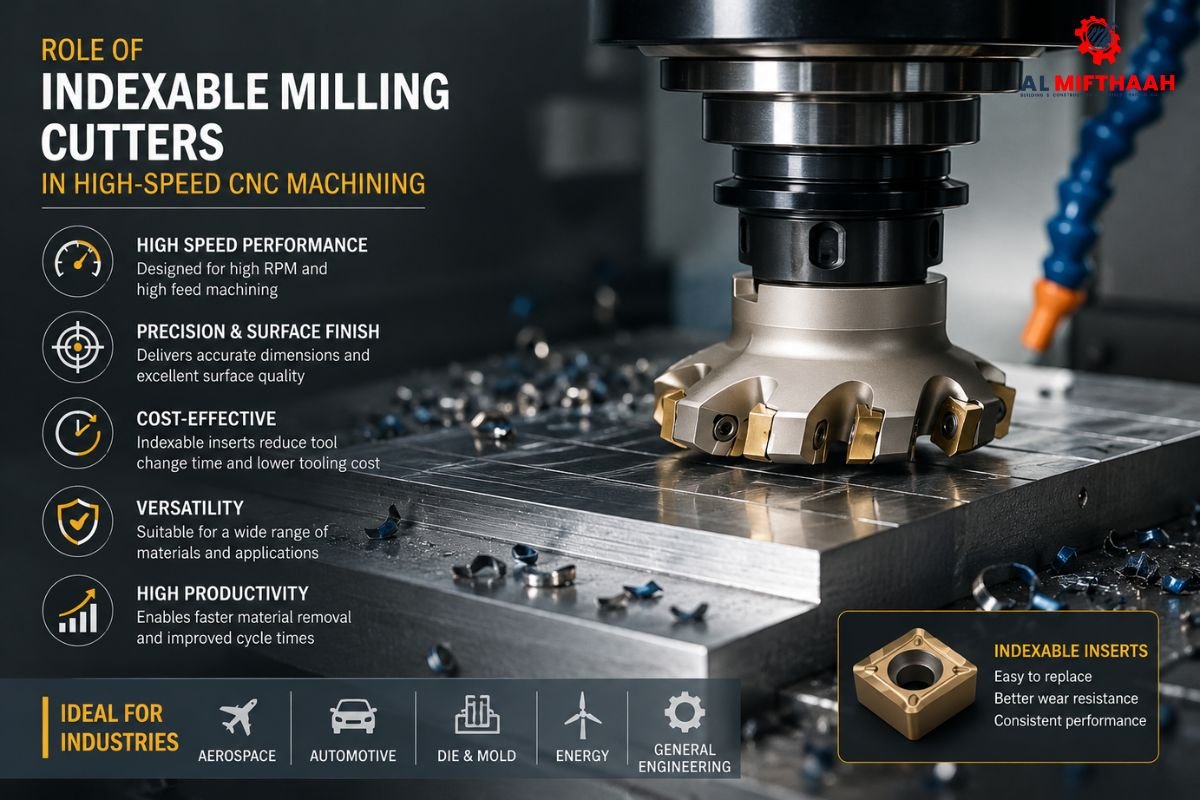
An indexable milling cutter is a tool body with replaceable carbide inserts bolted in. When the edge dulls, you rotate or swap the insert instead of sending the whole tool out for regrinding. That distinction matters more at high speed than at conventional feeds, because edges wear faster and every stopped spindle costs real production time. Most multi-shift shops in the UAE switched to indexable systems for this exact reason, not because it’s trendy tooling.
This piece covers what actually separates a decent insert from a bad one, why the split between tool body and insert works the way it does, and what to check before you commit to a supplier or tool line.
What makes indexable milling cutters different?
A solid carbide end mill is one piece, start to finish. Dull the edge and it either gets reground or scrapped. An indexable cutter splits that job: the body holds the geometry and mounts to the spindle, the insert does the cutting.
Rotate a worn insert to expose a fresh edge, four to eight times depending on the shape, and only replace it once every edge is gone. The body stays in the machine for years.
Moreover, that split is where the cost savings actually live. A body is close to a one-time buy. Inserts are the recurring cost, and on high-consumption jobs (roughing cast iron, stainless brackets, that kind of thing) the insert spend adds up fast. The best milling tools dealers UAE help to find the best one.
Why do they matter in high-speed CNC machining?
Push spindle RPM and feed rate up, and edge wear accelerates right along with it. Chips get harder to clear. Any imbalance in the tool body turns into chatter you can hear.
A few ways indexable tooling pushes back on that:
- A fresh insert edge cuts the same way every time. A resharpened solid tool doesn’t; geometry drifts a little with each regrind.
- Swapping an insert takes two minutes at the machine. Sending a solid tool out for regrinding takes days.
- Indexable bodies are built for high-RPM balance from the start, which matters more the faster you push the spindle.
I’ve watched shops switch from solid roughing tools to indexable face mills on aluminum aerospace parts and shave 15 to 20 percent off cycle time, mostly from running faster feeds without babysitting edge wear mid-job. Not a guaranteed number for every shop, but a realistic one for that kind of work. Saif Precision tools supplier in UAE is the reliable one.
Insert materials and geometries that affect performance
Grab the wrong insert grade and most of what indexable tooling gets you disappears.
- Carbide grade decides heat and abrasion resistance. Uncoated works fine on aluminum. Steel, stainless, titanium: you want a coated grade like TiAlN or TiCN, or the edge won’t survive the heat at speed.
- Geometry shapes chip formation and cutting force. Positive rake cuts lighter, better for soft or gummy materials. Negative rake is tougher, handles interrupted cuts and hard alloys, but eats more spindle power to do it.
- Chipbreaker design controls how the chip curls off the insert. Get that wrong at high speed and you’re recutting chips, which chews up both the finish and the insert edge.
- An Inconel bracket and an aluminum enclosure running three times the RPM need completely different inserts. This isn’t a fine-print detail. It’s the difference between an insert lasting its rated life and one that chips on the third pass.
Choosing the right cutter for your application
There’s no single best indexable cutter. It depends on material, whether you’re roughing or finishing, how rigid the machine is, and what tolerance you’re actually holding.
| Factor | What to consider |
| Material | Insert grade and coating need to match hardness and heat sensitivity |
| Operation type | Roughing wants durability; finishing wants a sharper edge and geometry |
| Machine rigidity | Older or lighter machines can struggle with aggressive negative-rake geometries |
| Insert availability | Confirm inserts are stocked locally, not just the tool body |
That last row catches more shops off guard than it should. The body is a one-time purchase. If your milling cutter dealers in Dubai don’t stock the specific insert grade, you’re waiting on an international shipment every time you need a refill, which erases the whole point of quick tool changes.
Common mistakes shops make with indexable tooling
- Running an insert past its edge life instead of rotating it early. The surface finish usually degrades before the wear is visible on the insert itself.
- Skipping the torque specific on insert screws. Under-torqued, the insert shifts during cutting and wears unevenly, sometimes fractures. Over-torqued, you crack the insert pocket in the body.
- Mixing insert brands on one tool line. Pockets are machined to tight tolerances specific to each brand’s geometry. A different brand’s insert, even with a matching ISO code, can seat wrong and throw off runout.
- Buying on price per insert alone. An insert that costs less but lasts a third as long isn’t actually cheaper once you count the changeover time and the scrap risk.
Maintenance and tool life practices
Long, predictable insert life comes down to a few habits, not one trick.
- Clean the pocket before every insert change. Leftover chip debris tilts the new insert slightly, and that throws off the geometry from the first pass.
- Track wear against cycle count instead of relying on the eye test. By the time wear is visible, the surface finish has usually already started slipping.
- Store spare inserts properly. Humidity and rough handling chip carbide edges before the insert ever cuts anything, and that’s a cost nobody notices until the tool underperforms out of the box.
Finding a reliable supplier
None of this matters if you can’t actually get stock when you need it.
- A dependable indexable milling cutter supplier in Dubai does more than sell tools. Technical support on matching insert grade to material, realistic lead times on replacement stock, a history with shops doing similar work. Manufacturing across the UAE, automotive parts to structural fabrication, leans on that kind of supply chain more than most buyers think about until it fails them.
- Comparing indexable milling cutter UAE suppliers, ask about stock on your specific ISO codes, not just how big the catalog looks. A wide range with thin stock on your actual grade doesn’t fix your downtime problem.
- Some buyers check adjacent product lines too. A supplier that also runs something like a Saif Precision tools supplier in UAE relationship tends to have wider industry connections and can chase down harder-to-find grades faster.
Bottom line
Indexable milling cutters solve a specific problem in high-speed CNC work: keeping edges fresh without the downtime of regrinding or replacing whole tools. That shows up most in high-volume or multi-material shops, where insert consistency drives cycle time and part quality directly. Getting the value out of it means matching grade to material, respecting torque specs, and finding a supplier who actually has what you need in stock.
If your current tooling setup is giving you recurring wear problems, Almifthaah works with shops across the UAE on this exact kind of tool selection and supply. Worth a conversation before your next order.
Frequently asked questions
Solid carbide is one piece, reground or scrapped when dull. Indexable tools separate the body from the insert, so only the insert gets replaced.
Four to eight edges usually, depending on the insert shape. Once every edge is worn, replace the insert; the body stays in service.
Yes, with the right insert. Finishing inserts run sharper, more positive geometries for a better surface finish than roughing inserts, which are built to survive abuse.
Wrong grade for the material, weak coolant flow, bad feed rates, or debris sitting in the insert seat. Any one of those alone can chip an edge early.
Better not to. Pockets are machined tight to each brand’s geometry, and a mismatched insert can seat wrong, which throws off runout.
Something like TiAlN cuts down heat transfer into the insert and resists abrasion, which stretches tool life noticeably on steel, stainless, or anything that runs hot at speed.
Local, if you can. Milling cutter dealers in Dubai usually mean faster replacement stock and less downtime, which tends to beat whatever you’d save ordering internationally.
Depends on insert size and manufacturer. Pull the actual datasheet for that tool body instead of guessing from a general number.
Aluminum too, especially with positive-rake, uncoated or PVD-coated inserts built for non-ferrous work. They cut down built-up edge and leave a cleaner finish.
Check if they stock inserts for your specific ISO codes, whether they’ll actually talk through insert selection with you, and if they’ve got a track record with shops doing work like yours.

How Long Do Mounted Points Last and When Should You Replace Them?
Everything You Need to Know About Tool Wear in Carbide Tipped Cutting Tools