
- September 1, 2026
- by Almifthaah
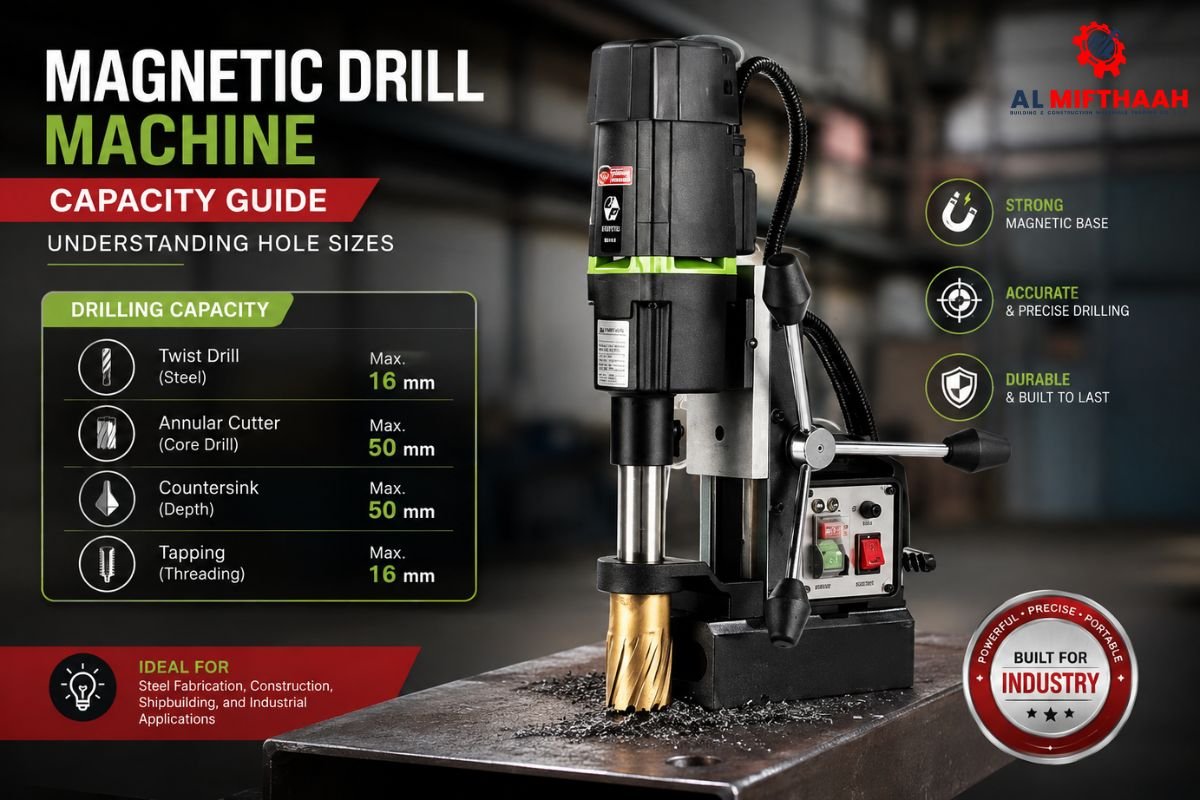
Magnetic Drill Machine Capacity Guide: Understanding Hole Sizes
A magnetic drill’s capacity is the largest size of hole and thickness of steel that it can slice through, always clearly presented on the spec sheet in millimeters, such as 32mm, 50mm, 100mm, along with the wattage of the motor and magnet hold force. While a larger number means a stronger magnet that provides more torque, it also requires a bigger and heavier machine to transport from one job site to another.
In the UAE market, a machine with a capacity of 35mm to 50mm is suitable for the majority of fabrication and structural steel projects. However, you will need to consider that cutting a plate thicker than 20mm and drilling through steel thicker than 50mm will require a heavy-duty machine.
Table of Contents
ToggleKey takeaways
- The capacity of the tool relies heavily on the size of the hole, thickness of the material, and the force the magnet holds.
- Annular cutting tools generate big holes easily even when the hole diameter is more than 20mm.
- When working with thin curved steel, the magnetic hold is expected to be substantially weaker.
- Dependable suppliers from the UAE supply spare cutters and magnets, thus minimizing downtime with the use of the machine.
What “capacity” actually means on a magnetic drill?
Every magnetic drill contains its own capacity rating, which includes aforementioned diameters such as 25mm, 32mm, 50 mm, and so forth. It also shows the drill’s capability for maximum depth, which shows you how large the hole your drill can manage to create with the help of your spindle and gearbox.
However, there is no mention of the magnets’ capability in the description of the drill. That is why the grinder which would be rated for 50mm diameter in thick and flat mild steel used in the factory could not work properly at all when dealing with rusted steel and curved surface. Buyers often confuse capacity figures of different drills, forget about magnet specifications, and then complain that one machine is not better than the other one. The best drilling machine suppliers in Dubai will provide the best one.
Motor power and magnet force: The numbers behind the rating
A capacity number refers to the maximum wattage that the machine’s motor can produce. It also takes into account the force produced by the magnet. The entry-level machines come with motors that produce anything between 1,200W and 1,600W, and the force of the magnets is between 1,200 kgf and 1,500 kgf. This is suitable for 25 mm to 32 mm deep cuts on flat steel of 6 mm thickness or more. Medium-range machines use motors of capacity from 1,800W to 2,000W and magnets of 1,800 kgf to 2,000 kgf, which can easily be used for cuts of 35 mm to 50 mm depth.
Furthermore, heavy industrial machines designed for shipbuilding or pipeline and thick plate formation can have a motor rated at 2,200W or more with dual magnets of the pole number exceeding 2,500 kgf, as they are intended to be used for holes of 100 mm and more. This does not mean that one can easily increase the power of the motor. It is crucial to ensure that both parameters are matched correctly since one can increase the torque capacity of the machine without upgrading the design, which leads to a serious safety risk while using the machine in the vertical position.
Twist drills vs annular cutters: why capacity changes by cutter type
The same equipment provides two different operational capacities based on the material loaded into the equipment. A twist drill creates cuts all over the hole’s cross-sectional area and therefore outputs sizable amounts of torque and heat as the diameter increases. After about 20 millimeters past that, the process of twist drilling starts moving slowly and with difficulty.
Annular cutters, or so-called core drills, only make a cut around the hole while ejecting the metal plug and thus not cutting through the metal. This is how a drill with a 50mm capacity can bore much larger holes than a twist drill would allow. The top HSS Annular Cutters suppliers in Dubai produce cutting depths of 25mm to 100mm, and the right match of depth with the kind of material will save time and resources. HSS annular cutters handle soft and hardened steel adequately, but carbide drills are pricier.
Matching machine capacity to steel thickness
Capacity charts assume a single clean pass through solid steel of a given thickness. Most structural work falls into three rough bands. Sheet and light gauge under 10mm runs fine on smaller 25-32mm machines with lighter magnets, since portability matters more than raw force here. Standard structural fabrication, roughly 10mm to 25mm, is where most Dubai construction and metal fabrication work actually sits, and it’s the sweet spot for 35-50mm capacity machines.
Heavy plate and multi-layer cutting above 25mm needs the 65mm-100mm class, plus pilot pins and coolant to manage the heat. Forcing a bigger cutter through a mid-range machine to push past its thickness band doesn’t get the job done faster. It usually ends in a burnt motor or a snapped cutter.
Capacity comparison by machine class
| Application | Typical Thickness | Recommended Capacity | Cutter Type |
| Sheet metal, brackets | Up to 10mm | 25-32mm | Twist drill or small annular |
| Structural steel, beams | 10-25mm | 35-50mm | HSS annular cutter |
| Heavy plate, shipbuilding | 25mm+ | 65-100mm | Carbide annular cutter |
| Pipeline, thick flange | Variable, deep bore | 100mm+ | Carbide, multi-pass |
Common mistakes when buying by capacity alone
The most common error is buying on the biggest printed number without checking magnet holding force against the surfaces the machine will actually sit on. A 50mm-rated machine is only as good as its ability to stay clamped on curved pipe, painted steel, or thin sheet, where it never gets the full magnetic footprint the spec sheet assumes.
Additionally, the second is ignoring cutter depth against material thickness. Too shallow, and you’re making multiple passes and burning time. Too deep, and you’re paying for capacity you’ll never use. Duty cycle gets underestimated too. A machine that handles the occasional 40mm hole fine can overheat fast if it’s running that size all shift. High daily volume usually means sizing up the motor class, not just the capacity rating.
Choosing the right supplier for your application
Capacity numbers only mean anything if the machine and cutters actually perform to spec once they’re on your job. Supplier reputation matters more here than most buyers expect going in. Genuine magnetic drilling machine dealers in Dubai, not generic hardware resellers, sell machines that are properly rated, backed by warranty, and matched to what you’re actually doing, rather than whatever happens to be sitting in stock.
Therefore, aftercare matters just as much. Magnets weaken, brushes wear, cutters need replacing on a schedule, so having best drilling machine suppliers in Dubai who keep spares on the shelf locally cuts the downtime that comes from waiting on an imported part. For a shop running several machines across different sites, that local stock often saves more than any discount on the initial purchase.
Expert insight
The machines that fail early on Dubai fabrication sites usually aren’t underpowered. They’re mismatched. A 32mm machine bought because it was cheaper, then run daily through 40mm structural holes, burns out its motor and gearbox far faster than a correctly sized 50mm unit would have from day one.
Almifthaah sizes machines against the actual project spec instead of a catalog assumption, and that’s a big part of why the same customers keep coming back for both machines and consumables. As a Saif Precision tools supplier in UAE, the priority stays on matching cutter grade, motor class, and magnet strength to whatever the client is actually cutting, not moving units off a shelf.
Final verdict
Magnetic drill capacity was never a single number you could shop by. It’s motor power, magnet holding force, and cutter type working together against the steel in front of you. A machine that looks oversized on paper can underperform on curved or thin material, while a mid-range unit paired with the right annular cutter can outlast something bigger pushed past its limits. Drilling tools suppliers in the UAE give the appropriate one.
If you’re weighing options for an upcoming project, Almifthaah can help match capacity to your actual application instead of a guess off a spec sheet.
Frequently asked questions
It’s the largest hole diameter and material thickness the machine can cut reliably, based on motor power, magnet holding force, and the cutter in use.
Not safely. Pushing past rated capacity strains the motor, overheats the magnet, and risks the cutter breaking or the machine lifting off the surface.
They only remove a ring of material instead of the full cross-section, which needs far less torque and heat than a solid twist drill of the same diameter.
They matter together. A strong motor paired with a weak magnet is actually more dangerous, since the machine can shift or detach mid-cut on curved or thin steel.
Most work between 10mm and 25mm thickness runs well on a 35mm to 50mm capacity machine with HSS annular cutters.
It depends on material hardness and how much you’re running, but visible tooth wear, slower cuts, or excess heat mean it’s time to swap the cutter before it damages the gearbox.
On abrasive or high-tensile steel, yes. Carbide holds an edge much longer, which offsets the higher upfront price once you’re cutting that material regularly.
Buying off the largest printed number without checking whether the magnet’s holding force and duty cycle actually match daily job conditions.
Not really. Machines built for portability and light gauge work don’t carry the motor or magnet class heavy plate cutting needs, and the reverse is true too.
Established drilling tools suppliers in the UAE with local stock and real technical support, Almifthaah among them, are a safer bet than generic importers with no aftercare.

How Thick Should Copper Shim Stock Be for Electrical Busbar Connections?

How to Select an Involute Gear Cutter by Module and Number of Teeth