

- November 12, 2026
- by Almifthaah
How to Select Copper Shim Thickness for Heat Sink Contact Interfaces
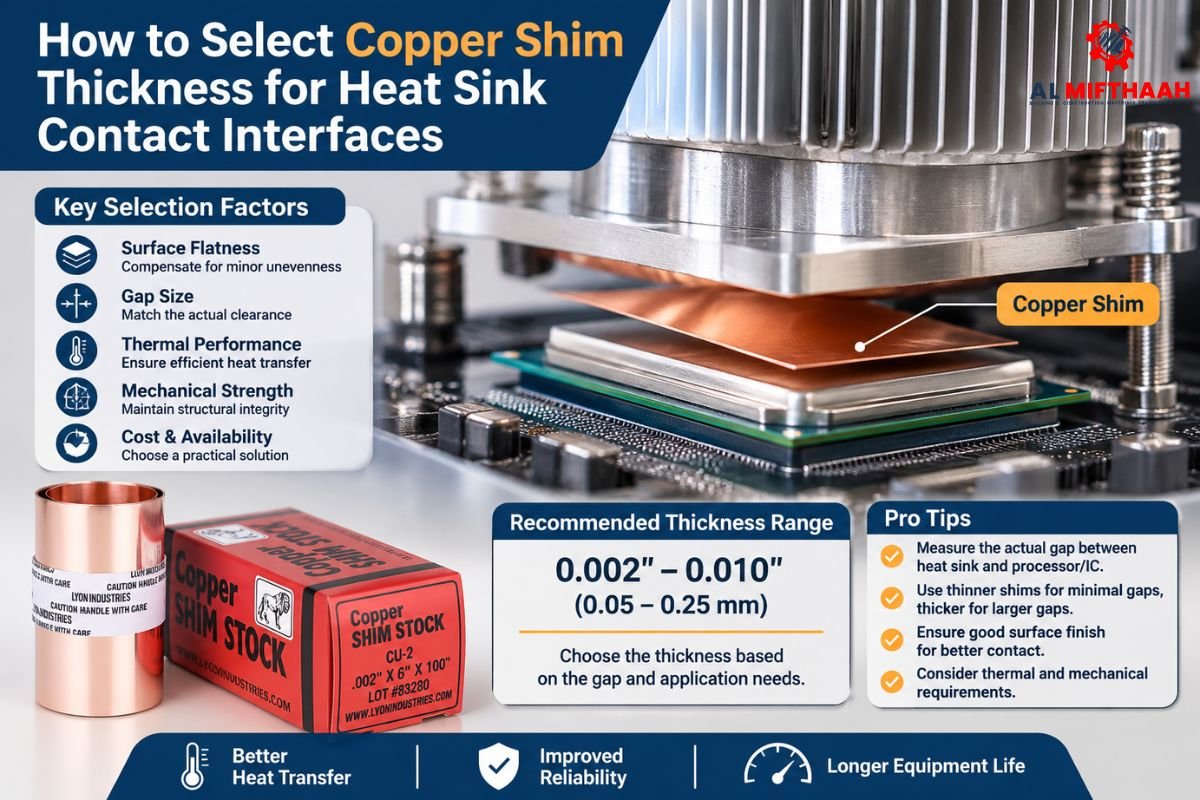
To select copper shim thickness for a heat sink contact interface, one would want to use the thinnest copper shim to fill the gap or correct the flatness error between the heat sink and the component being assembled, but thick enough to provide sufficient clamping force to seat both surfaces firmly. Copper is one of the best heat conductors among all the metals, but every extra fraction of a millimeter adds thermal resistance.
Thermally, in most of the electronics and power assemblies shims between 0.05 mm and 0.3 mm are the most common. The final call will depend on surface flatness, the force applied by the bolts, and the thermal interface material used. This guide takes the engineers in Dubai through the calculation and selection process, and finally the different sourcing options.
Table of Contents
ToggleKey takeaways
- Make sure to use the thinnest copper shim that fits the gap you measured; do not use a thicker shim unless the design calls for it.
- Estimate bulk resistance using the formula R = t / (k × A), and add in interface layers.
- Place a thin and even amount of thermal interface material between the shim and the washer, and tighten to the designated torque.
- Source shims and measuring tools from suppliers that provide certificates, tolerance data, and calibration records.
What is a copper shim in a heat sink contact interface?
A copper shim is a thin, flat sheet of copper between a heat-producing item and a heat sink. It is meant for filling in small spaces, changing the mounting position, or enhancing the thermal path between surfaces that don’t fit together as well as they should. Copper is used by engineers because it has one of the highest thermal conductivities of any commercial metal, approximately 390 W/m·K at room temperature.
Therefore, shims are frequently seen in power modules, in laser diode assemblies, in industrial drives, and even in high-density control assemblies. In these assemblies, even an insignificant air gap can lead to a high temperature rise, due to the poor thermal conductivity of air. The right kind of copper shim eliminates that air gap, providing heat with a low-resistance path to the heat sink.
Why does shim thickness matter for heat transfer?
Thickness influences the heat flow in two directions. The thicker the shim, the wider the gap, but also the more conductive material there will be for heat to conduct through. This leads to a compromise between gap filling and thermal resistance.
Thermal resistance of a flat shim is related to it simply:
R = t / (k × A)
The thickness, t, is in metres; thermal conductivity, k, is a constant; contact area, A, is the area of the contact surfaces. The table below shows the bulk resistance of a copper shim with a 25 mm × 25 mm contact area and k = 390 W/m·K.
| Shim Thickness | Bulk Thermal Resistance (K/W) | Typical Use Case |
| 0.05 mm | 0.00020 | Very flat, precision-machined surfaces |
| 0.10 mm | 0.00041 | Light gap correction with good flatness |
| 0.20 mm | 0.00082 | Moderate height or flatness errors |
| 0.30 mm | 0.00123 | Larger gaps or warped mounting surfaces |
These values indicate only the self-resistance of the copper. The thermal interface material is as important as the actual shim since each contact face represents a resistance to the flow.
How do you calculate thermal resistance of a copper shim?
Use the contact area and the thickness of the shim, and divide the thickness by the product of conductivity and area. A 0.2 mm thick copper shim with an area of 625 mm² yields approximately 0.00082 K/W. Given that the maximum power dissipation for your component is 100 W, the temperature difference across the shim is approximately 0.08 °C. That number is small, and is the reason why many designers are more concerned about grease layer and surface contact contributions.
This is the point at which the calculation is more significant at a higher power. With 500 W or higher, a varying resistance of just a few ohms can accumulate over time and cause the junction temperature to noticeably increase with a thick shim that has been used out of habit.
How do you choose the right copper shim thickness?
The choice of thickness is a measurement of the problem, calculation of impact, and then testing. Follow these steps:
- Use a dial indicator to measure gap or flatness error on a surface plate and use feeler gauges to check the clearance at each mounting point.
- Refer to the component datasheet and calculate the temperature rise you can tolerate for your component and the power dissipation you expect.
- Choose the thickness of the shim that is approximately equal to the gap. Use a slightly thicker shim only to compress it to fit the shim in the design.
- Find the bulk thermal resistance and see how it relates to the thermal budget.
- Ensure mounting pressures and bolt torques are in accordance with the manufacturer’s specifications.
- Construct a prototype and use a thermocouple or thermal camera to determine the case or junction temperature.
What gap or flatness problem are you solving?
The shim should be a replica of the problem. A thick shim will raise the component, cause stress to solder joints, or cause a ceramic substrate to warp. A thin shim will leave gaps which can catch heat. Measure before choosing.
How does mounting pressure affect the choice?
Copper is a soft material and easily bent when clamped. The pressure should be sufficient to ensure good conformance between the two surfaces and to minimize contact resistance. If the pressure is too great, however, the brittle components may break, or the heat sink may be bent. Operate within the mounting specification and apply a torque wrench with a known sequence for multi-bolt assemblies.
Which thermal interface materials work with copper shims?
A copper shim is not likely to be used alone. There are still micro peaks and valleys on both surfaces which retain air, and this typically requires a layer of thermal material. The most common choice is thermal grease, which should be easy to apply, and it will fill up small irregularities. In production, the phase-change pads are very helpful since they remain in place while working with the material. Low-pressure designs can be achieved with graphite pads or thermal tapes, depending on how well these work in the assembly.
Apply grease sparingly. A thick layer will have the effect of increasing resistance, not decreasing it. Apply a thin, even coating on each contact surface, and then clamp to torque. Never reuse grease – contamination diminishes effectiveness.
Where can you source shims and measuring tools in Dubai?
Quality shimming is dependent on quality supply. Most of the engineers in UAE normally get copper shim stock from the home country and check the thickness before using it or the quality of the material. A good supplier should be able to supply material certificates, thickness tolerance data, and small-quantity cutting for prototypes.
Almifthaah, which also operates under the Saif Precision tools supplier in UAE for industrial tools and abrasives. If teams require measuring equipment in addition to shim stock, having a single supplier can streamline the process of procurement and delivery. Evaluate quotes for tolerance, certification, and lead time, not just cost.
What should you look for in shim stock suppliers?
Consider asking for mill test certificates or similar material documentation when you are assessing shim stock suppliers in Dubai. Check the copper grade and temper, as the annealed copper can be compressed more easily than harder grades.
Additionally, ask the supplier for thickness tolerances, typically plus or minus numbers, and inquire if the supplier can do custom widths. In the initial phase of testing during the design process, it is helpful to use a wide thickness range of shim stock supplied by a Lyon shim stock supplier in Dubai.
Which precision instruments and measuring tools do you need?
It is impossible to select accurately unless you measure accurately. A basic tool kit consists of a micrometer for checking the thickness of a shim, a feeler gauge for checking clearance, a dial indicator with magnetic base for flatness, and a surface plate for reference. A digital thermometer or thermocouple is also used by many engineering teams to check results. Be sure to find precision instruments suppliers in Dubai that will offer calibration certificates because uncalibrated tools can cause errors greater than the tolerance of the shim.
Furthermore, machine measuring tools dealers in Dubai provide calibration services, spare parts, and replacement gauges for workshops that have to update or replace existing equipment. It is important to make sure calibration is done regularly, usually once a year and after any falls or heavy usage.
| Item | Purpose | What to Check |
| Copper shim stock | Gap filling and height correction | Purity, thickness tolerance, temper |
| Micrometer | Measuring shim thickness | Calibration certificate, resolution |
| Feeler gauges | Measuring clearance | Blade accuracy, material hardness |
| Dial indicator and stand | Checking surface flatness | Resolution, stand rigidity |
| Surface plate | Reference flat surface | Grade, levelness, cleanliness |
What common mistakes should you avoid?
There are some common error types that occur repeatedly in assemblies of heat sinks.
- The first one is picking shim thickness based on habit, not on measurement. A flattish shim may not fit a product that is not flattish when it is pressed into place.
- The second error is to use too much thermal grease. Too much material will make the assembly harder and can extrude onto other parts.
- The third one is ignoring surface finish. To prevent high contact resistance, the contact faces should be cleaned with an appropriate solvent prior to assembly.
- Engineers occasionally overlook the fact that copper can harden when it is clamped over and over. Removing and replacing a shim could cause it to lose its flatness and compressibility. Be sure to use new shims in every assembly that is critical for reliability.
- Finally, do not use uncalibrated instruments. With poorly sourced gauges, teams purchasing cheap gauges may be reading a 0.10 mm shim as a 0.13 mm, and this could significantly affect the thermal results. Confirm Dubai precision instrument suppliers and maintain precision instrument calibration records.
How does Dubai’s climate affect copper shim performance?
The high ambient temperatures, humidity, and salt content in the air have an impact on both assemblies and materials in Dubai. Enclosures may heat up more in the summer and thus leave less headroom for heat sink performance. Exposed copper and aluminium surfaces are susceptible to accelerated oxidation in coastal environments and may require a protective coating or enclosure.
Moreover, regional design teams should design with a greater thermal safety than teams would in a cooler climate. Verify that greases and pads are suitable for continuous high-temperature applications and that shim surfaces are kept clean during installation in dusty applications. Local stockists with experience, such as machine measuring tools dealers in Dubai will be able to suggest materials that will work well in the long run.
Final verdict
The thickness of the copper shim used between a heat sink and interface is not a guess; it’s a measurement. First, map the gap or flatness error and then determine the thermal resistance and choose the thinnest shim that will close the gap with the proper compression. Use it with an appropriate thermal interface material, test with prototypes, and ensure that all measuring devices are calibrated.
This process is quicker and more predictable for engineers in the UAE when it comes to reliable sourcing. Those working with a trusted partner for Shim Stock suppliers in Dubai and a reliable supplier of measuring and workshop equipment in the UAE can ensure that their teams are able to progress from design and testing to assembly with minimal delays. A small amount of time spent on measurement and sourcing will actually save a lot of time when troubleshooting.
Frequently asked questions
Generally, yes, thicker copper resists better, but a shim so thin as to not fill gaps will leave the air which insulators.
Usually, thin thermal grease or a phase-change pad will suffice, as it will seal minute surface gaps.
Use a dial indicator to set flatness on a surface plate and use a feeler gauge to check clearance at mounting points on a surface plate.
Find out where locally some sell material certificates, thickness tolerance data, and can cut small quantities for prototypes.

How to Identify the Correct Gear Cutter When the Markings Are Missing

Carbide Tool Maintenance Tips Every Machinist Should Know