
- October 1, 2026
- by Almifthaah
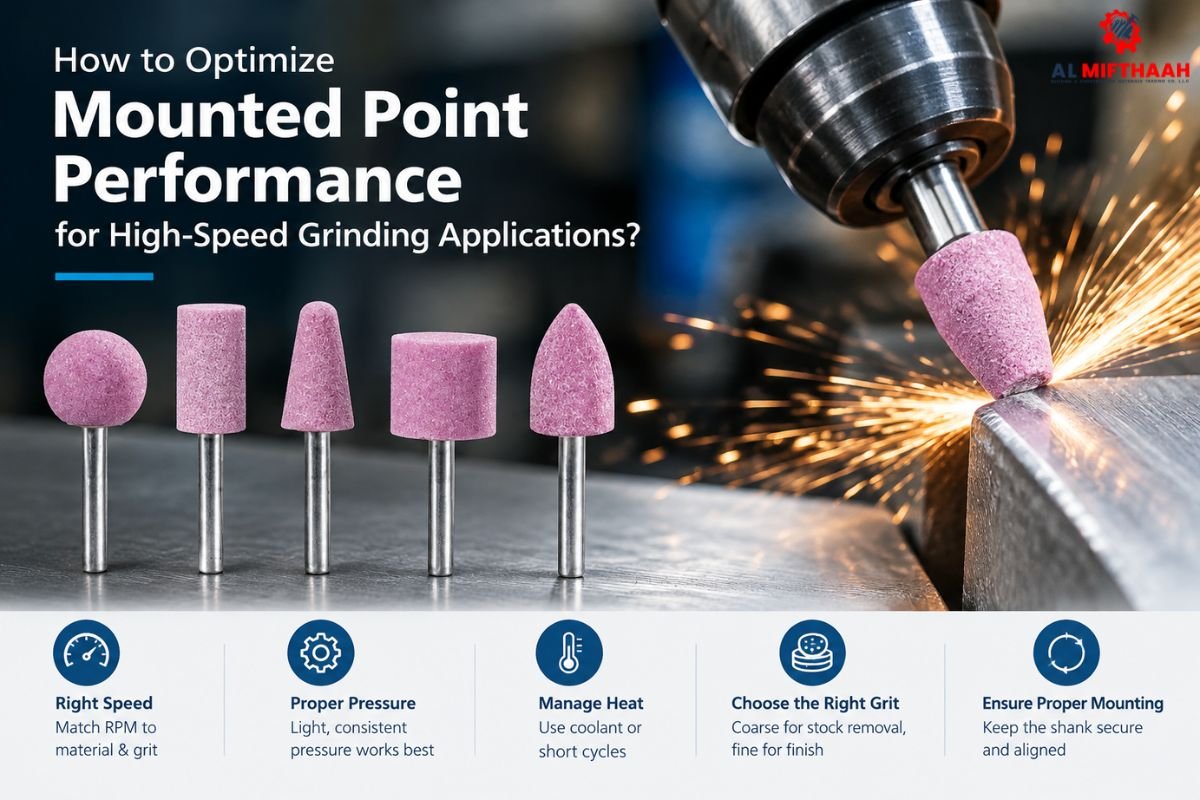
How to Optimize Mounted Point Performance for High-Speed Grinding Applications?
To maximize mounted point performance when used in high-speed grinding, ensure that the point is not operated above its stipulated RPM, the abrasive used is appropriate for the workpiece, the shank is kept short and straight, only light pressure is applied, and the point is dressed or replaced whenever it gets loaded or deformed. Following all of these recommendations consistently will result in quicker material removal, superior finishing, fewer broken points, and a safety-conscious operation.
Therefore, mounted points are small components that usually revolve at high speeds. A slight shank bend, an incorrect grit, or excessive pressure may result in process issues such as chatter, burned metal, or point destruction. Most of the above-mentioned problems arise as a result of the mistakes made before the grinder is turned on.
Table of Contents
ToggleKey takeaways
- The shank stick-out should be maintained at a minimum, and the RPMs should remain the same as indicated on the point.
- Select the pick shape to match the specific material, and not the one already in the tool drawer.
- Use light pressure, have a clean cutting face, and dress on time in order to produce better results than brute force.
- Remember to test-run and inspect each point carefully, making sure to use full PPE. With small points, failure generally happens quickly and without warning.
What does optimizing mounted point performance mean?
Mounted points are small abrasive heads bonded to a steel shank. They run in die grinders and flexible shaft machines, and you see them in weld cleanup, deburring, internal bores, die and mold finishing, and casting work.
However, optimizing means balancing cut rate, tool life, surface finish, and operator safety. You rarely improve one without paying for it somewhere else. Running above rated speed may cut faster for a few seconds, but the odds of a breakage jump. What you want is the fastest cut that stays safe, with a point that holds steady and a finish that repeats from part to part.
How to choose the right mounted point?
- Shape and size
Shape decides where the point can reach. Cylinders suit flat faces and walls, balls fit concave areas and radii, cones get into corners, and tree or flame shapes follow contours.
Pick the largest diameter the job allows. A bigger head has more abrasive to wear through, runs steadier, and makes more even contact. Check the shank against your collet as well. The 3 mm and 6 mm sizes are the common ones, and the 6 mm shank flexes less on heavier work.
- Bond and grit
Vitrified bonds hold their shape and cut freely, so they suit precision work and stock removal. Resin and rubber bonds give a little, which helps when you are blending or finishing.
Grit is easier to think about in rough bands:
- Coarse, about 30 to 60, for fast stock removal and weld cleanup
- Medium, about 80 to 120, for blending and general deburring
- Fine, 150 and above, for final finishing
Order against a proper spec sheet. Any abrasive tools supplier Dubai that buyers rely on should be able to give you maximum RPM, grit, bond, and dimensions for each point. Choosing on shape alone is how mismatched tools end up on the bench.
Setting the correct speed and RPM
Every mounted point has a maximum operating speed, usually printed on the point or its packaging. It depends on head diameter, bond type, and shank length. Treat it as a ceiling.
What the abrasive actually feels is surface speed: diameter times pi times RPM. A small head has to spin faster than a large one to reach the same surface speed, which is why a 6 mm point can be rated for tens of thousands of RPM and a 50 mm head for far less.
A few rules that save points:
- Never exceed the marked RPM, even if the grinder can go faster.
- Keep the overhang short. Rated speeds assume limited exposed shank, and a long stick-out flexes and whips.
- Seat the shank deep in a collet that matches its diameter exactly.
- Measure actual speed. Air grinders can overspeed at the wrong pressure and sag under load, so fit a regulator and use a tachometer where you can.
Running too slow causes trouble too. The bond does not wear away the way it should, so the point glazes, cuts poorly, and invites you to push harder.
Matching the abrasive to the material
The grain has to suit the workpiece. Get it wrong, and you get loading, burning, or a cut that never really starts.
| Material | Suitable abrasive | Practical note |
| Carbon and alloy steel | Aluminum oxide | General purpose weld cleanup |
| Hardened tool steel | White aluminum oxide | Cuts cooler, less burning |
| Stainless steel | Ceramic or iron-free aluminum oxide | Light passes limit heat tint |
| Cast iron | Silicon carbide | Handles brittle, abrasive surfaces |
| Stone, glass, ceramics | Silicon carbide or diamond | Use lower pressure |
Aluminum and brass clog abrasive points quickly. On those metals, and on heavy weld removal, a carbide burr usually cuts cleaner and lasts longer. If you go that route, look for a carbide burr supplier in Dubai UAE that lists cut type, shank size, and head shape clearly.
Furthermore, on stainless, use points labeled iron-free and sulfur-free so you do not contaminate the workpiece.
Checking point and tool condition
Most mounted point failures are decided before the grinder is switched on. Check each point first:
- Cracks, chips, or a head that is loose on the shank
- A straight shank
- Any history of being dropped, soaked, or stored somewhere damp or hot (discard those, especially resin-bonded types)
- A clean, unworn collet
Then mount it and spin it slowly to look for wobble. Run it at full working speed for about 30 to 60 seconds with your body out of the line of the tool. A hidden flaw usually shows itself in that first minute.
Additionally, look after the grinder too. Worn bearings and dirty collets add runout, and runout shortens point life.
Pressure and grinding technique
Let the abrasive cut. Too much pressure bends the shank, overheats the point, and clogs the surface.
- Bring the point to the work already at full speed, and avoid impact.
- Use light, steady pressure and keep the tool moving.
- Use the part of the head the point was designed for, and do not plunge into narrow slots where it can jam.
- Avoid levering sideways, which loads the shank.
- Lift off the work before you stop the tool.
If you feel the urge to press harder, the cause is usually the wrong grit, low speed, or a loaded point. More force will not fix any of them.
Cooling and dressing
Managing heat
Most mounted point work is dry, so heat control comes down to technique. Use short passes, let the workpiece cool, and do not linger in one spot. Heat tint on stainless or blue marks on tool steel means you have overheated it.
Wet grinding can improve finish and extend life when both the point and the grinder are rated for it. Check the manufacturer’s guidance first, because some resin bonds react badly to coolant. Never dunk a hot point in water. Thermal shock can crack it.
Dressing and restoring the cut
A shiny point that cuts slowly is glazed. One with metal smeared across its face is loaded. Both need dressing.
- Use a dressing stick or diamond dresser at working speed.
- Keep contact light and take off just enough to expose fresh grain and restore the shape.
- Retire the point once the head is worn close to the shank or the shape will not come back.
Dressing buys you more life, but it will not rescue the wrong grit or the wrong speed.
Safety rules for high-speed grinding
Mounted points are rarely guarded, so protecting yourself matters more.
- Wear safety glasses with side shields plus a face shield, hearing protection, and a respirator suited to the dust.
- Keep loose gloves, sleeves, and jewelry away from rotating tools.
- Clamp the workpiece so both hands stay on the grinder.
- Keep sparks away from flammable material and make sure the area is ventilated.
- Do not use a point above its rated RPM or with a damaged shank.
- Follow the manufacturer’s instructions and recognized standards such as EN 12413 for bonded abrasive products.
Moreover, store points in their original packaging, dry and protected from knocks. Points loose in a toolbox chip and crack. Saif Precision tools supplier in UAE will give you the right advice.
Practical optimization tips
A checklist worth keeping near the bench:
- Compare the grinder’s real speed with the point’s rated RPM before mounting.
- Keep the overhang short and clean.
- Choose the largest head that fits.
- Change grit when the finish stops improving, not after the point is used up.
- Keep a few shapes and grits within reach so the tool fits the job instead of the other way round.
- Count how many parts each point finishes, and replace on that number.
Sometimes the answer is a different tool. Mounted points are best for small, precise areas. On larger surfaces and blending work, flap wheels give a more even finish. Many buyers searching for a high-quality flap abrasive wheels supplier in Dubai are solving exactly this: a mounted point is being asked to do a job a flap wheel handles faster.
When sourcing, ask any abrasive tools supplier Dubai shops use for data sheets that show RPM ratings, and pick one who can explain them. Almifthaah, a Saif Precision tools supplier in the UAE, works with industrial buyers on precision tools and abrasives.
Final thoughts
Good mounted point performance comes from a short list of habits. Choose the shape, bond, and grit for the job. Stay within rated RPM with a short overhang. Match the abrasive to the material. Inspect and test-run each point. Keep pressure light, watch heat, dress when the point glazes or loads, and wear full PPE.
Small changes to speed, grit, and technique usually show up quickly in cut rate, finish, and tool life. If you want help matching specifications to your application, the team at Almifthaah, a Saif Precision tools supplier in UAE, can point you toward suitable options.
Frequently asked questions
Use the maximum RPM marked on the point, which depends on head size, bond, and shank length. Smaller heads have higher ratings, but stay at or below the printed number.
No. Overspeeding raises the chance of the head bursting or the shank whipping. If you want a faster cut, change the grit or your technique instead.
Glazing usually points to low speed, the wrong grit, or a bond too hard for the material. Loading is common on soft metals like aluminum. Dress the point or change abrasively.
Keep the overhang short, seat the shank deep in a matched collet, press lightly, and avoid side leverage. Replace a bent shank straight away.
Sometimes. It helps when the point and grinder are rated for wet use. Check the manufacturer’s guidance, especially for resin bonds, and never quench a hot point.
Touch a dressing stick or diamond dresser lightly to the spinning point. Remove only enough to expose fresh grain and restore the shape.
Pick one labeled for stainless, usually ceramic or iron-free aluminum oxide. Take light passes to limit heat tint and contamination.
Abrasive points load up quickly on soft metals. A carbide burr, sourced from a carbide burr supplier in Dubai, UAE, is usually the cleaner option.
For blending larger surfaces, a flap wheel works faster and more evenly. A High-Quality Flap Abrasive Wheels Supplier in Dubai can advise on grit and backing type for your metal.
Clear RPM ratings, grit and bond details, consistent quality, and technical support. A dependable abrasive tools supplier in Dubai that buyers use will help match tools to your applications.

How Long Do Mounted Points Last and When Should You Replace Them?

Everything You Need to Know About Tool Wear in Carbide Tipped Cutting Tools