- August 1, 2026
- by Almifthaah
How to Identify Premium vs Low-Quality Mounted Points?
Table of Contents
ToggleKey takeaways
- High-quality mounted points can handle both excessive heat and pressure and maintain their shape through usage.
- Additionally, check the consistency of grit and the strength of the binder before the purchase.
- Select a reputable supplier of grinding tools used by the industrial sector in Dubai.
- Conducting the proper inspection prevents waste, rework, and delays in production.
Mounted points are almost indistinguishable on a shelf. Identical shapes with similar shanks of an approximately equivalent size. After that, they come in contact with metal, and the “high end” or “low end” becomes immediately apparent. A good one will cut in a clean manner, maintain its profile, and hold for an entire shift. A bad one is dull and loses shape in a few minutes or even breaks under normal pressure. Have you ever wondered why one batch seems to perform better than the other when you would not expect it to be based on the same paper? It is probably the quality of the grit, bonding material, and the consistency of the manufacturing.
What are mounted points & why does quality matter?
Mounted points are small abrasives attached to a metal shank for grinding, deburring and finishing in areas that are difficult or inaccessible. They can be found in metalworking shops, die and mold shops, welding shops and fabrication units all over the UAE wherever precision work is undertaken with stainless steel, aluminium or cast iron every day.
But there is more to it than people realize when it comes to quality. If you have a worn point that is not wearing down evenly, you could end up gouging instead of smoothing. One that overheats will crack stainless steel or cause it to become discolored, only to become apparent if the customer complains later. If a shop has a busy schedule, an unreliable batch of points is not to be taken lightly. It takes time, uses material, and at times the cost of a client too.
That’s why experienced buyers do not order merely on the price. They understand the difference between a tool that does the job and one that appears to do the job.
Five signs you’re looking at a premium mounted point
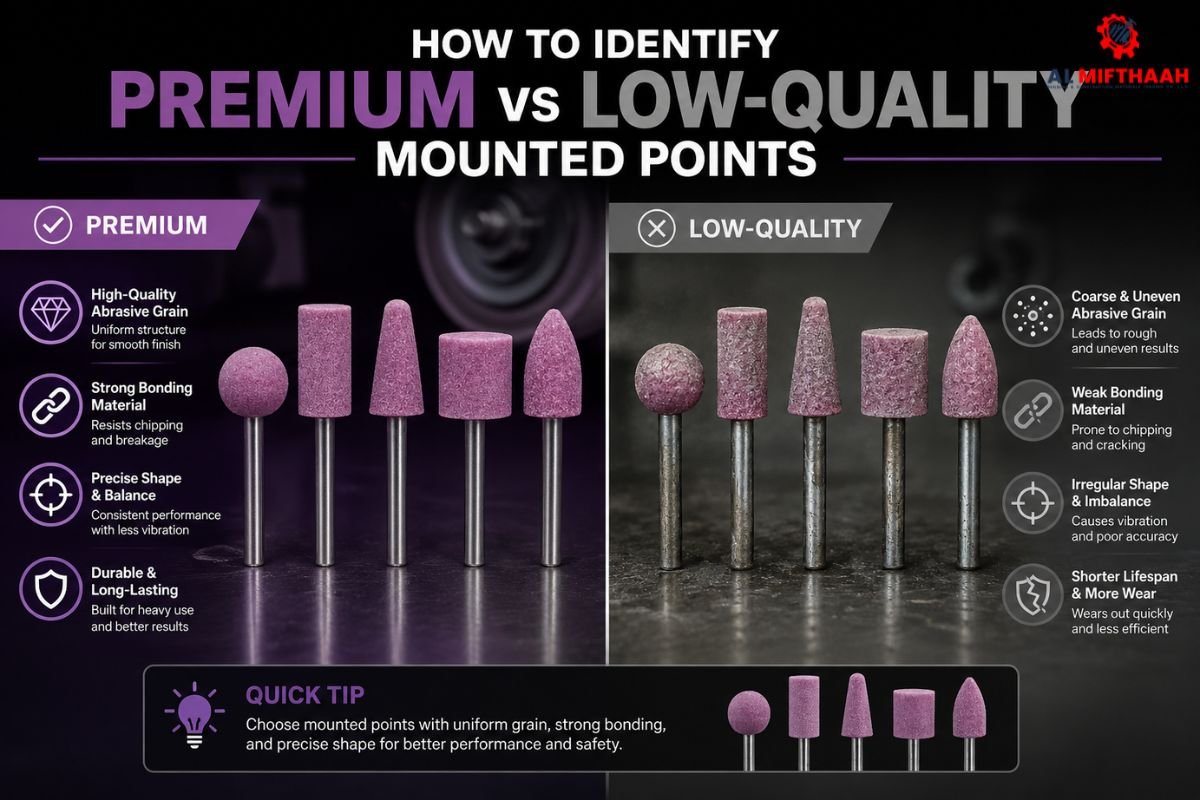
1. Uniform Grit Distribution
Gently run fingers over the surface. A high-quality tool is uniform in all of its parts: no clumping, no bare spots, no large bits of grit everywhere. The uniformity is achieved by controlling the manufacturing process, and this defines whether or not the tool wears evenly.
2. Solid, Centered Shank Attachment
Inspect abrasive head shank interface. If it’s a good point, that seam is in the middle and is firmly in place, without any slack or looseness, when spinning it in the hands. An off-center shank produces vibration while working, reducing tool life and adversely affecting finish quality.
3. Consistent Color and Texture
Premium abrasive grains are considered and developed with consistent source and processing in mind. Mixed-grade material is typically indicated by patches of varying color on the same point or by texture that varies from coarse to fine in the same tool. That is not something that a reputable manufacturer would want to do.
4. Weight That Matches the Size
It’s true, but this requires experience to determine. Premium points are the same density as the grit rating. If a point feels abnormally light for its size, it may not have enough actual abrasive in it, as it might have too much filler.
5. Clean, Sharp Edges Straight Out of the Box
Look at the edges of the abrasive head. Premium points arrive not only trimmed, but finished off clean, with no rough edges or corners- before you’ve even used them. The first sign that the bond is chipping before use is applied is that it is not going to withstand grinding pressure.
Common red flags of low-quality abrasives
The poorly mounted points will reveal their faults quickly, in some cases within the first few minutes of use.
- Glazing: The surface smoothens and shines up rather than cuts, since the bond cannot wear off the grit quickly enough.
- Excessive heat buildup: When the tool/particle warms up quicker than anticipated, it is likely that the bond material is too soft.
- Uneven wear: The point becomes misshapen, so that it has a lopsided profile rather than maintaining a consistent one, thus making it very hard to precisely work the point.
- Grain shedding: The presence of loose particles that fall off during use indicates a weak or under-cured bond.
- Shank flex: All bending at the shank-head joint indicates that the mechanical or adhesive connection is not secure.
If you are experiencing any of these situations on a frequent basis, then you might want to rethink the supplier and not the individual product that you are purchasing.
Premium vs low-quality: A side-by-side comparison
| Feature | Premium Mounted Point | Low-Quality Mounted Point |
| Grit distribution | Even, consistent throughout | Clumped or patchy |
| Shank bond | Centered, secure, no wobble | Off-center, may loosen with use |
| Heat resistance | Keeps cutting under heat | Glazes or overheats quickly |
| Shape retention | Holds original profile through use | Wears unevenly, loses shape fast |
| Surface finish | Clean edges, no chipping | Rough edges, visible flaws pre-use |
| Lifespan | Longer, consistent performance | Short, unpredictable wear |
| Cost per job | Lower long-term due to efficiency | Looks cheaper upfront, needs frequent replacement |
How does bond type affect performance and longevity?
The bond holds the abrasive grains together and attaches them to the tool’s structure. It’s probably the single biggest factor separating a premium mounted point from an inferior one, and it’s easy to overlook because you can’t judge it just by looking.
Moreover, vitrified bonds tend to offer rigidity and heat resistance, which suits precision grinding where shape retention matters. Resin bonds flex more and are used for general-purpose deburring. Problems start when manufacturers cut curing time short or use lower-grade resin fillers to save cost. The tool looks fine on the shelf. It fails on the job.
An expert such as industrial equipment dealers in Dubai who understands bond chemistry and can tell you which type suits your application is usually a better long-term partner than one who just sells whatever’s sitting in stock.
Mistakes buyers make when sourcing mounted points
Even experienced procurement teams fall into a few predictable traps. Buying purely on price is the most common one; the cheapest points often cost more over time once you factor in replacement and rework. Ignoring grit rating specifications is another. Using the wrong grit for a given material leads to poor finish and faster wear. Abrasive tools dealers in Dubai will help you to choose the right one.
Skipping supplier verification raises the risk of mismatched or substandard batches showing up in a “trusted” order. Storage gets overlooked too. Mounted points sitting in humid or inconsistent conditions can degrade before anyone’s even touched them. Therefore, skipping a trial batch before a big order makes it much harder to catch a quality problem before it’s already on your shop floor.
Why does sourcing matter as much as the product?
Even a well-made mounted point can underperform if it wasn’t stored, handled, or shipped properly. That’s where a reliable abrasive tools supplier Dubai businesses have worked with for years actually earns its keep. A supplier who stores product correctly, checks batches before they go out, and can answer specific questions about bond type or grit compatibility saves you problems you’d otherwise only discover mid-job.
Among abrasive tools dealers in Dubai, Almifthaah supplies consistently graded abrasives for demanding industrial use. If you also need a High-Quality Flap Abrasive Wheels Supplier in Dubai, sourcing everything from one place makes quality control across your whole toolkit a lot simpler than juggling several vendors with different standards.
Therefore, Almifthaah works alongside other industrial equipment dealers in Dubai, serving fabrication shops, workshops, and manufacturing units on tight schedules. For anyone researching a Saif Precision tools supplier in UAE, Almifthaah’s range covers both precision tooling and general abrasive needs.
Expert recommendations for bulk buyers
Request a sample batch before committing to large quantities, especially with a supplier you haven’t used before. Ask for technical data sheets on bond type and grit specification instead of relying on packaging copy alone. Match grit and bond to the material you’re working with; stainless steel, cast iron, and aluminum don’t respond the same way to abrasive tools.
If you’re rotating suppliers to cut costs, run a side-by-side comparison before you fully switch over. And build an actual relationship with your supplier. One who understands your production needs can flag issues early and suggest alternatives before a problem becomes expensive.
Working with the same abrasive tools supplier Dubai teams keep coming back tends to cut down the guesswork, mostly because the supplier already knows your order patterns and what you actually need.
Final thoughts
Once you know what to check, telling premium mounted points from low-quality ones stops being guesswork. Grit consistency, shank bonding, heat resistance, and shape retention say more about a tool’s real quality than the price tag ever will. The shops that avoid repeat headaches are the ones that inspect before buying and stick with suppliers like high-quality flap abrasive wheels supplier in Dubai who actually know the product.
If you’re sourcing mounted points, flap wheels, or precision tooling and want consistent, verified quality on every order, Almifthaah can help. Get in touch to talk through your specific application and get abrasives that hold up on the shop floor, not just in the packaging.
Frequently asked questions
Check for an uneven grit texture, an off-centered shank, or rough and chipped edges. These are typically apparent even before picking up the tool.
Yes, and by a significant amount. These have longer duration of shape retention and cutting power, resulting in reduced replacement costs and lower costs over time.
Vitrified bonds. They are more rigid and heat-resistant, important properties if the task requires the tool to maintain its shape.
It can. The lack of even wear or an excessive point pressure can burn through the surface or cause discoloration of materials such as stainless steel.
Request technical data sheets, ask for a sample batch, and ask if they’re willing to explain the type of bond and grit specs without hesitation.
It’s not always, but if the point feels exceptionally light compared to its size, that’s a warning sign. This frequently results in less effective abrasive material and more filler.
The bond cannot remove the worn-out grit quickly enough, and the surface becomes smooth rather than continuing to cut.
Yes. Small test runs identify issues early on before committing to a big order that is subpar.
Consistent cutting and even wear is even distribution. Grit that is clumped or patchy will wear unevenly and not last as long.
Everything that goes into storing, batching verifications, and technical support costs. Skipping them to save a few dirhams usually costs more in downtime later.
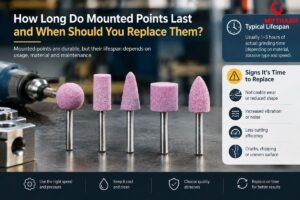
How Long Do Mounted Points Last and When Should You Replace Them?
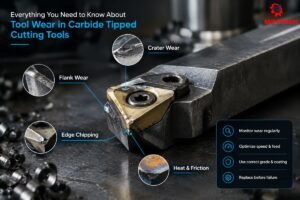
Everything You Need to Know About Tool Wear in Carbide Tipped Cutting Tools