

- November 9, 2026
- by Almifthaah
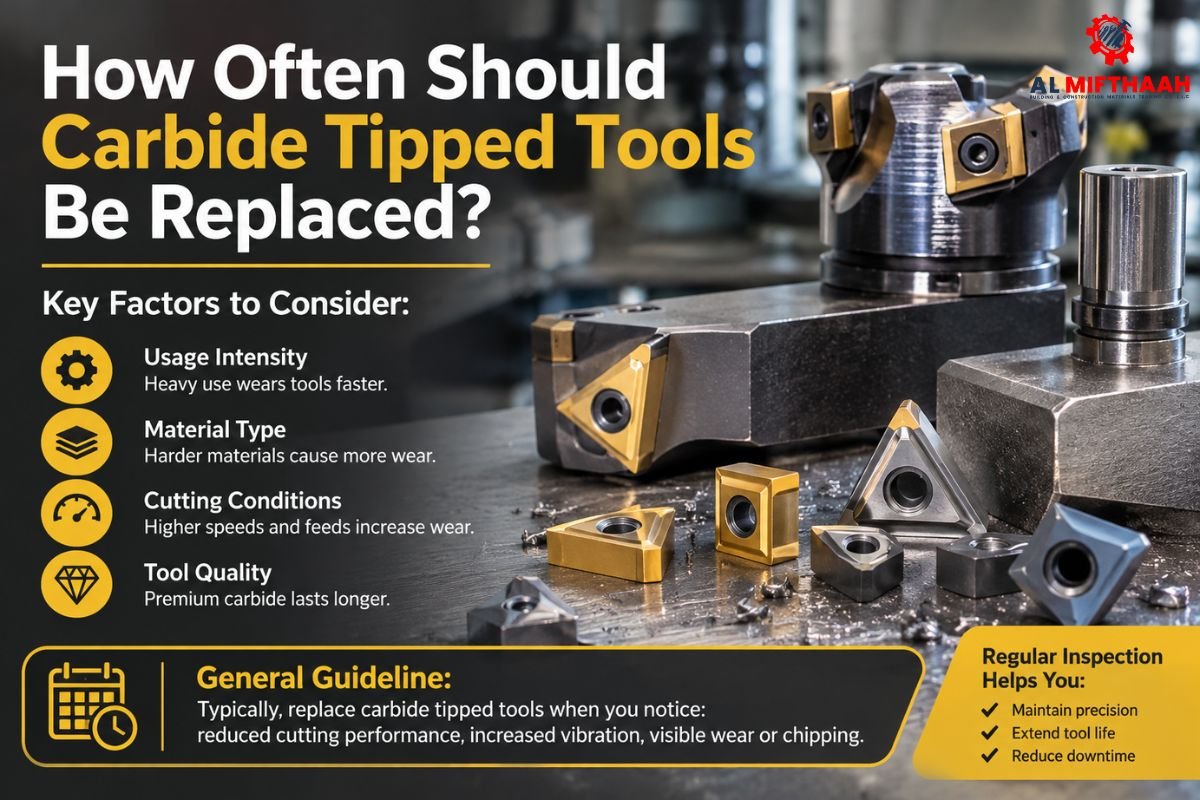
How Often Should Carbide Tipped Tools Be Replaced?
Replacement of carbide tipped tools will only be needed when the wear of the cutting edge reaches a specified limit and not based on time. In the case of most finishing operations the machinist may consider a flank wear of about 0.3mm as the practical criterion for replacement of the tool. This may be longer for roughing cuts.
Therefore, if chipping is noticeable, cracks appear, a built-up edge occurs, cutting force raises or dimensions deviate from the standard then it would be advisable to replace the tool. Tool life depends on various factors such as type of material, cutting speed, feed rate, depth of cut and type of coolant used. Checking the cutting edges of the tools at every job done will help to prolong the tool life.
Table of Contents
ToggleKey takeaways
- Change tools at a predetermined wear point, typically at the flank wear of 0.3 mm for finishing, not at a specific time.
- A Single Flute Carbide Endmill UAE should be evaluated on chip clearance and corner rounding, and be matched to the material prior to cutting.
- Buying from a carbide endmill supplier in Dubai means the provision of steady coolant, rigid set up and correct cutting data which extends the tool life beyond what most shops expect.
- Collaborate with a Saif Precision tools supplier in UAE that provides replacement inserts and guides the grade selection in case of repeated wear patterns.
Why do carbide tipped tools wear out?
Carbide tips are made of tungsten carbide (a lot harder than high speed steel) that maintains its hardness at higher temperatures. This allows carbide tipped tools to cut steel, cast iron, stainless at speeds that would destroy a regular tool. However, it’s not just a matter of hardness that will prevent wear. With each cut you are generating friction, heat and pressure (all very small contact areas) which changes the shape of your cutting edge.
Generally four things cause wear:
- Abrasion caused by hard particles like scale, sand inclusions or hard skin on the work piece.
- Heat that softens the surface of your tip and causes crater formation on your rake face to happen faster
- Adhesion where work piece material “welds” to your edge and pulls small chunks of material out when it breaks free
- Mechanical shock due to interrupted cuts, uneven stock, or sloppy set-ups that have uneven loading on your cutting edge.
The wear is gradual so it is easy to overlook. Not often will a good set-up tool suddenly fail. Instead what happens is your sharp cutting edge loses its shape and you have increasing cutting forces. The surface finish slowly gets worse. By the time you look at your part and think it’s wrong, you may have already been beyond your useful life of the tool for several parts. Similarly for drilling tools. Abrasion and heat for the same reasons apply to the drilling tools in your shop.
When should carbide tipped tools be replaced?
Honestly, how long a tool lasts really depends on the job. Even if two shops use the same tool, they can get totally different results just based on how they set up and run their machines.
Why doesn’t a fixed schedule work?
Some shops swap out tools after every eight-hour shift or a certain number of parts. This is easy to plan, but it doesn’t consider what’s actually happening at the cutting edge. A tool might last a whole shift cutting soft aluminum at a moderate speed, but then fail in minutes on hardened steel. A set schedule either means you’re tossing out perfectly good tools or letting damaged ones keep working. Neither helps your production or your profits.
Using wear limits as your replacement rule
A better way is to set a wear limit for each specific job and check the tool against it. The most common way to measure this is flank wear, which is the flat area that wears down along the side of the cutting tip. Many machinists and tool standards consider about 0.3 mm of flank wear a good limit for finishing work.
Roughing jobs usually allow more wear because the surface finish isn’t as critical and the cut is tougher. However, you still need to monitor cutting force and chipping. The exact limit should come from your tool manufacturer’s recommendations and what your customer needs in terms of surface finish and part tolerances.
| Operation | Typical Wear Reference | Practical Action |
| Finishing turning | About 0.3 mm flank wear | Index or replace before surface finish falls out of spec |
| Roughing turning | Larger wear may be acceptable | Watch cutting force and chipping, not wear alone |
| Endmill slotting | Corner and edge wear | Replace when burrs, heat marks, or poor wall finish appear |
| Hard material facing | Notch and flank wear | Replace at the first notch or chip |
Those numbers are general reference points – check the limit with the data from the manufacturer of Single Flute Carbide Endmill UAE for your grade and geometry.
Signs that tell you it is time to replace a tool
Don’t wait till the cutting edge breaks to replace the tool – look for those signs during every job
- The surface finish is worse or marks from chatter are visible
- Parts have different dimensions, even when you don’t change the offset; measure them with gauges
- The tool has more cutting noise, more vibration or a higher load on the spindle
- Chips have a different colour, have a different shape or stick to the tool
- The edge has small missing pieces, cracks or notches
- Workpiece material is on the cutting face as a built up edge
What does flank wear on the edge?
Flank wear is a flat, reflective strip along the side of the cutting edge that touches the finished surface. With a lens you can see the width of that strip and check if it is past your limit. A loupe is adequate to inspect the tool quickly but measuring tools like digital microscopes have readouts that give you numbers to write down. In many shops workers record wear measurements next to the number of finished parts – this makes it simpler to know how each grade cuts each material.
When chipping means immediate replacement?
The small chipping on the surface of the roughing insert is fine as long as the cut is consistent. Bigger chips, cracking to the tip, or a groove deep enough to alter the cut require special attention. The damaged cutting edge may snap during the operation, leave scratches on the workpiece, or generate vibration through the spindle and tool holder. In case the chip is large enough to stick by nail, stop the machine, adjust the set-up, and replace the insert. Don’t forget about safety, a broken tip will cost way more than a new insert.
Types of wear and what causes them
Every wear type has its own causes. Understanding of the problem helps improve the process.
| Wear Type | What You See | Usual Cause | Recommended Response |
| Flank wear | Gradual land along the side of the edge | Normal abrasion | Replace at your wear limit |
| Crater wear | Dish-shaped hollow on the rake face | High temperature and fast chip flow | Reduce speed, improve coolant, then replace |
| Notch wear | Groove at the depth of cut line | Work-hardened skin or scale | Change depth of cut or use a tougher grade |
| Chipping | Small fractures along the edge | Interrupted cuts or vibration | Check setup, then replace |
| Built-up edge | Workpiece material stuck to the edge | Low speed or sticky materials | Raise speed, adjust coolant, clean the edge |
| Thermal cracking | Fine cracks across the cutting edge | Heat cycling from uneven coolant | Keep coolant steady, then replace |
A beneficial practice is to mark or snap a picture of the used edge for each job. By examining the wear level of the worn edge over a period of weeks, one will recognize the reason for it, whether it is the cutting speed, the coolant used, setup, or the grade of the tool. If a shop has a trusted tool supplier, one can get feedback about which grades to choose.
Single point tools and endmills need different replacement rules
The location of wear on single point tools and endmills will vary and so will the replaceability rules.
- Replacing carbide tipped single point tools on lathes
Single point tools on lathes carry either brazed carbide tips or indexable inserts. If the seat and clamp are in good shape, with indexable inserts, the first step is to turn the insert to a fresh cutting corner. Replace insert when all corners are worn. The tips on the brazeled are different from the standard, in that the tip can be regrounded many times, but only until it is too small to fit into the tip holder. Brazed carbide tools are sent for professional grinding in most shops, as regrinding with the proper diamond wheel and heat control is necessary.
- Replacing a single flute carbide endmill
If you’re searching for a carbide endmill supplier in Dubai, you might have the question of how long their flutes will last. One flute design is used for one cutting edge and a large chip gullet, the right flute for aluminium and other non-ferrous metals as long chips do not pack. Due to this geometry, the wear will be different than that of a multi-flute cutter. You determine replacement through corner rounding, burrs on the wall and clearance of chips. Even if the cutting edge appears to be intact, as the corner becomes larger than the drawing will allow, or chips begin to pack and rub the wall, the endmill is at the end of its useful life. Abrasive tools for finishing can be used to clean up the Burrs left behind.
How to extend carbide tool life?
You can’t just change tools at any time you like. Good process habits extend the time between changes, and minimize surprises on the shop floor.
- Begin at the tool manufacturer’s speed and feed suggestions
- Apply correct coolant concentration and flow rate for the material
- Minimize tool overhang and keep holder clean and secure
- Select a grade suitable for the material to be worked
- Replace or index inserts before they attain the wear limit.
Speeds, feeds, and coolant
Speeds and feeds determine heat and chip load. Overspeed increases the running temperature and accelerates crater wearing. If the speed is too low, it will rub and cause edge accumulation. Coolant removes heat from the system and washes chips from the cutting zone. The flow is more important than the volume of water, because the intermittent water temperature variations may cause thermal cracking, which can occur at the tip every time it is heated or cooled. Make small adjustments to the test and record the results to determine which of the test settings does actually extend tool life.
Setup, runout, and rigidity
Setup is the manner of meeting the edge with the material. Overhang results in vibration and vibration chips the edge. Before each run, inspect the condition of the check, clamp torque and runout. Precision tool alignment and fixturing is possible with shim stock that can be purchased from our shim stock line. Good machine tools accessories like holders and collets maintain a concentric position of the tool.
Choosing a reliable tool source in Dubai
Tool life management involves part of the selection of the correct tool. The cutting and milling tools Dubai suppliers are readily available and can be delivered quickly are what Dubai machine shops, fabricators and maintenance teams are looking for. It is also a challenge for fabrication shops that operate on magnetic drills to maintain uniformity in tooling. Price is not the only factor that matters, consistency is equal. The wear pattern and thus new cutting data can be changed due to different geometry of the tool cut from a different batch.
When you compare suppliers, look for these qualities:
- If you want to perform the same job again, you will get a consistent grade and coating.
- Geometry and cutting data, both recorded and recommended
- Replacement Inserts & Holders are kept in stock.
- Technical guidance for repeat wear pattern advice.
- Simplify return and warranty policies
Almifthaah will be a perfect choice for shop owners searching for a Saif Precision tools supplier in UAE as it supplies abrasives, milling tools, drilling tools, threading tools, cutting tools, machine tool accessories, magnetic drill machines and measuring instruments.
If you’re looking for a Carbide Tipped Single Point Tools supplier in Dubai, you should also discuss the flute count, coating, and recommended speeds, in addition to the price. Ask your supplier for the wear value they are recommending for your particular job; maintain a simple record of the results.
Bottom line
There isn’t a single time when carbide tipped tools should be replaced. They can only be worn for a certain period, have a set of warning signs, and are either protected or shortened by a process. Know how much flank wear you have, observe for chipping and changes in surface finishes and treat each worn flank as information on your setup.
Moreover, retailers who diligently check parts and have a reliable source of cut and milling tool Dubai buyers can count on typically experiencing more consistent part quality and fewer surprises. A carbide tipped single point tools supplier in Dubai can help you match grades to your materials so that your team doesn’t have to guess.
Frequently asked questions
Change at the wear limit of 0.3 mm of flank wear for finishing or earlier if chipping or poor finish.
The first indication is normally increased surface roughness, which is typically followed by dimensional drift. Always check under magnification, first.
Yes. Endmills are evaluated for corner rounding and wall finish and single point tools are evaluated for flank wear.
Yes. A steady flow of coolant will minimize heat cracking and buildup at the edge, which will extend tool life on most materials.

How to Identify the Correct Gear Cutter When the Markings Are Missing

Carbide Tool Maintenance Tips Every Machinist Should Know