

- May 21, 2026
- by Almifthaah
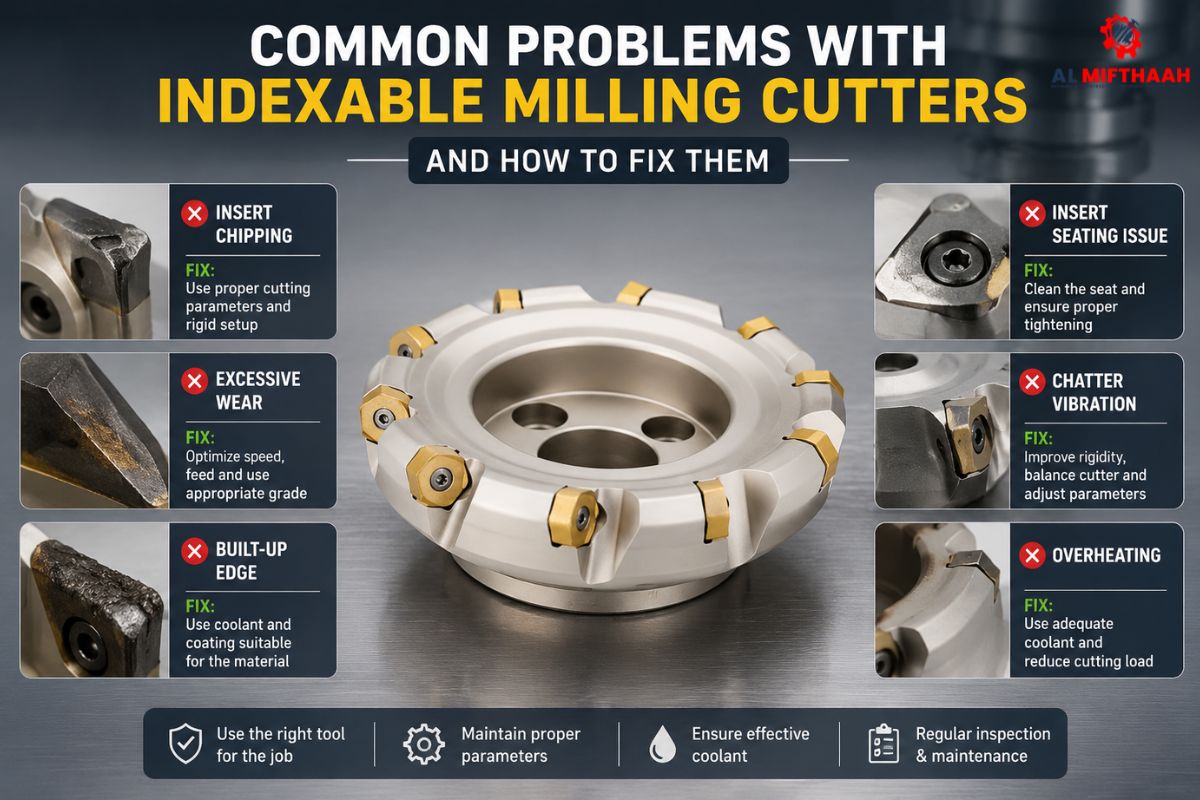
Common Problems with Indexable Milling Cutters and How to Fix Them
Table of Contents
ToggleKey Takeaways
- Most milling problems are caused by incorrect speed and feed.
- Vibration lowers surface quality and insert life.
- A well-balanced flow of coolant prevents hot spots.
- The accuracy of the machining is directly dependent on the cutter’s alignment.
High-precision cutting tools play a vital role in modern cutting. But even the very best indexable milling cutters can cause issues with either improper setup, speed, or insert selection. In many workshops, small errors result in bad surface finish, tool damage, additional downtime, and material loss. So, knowing them will help to ensure a high quality of machining and minimize manufacturing cost.
Almifthaah frequently interacts with industrial cutting tool users and knows how to utilize the correct cutting tools in their machines to maximize tool life and performance.
Why do indexable milling cutters fail?
Indexable milling cutters are used for fast and precise removal of metal. However, there are occasional user problems due to improper operating conditions. The most frequently occurring problems are:
| Problem | Common Reason | Result |
| Poor surface finish | Wrong speed or insert | Rough machining |
| Insert chipping | Excessive feed rate | Tool damage |
| Vibration | Weak setup | Inaccurate cutting |
| Heat generation | Low coolant flow | Short insert life |
| Chip buildup | Poor chip evacuation | Machine stoppage |
Common problems in many factories that adopt an indexable milling cutter UAE solution are these problems when they do not perform regular maintenance. Most failures can be avoided by appropriate inspection prior to machining.
What causes poor surface finish?
One of the main grievances in milling operations is a rough or uneven surface. Usually, this is due to a mismatch in the cutter speed and material type.
Other common causes include:
- Worn-out inserts
- Loose cutter holding
- Wrong feed rate
- Low machine rigidity
- Incorrect insert geometry
For example, with an indexable insert face mill cutter, choosing the improper insert grade for stainless steel will leave marks on the surface of the workpiece.
How to fix it
- Replace worn inserts when they show signs of wear.
- Make sure that spindle alignment is done carefully.
- Keep a proper cutting speed balance.
- Decrease feed when vibration occurs.
- Choose inserts according to material hardness
Additionally, insert pockets should be cleaned regularly, as dust and chips can impact cutter positioning.
Why do inserts break too early?
Increase machining cost by reducing production speed due to breakage. Operators tend to try to speed up their operation by increasing cutting speed, in many cases. But too fast, too hot, and too pressured!
The following are some common causes of an insert failure:
- High cutting load
- Sudden tool entry
- Improper clamping
- Hard material impact
- Insufficient coolant
Several workshops that buy their tools from a trusted indexable milling cutter supplier in Dubai report better insert life after improving coolant flow and reducing aggressive cutting conditions.
Quick solution steps
- Use recommended cutting parameters to begin with.
- Try to avoid cuts where possible that are broken into segments.
- Apply correct torque when inserting the insert.
- Immediately change any broken insert seats.
- Use temperature monitoring during extended operations.
The life of inserts can be extended appreciably by making small changes.
How can vibration problems be reduced?
Vibration (chatter) has a negative impact on tool life and on the accuracy of the machining operation. Furthermore, it can cause unwanted noise and cause damage to the machine over time.
The issue is typically seen when:
- Too long tool overhang
- The set-up of the machines is poor.
- The feed rate is made unstable.
- The diameter of the cutter is wrong.
- Inserts are irregularly located.
Practical ways to control vibration
- Keep tool extension as short as possible.
- Tighten fixtures properly.
- Stable machining parameters should be used.
- Select balanced cutters.
- Slightly decrease depth of cut
Experienced machinists working with milling cutter dealers in Dubai often recommend testing different feed combinations before starting large production runs.
The edges of inserts can slowly become damaged from vibration, even if it is small. Early correction is therefore very important.
What happens when chips do not clear?
Accumulation of chips is another significant problem in milling operations. If the chips are not removed from the cutting area, they generate heat and spoil the surface of the material being cut.
This is a problem that escalates in deep cavity milling or high-speed machining.
Poor chip removal is indicated by the following:
- Burn marks on material.
- Recutting noise
- Insert edge damage
- Increased spindle load
- Sudden cutter stoppage
The following are some of the best fixes for controlling chips.
- Apply proper direction of coolant application.
- Allow more airflow in the vicinity of the cutting zone.
- Select chip-breaker inserts
- Avoid excessive depths of cut.
- Clean the work area frequently.
However, operators should never neglect the shape of the chips. If the chips are long and continuous, it is generally a sign of improper setup of the cutting process.
Why does cutter alignment matter?
Misalignment has a direct impact on the accuracy of the machining. Even the best cutting tools will break if the cutter is not installed properly.
Misalignment can cause:
- Uneven insert wear
- Dimensional errors
- Higher spindle stress
- Surface quality problems
Many error cases occur when the machine operator is installing the machine, so many suppliers, such as Almifthaah, will guide the machine operator on the correct installation method.
Alignment improvement tips
- Regularly check spindle runout.
- Must use clean tool holders.
- Tighten holders evenly.
- Check the cutter balance prior to operating the machine.
- Avoid damaged adapters.
Machining errors can be minimized by setting up maintenance schedules with a reliable Saif Precision tools supplier in the UAE.
Simple tips for longer tool life
Good maintenance will optimize cutter performance and minimize unexpected downtime.
Useful daily practices
- Keep inserts in a dry place.
- Replace the worn inserts as soon as possible.
- Follow machine manufacturer settings
- Keep coolant concentration balanced
- Monitor unusual cutting noises.
In the real world, you will find that preventive maintenance is always less expensive than emergency replacement of tools.Additionally, adequate operator training also ensures a consistent machining process.
Wrapping up
When indexing with these indexable milling cutters, they can not only speed up the machining process but can also accurately position the workpiece to be machined, yet only when indexing correctly. Defects such as insert breakage, vibration, poor surface finish, and chip accumulation can decrease productivity considerably. Hence, periodic maintenance, correct setup, and cutting parameters are required to ensure smooth machining operations.
Many companies are looking for reliable machining services and high-quality cutting solutions, which is why they can turn to a company with a lot of experience such as Almifthaah. Selecting the appropriate indexable milling cutter UAE solution and operating it correctly can enhance tool life, quality of the cuts made, and production efficiency.
Frequently asked questions
1. How often should milling inserts be replaced?
Replace inserts as soon as they show signs of wear or reduced cutting ability.
2. Why does vibration happen during milling?
Typical causes of vibration include weak setup, long tool overhang, and unstable feed rates.
3. Can coolant improve insert life?
Yes, the heat is lower, and insert durability is greatly extended when proper coolant flow is maintained.

How Thick Should Copper Shim Stock Be for Electrical Busbar Connections?

How to Select an Involute Gear Cutter by Module and Number of Teeth