

- September 19, 2026
- by Almifthaah
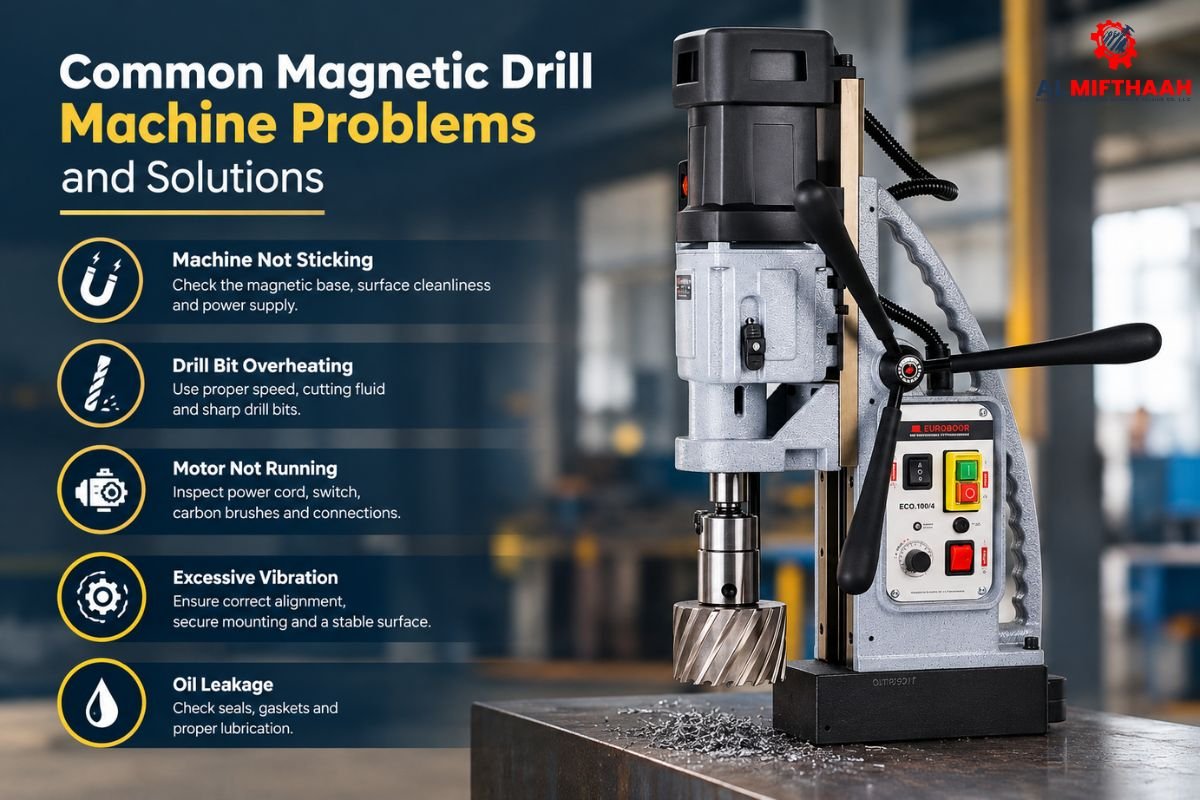
Common Magnetic Drill Machine Problems and Solutions
The most common magnetic drill problems are a magnet that won’t hold, cutters that break or dull early, chips and coolant trouble, a motor that won’t start or overheats, and wobbly holes. Most trace back to the same handful of causes: a dirty or thin work surface, wrong feed pressure, weak coolant flow, worn carbon brushes, or a poor power supply.
Each problem below comes with its fix, followed by a few points specific to UAE sites and a short section on what to ask magnetic drilling machine dealers in Dubai before you buy.
Table of Contents
ToggleKey takeaways
- A drill that won’t hold is usually sitting on dirty, painted, or thin steel. The magnet itself is rarely dead.
- Cutters seldom fail alone. Wrong feed, weak coolant, or a lifting base does the damage.
- Check brushes, cords and vents before you blame the motor.
- Strap the machine on vertical and overhead work, every time.
Problem 1: Magnet not holding firmly
The drill shifts, lifts at one edge, or slides the moment the cutter bites. It’s a common fault, and it puts both the cutter and the operator at risk.
Nearly every case comes down to what sits between the base and the steel, or how much steel there is:
- Paint, mill scale, rust, or grease under the base
- Swarf trapped between base and plate
- Curved or pitted steel, such as pipe
- Steel that’s too thin (many makers quote about 10 mm for full hold, and some ask for more)
- Non-magnetic metal such as aluminium, copper or most stainless grades
How to fix it?
- Start by wire-brushing the spot to bare steel and wiping the base face. Then switch the magnet on and nudge the machine by hand. If it moves, don’t cut. A magnet can look seated and still shift once vibration builds, so this quick test is worth doing every time.
- Thin sheet or box section needs help: clamp a thick steel plate to the work and mount the drill on that. Non-magnetic metal calls for a clamp-on base or fixture, and pipe for a pipe clamp.
- On vertical or overhead work, fit the safety chain or strap before you energise the magnet. If power drops mid-cut, that strap is the only thing holding a heavy drill up.
- Additionally, keep away from steel that’s being welded on, since welding current can pass through the magnet and damage the circuit board.
Problem 2: Cutters breaking or dulling
Cutters that chip, snap, or go blunt after a few holes usually point to how they were used, not to a bad cutter.
Feed pressure is the usual reason, and it goes wrong in both directions. Too light, and the edges rub instead of cutting, which dulls them. Too heavy, and the base can partly lift, so the cutter wedges sideways in the hole and shatters.
Fixes
- Steady, firm pressure with chips curling out is the target. If you’re leaning on the handle, look for another cause.
- Speed matters just as much. The outer edge of a big cutter travels faster than a small one, so RPM should drop as diameter grows. Moving from a 22 mm cutter to a 50 mm one at the same speed is a quick way to ruin it. Ask magnetic drilling machine dealers in Dubai for the maker’s speed chart, and match the cutter type (cobalt HSS or carbide-tipped) to the steel.
- However, two smaller habits help. On a thick plate, keep pressure constant and ease off slightly just as the cutter breaks through, so it doesn’t grab at the bottom. And change a dull cutter early: it strains the motor and tempts operators to press harder, which is what breaks it.
Problem 3: Chips packing, coolant failing
Packed flutes make a cutter bind, and on a bad day the whole drill twists on the plate. Running dry is less dramatic but just as costly, because heat softens the cutting edge and tool life drops quickly.
The swarf tells you what’s happening. Blue or purple chips mean heat, from low coolant, heavy pressure, or too much speed. What helps:
- Clear the cutter of chips before every hole.
- On deep cuts, back off briefly so long chips break up.
- Fill the coolant tank before starting, and check that fluid actually reaches the cutter.
- Use the machine’s built-in coolant feed. Squirting fluid from outside works poorly on a spinning cutter.
- If flow stops mid-job, check the line for a blockage before you carry on.
- Use a cutting fluid made for annular cutters, mixed as the label says. Wrongly diluted fluid shortens cutter life.
Problem 4: Motor dead or overheating
Work from the wall socket inward. If neither the magnet nor the motor responds, the fault sits upstream of both: the supply, cord, fuse, wiring, or magnet switch. If the magnet grips but the motor won’t run, suspect carbon brushes that are stuck or worn.
Brushes wear like brake pads. A common guideline is to check them every two to three months, or after 100 to 200 hours of use, but your manual has the final word. Heavy sparking, a burning smell, or power that fades mid-cut means they’re due. Keep a spare pair, and if you need a match, send the model plate details to drilling tools suppliers in the UAE.
Overheating usually has one of these behind it:
- Blocked vents or dust packed around the motor
- A dull cutter overloading it
- A long, thin extension cord that drops voltage
- Big holes back to back with no rest
Fixes- Clean the vents, change the cutter, use a short heavy-gauge cord or plug in directly, and give the machine a breather after heavy cuts.
Problem 5: Wobbly holes, rough feed
Oversize holes, chatter, or a stiff gearbox point to wear or dirt in the arbor, slide, or gears.
Fixes-
If a cutter wobbles, clean the arbor, check the shank and pilot for damage, and make sure the cutter seats fully. Holes that stay oversize after that usually mean a worn shank or arbor.
Therefore, a sticky or loose feed is normally down to the slide gibs. Adjust them and lubricate lightly, since loose gibs let the cutter chatter and chip its teeth. If the gears grind when you change, follow the manual on when to shift and check the gearbox lubricant. Stiff handles need only a little lubricant on the controls.
Problem 6: Magnet or circuit failure
Sometimes the base is clean and thick enough, yet the hold stays weak. Look at the base face for scratches or cracks first. If it’s undamaged, the cause may be a failing magnet coil or a faulty magnet switch, and neither is a site fix.
Fixes-
Stop using the machine, tag it, and send it to a technician rather than opening the electrics yourself. A drill that loses hold mid-cut can fall or snap a cutter, so don’t keep working with it.
Moreover, some machines have a safety circuit that cuts the motor when the base lifts. If yours trips repeatedly, look at the surface and the magnet, and leave the circuit alone.
Dubai site conditions to plan for
Summer heat pushes motors closer to their limit, so keep the machine out of direct sun between cuts and top up warm coolant tanks more often. Humid, salty air near coastal yards can leave a rust film on the magnet face and tooling, and even a light film reduces grip. Fine dust blocks vents and gets into slides, so blow the machine out and wipe the slides. Generators and long cable runs are common on sites, and voltage sag hurts brushed motors, so check that the machine’s rated voltage matches the supply.
A short pre-shift routine covers most of this:
- Wipe the magnet face and clear chips
- Inspect the cord and plug
- Check the cutter teeth and fill the coolant
- Test the emergency stop, then nudge-test the hold
Moreover, keep spare brushes, coolant, and a safety strap on site. The best machine tools accessories in Dubai are simply the ones that fit your machine’s arbor and speed range.
Choosing machines and spares wisely
Problems come from a poor mismatch- say, a drill press that’s too light for its task or an unsuitable cutter. Before you buy, ensure you know the holding power rating, the minimum thickness of the metal, whether there’s a safety circuit that will automatically turn the machine off if the base gets lifted, and how easy it is to find suitable brushes, cutters, and motor spindles.
Magnetic drilling machine suppliers in Dubai differ in what they keep in stock and repair tasks. Therefore, ensure you get a list of spare parts before making the purchase. When you compare the best drilling machine suppliers in Dubai, look at how fast a brush set arrives and who repairs a burnt armature.
Almifthaah, which also goes by Saif Precision, supplies precision tools and abrasives in the UAE. Buyers searching for a Saif Precision tools supplier in UAE will land there, and it’s a fair place to ask these questions.
Bottom line
Most magnetic drill breakdowns start small: a chip under the base, a dull cutter left in, brushes nobody checked. A five-minute look before each shift catches most of them before they cost you a cutter or a day.
When you pick a supplier, spares and servicing matter as much as the price tag. Compare the best drilling machine suppliers in Dubai on both, and keep one dependable contact for the day a brush set or cutter runs out. For some buyers, that’s a Saif Precision tools supplier in UAE like Almifthaah.
Frequently asked questions
Almost always the surface: paint, rust, swarf, or steel that’s too thin. Clean it to bare metal and check the minimum thickness in your manual. On thin work, use a backing plate.
Around 10 mm gives full holding force on many machines, though some manuals ask for more. Thinner steel weakens the grip, so check your model’s figure.
Not directly. Aluminium and most stainless grades won’t hold the magnet. A clamp-on base, a fixture, or a steel backing plate gets around it.
Heavy feed, a base that lifts slightly, chips packed in the flutes, or low coolant. Keep the feed steady, clean the base, and clear the flutes before each hole.
Heat. Low coolant, heavy pressure, or too much RPM for the cutter size are the usual causes. Stop, let it cool, and fix the cause before continuing.
A common guideline is every two to three months or 100 to 200 hours of use. Check sooner on heavy work, and follow your manual.
Holding force, minimum steel thickness, spare parts stock, servicing, and manuals. If a dealer can’t answer these clearly, that tells you something.
Spare brushes, a cutter or two, coolant and a safety strap. Confirm arbor size and shank type first when browsing the best machine tools accessories in Dubai.

Everything You Need to Know About Tool Wear in Carbide Tipped Cutting Tools

How to Choose the Right Gear Cutter: Module, Tooth Count, and Pressure Angle Explained