
- August 3, 2026
- by Almifthaah
Annular Cutters vs Twist Drill Bits: What’s Better?
Table of Contents
ToggleKey takeaways
- Annular cutters provide a speedier and tidier drilling technique when working with holes larger than 12mm in structural steel.
- Twist drill bits are ideal for smaller holes, portable jobs, and jobs that require drilling in a general way.
- By choosing the cutter correctly and matching it to the magnetic drill, the performance of both machines and the cutter is extended.
- Quality cutters ensure better quality of the holes being drilled, while also extending the life of the tool.
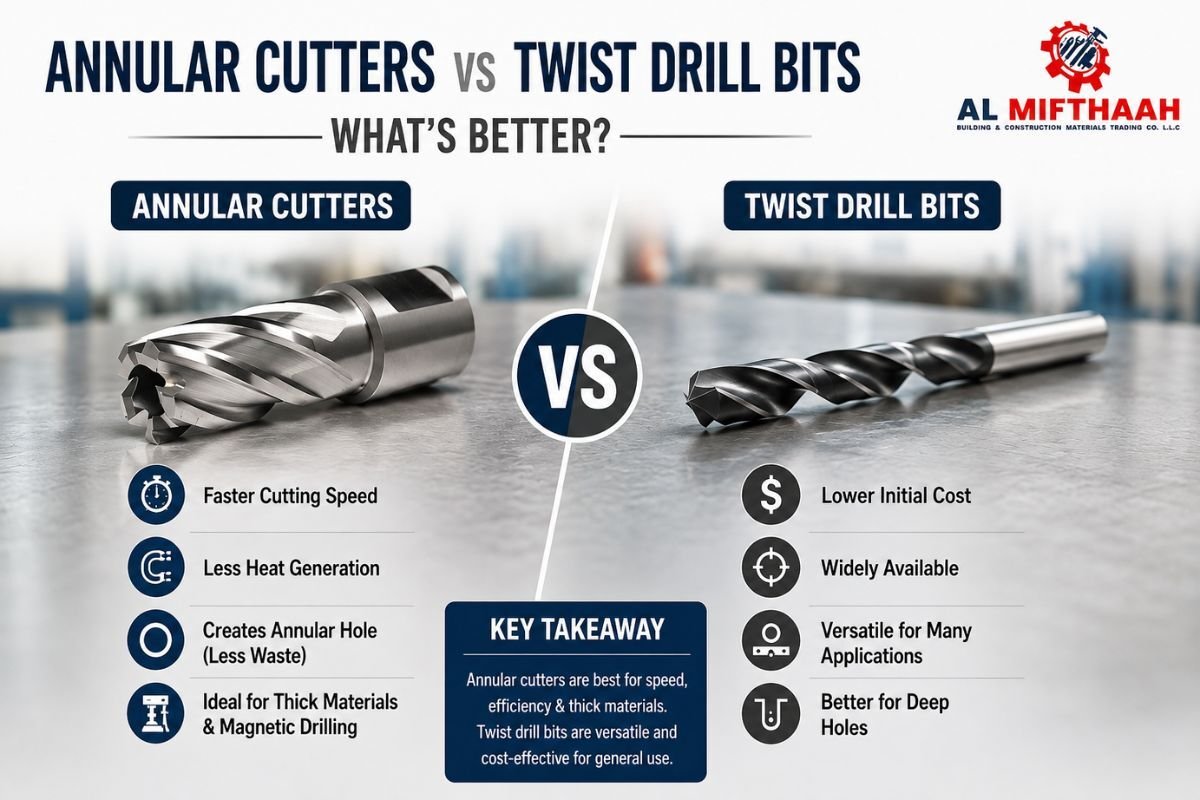
If you drill steel for a living, you’ve probably had this argument on the shop floor: annular cutter or twist drill? The honest answer is that neither one wins outright. It depends on hole size, material thickness, and how many holes you’re cutting in a shift. Annular cutters generally outperform twist drills on anything larger than 12mm, because they remove a ring of material instead of the whole core, which means less heat and less torque needed. Twist drills still hold their ground for small holes and quick, one-off jobs where a magnetic drill press isn’t practical.
What are annular cutters?
An annular cutter (also known as an annular cutter or broach cutter) is a cutting tool used to create large, precise holes in metal. It does not remove the entire material contained in the hole, but only the outer material, and the inner material is left, called the slug. The hole is finished when the slug is pushed out by the pilot pin. An annular cutter will run faster, consume less power, and maintain cleaner holes than a twist drill bit, since less material is removed. Most annular cutters are manufactured from either High-Speed Steel (HSS) or carbide-tipped HSS depending on the material to be drilled.
What are twist drill bits?
Twist drill bits are a one of the most used kinds of “bit” used for making holes in metal, wood, plastic and other materials. They are pointed and have flutes that spiral through the material and remove chips from the hole. The difference between annular cutters and twist drill bits is that the latter remove all of the material inside of the hole, making them more difficult to cut and generate more heat. They come in various sizes and materials such as High-Speed Steel (HSS) and carbide, and are suitable for general purpose drilling operations, repairs, fabrication, construction, and in everyday workshop applications.
Annular cutters vs twist drill bits: The real differences
The comparison usually comes down to speed, hole quality, and how much material you’re removing. Here’s how the two stack up on a typical structural steel job:
| Factor | Annular Cutters | Twist Drill Bits |
| Cutting method | Removes a ring, leaves a slug | Removes the full core |
| Speed on thick steel | Significantly faster (up to 60–70% less power draw) | Slower, more heat buildup |
| Hole accuracy | Very precise, minimal burring | Prone to wander on thick plate |
| Best hole size | 12mm and above | Under 12mm |
| Machine required | Magnetic drilling machine | Handheld drill or drill press |
| Cost per hole | Lower on large-diameter, high-volume work | Lower on small, occasional holes |
| Portability | Needs a stable base | Works anywhere |
Therefore, fabricators sourcing from drilling tools suppliers in UAE often ask which tool pays for itself faster. On steel structures, beams, and flange plates, annular cutters usually do, simply because they cut a 25mm hole in a fraction of the time a twist drill would take.
Why do magnetic drilling machines change the equation?
Annular cutters aren’t really built to be used freehand. These tools are built specifically for magnetic drilling machines, which are designed to stay firmly attached to steel surfaces and keep the cutter steady while it operates. It is important to have such steadiness since otherwise the cutter can vibrate and cause chipping, opening an oval rather than a round hole.
The lack of awareness of this problem is what costs a lot of fabricators their money. They buy a good cutter, pair it with an underpowered or worn-out magnetic drill, and the tool never performs the way it’s rated to. If you’re weighing up magnetic drilling machine dealers in Dubai, check the machine’s magnetic holding force and RPM range against the cutter sizes you actually plan to run. A mismatch here shortens cutter life more than almost anything else.
Choosing the right HSS annular cutters for your job
Picking a cutter isn’t just about diameter. Cutting depth, coating, and shank type all affect how long the tool lasts and how clean the hole comes out.
- Cutting depth: Match it to your plate thickness plus a small margin. Run a shallow cutter on a thick plate, and it burns out fast.
- Coating: TiN or TiAlN coatings extend tool life on stainless and harder alloys.
- Shank type: Weldon shanks are standard for most magnetic drills; check compatibility before ordering.
Moreover, fabricators looking for HSS Annular Cutters suppliers in Dubai should ask for cutters rated specifically for their material grade. Mild steel cutters don’t hold up well on stainless, and using the wrong one is one of the most common reasons cutters fail early.
Mistakes that cost fabricators time and money
A few habits show up again and again on job sites, and all of them are avoidable:
- Running the cutter dry instead of using cutting fluid, which shortens tool life dramatically.
- Ignoring RPM charts and running cutters too fast for the material.
- Skipping pilot pin checks. A worn pin causes off-center holes.
- Buying cheap cutters in bulk instead of fewer, better ones.
The last point mentioned is significant. It happens often that when companies choose the best drilling machine suppliers in Dubai only according to their price offers, they pay more because their cutters become inefficient and get changed twice as frequently.
What does tool quality from Saif Precision Tools tell you?
Not all HSS is the same. The quality of the cutter depends on the quality of the steel, the consistency of the heat treatment, and the tolerance of the edge. Cheaper cutters are often made from inconsistent batches of HSS, which results in uneven wear after the first few dozen holes drilled.
Saif Precision tools supplier in UAE, is a name that many fabricators mention when discussing consistency. Batch-to-batch reliability tends to be the main thing that will determine whether you stay with one supplier or abandon them after one defective order.
Expert insights from the shop floor
Experienced fabricators tend to keep two sets of cutters on hand, one for mild steel and one for stainless, rather than trying to make a single cutter work across materials. It’s a small habit, but it noticeably extends tool life.
Furthermore, there’s another difference worth noting: buying from drilling tools suppliers in UAE that stock replacement pilot pins and slug ejectors separately, instead of treating the cutter as disposable the moment one small part wears out. It costs a bit more planning, but it’s a cheaper way to run a shop over time.
How to choose a reliable supplier in Dubai?
Dubai has no shortage of tool suppliers, but reliability varies a lot. A few things worth checking before committing to one:
- Do they stock genuine HSS and carbide-tipped options, or just one grade?
- Can they advise on cutter-to-machine compatibility, or do they just sell parts?
- Do they offer after-sales support if a cutter underperforms?
When comparing magnetic drilling machine dealers in Dubai, ask whether they also stock compatible cutters and consumables. Dealing with one supplier for both machine and tooling usually means fewer compatibility headaches down the line.
Maintenance tips that extend tool life
- Clean chips and debris from the cutter after every job, not just at the end of the day.
- Store cutters in a dry case. Moisture causes rust on the cutting edges.
- Re-sharpen HSS cutters while they’re still in decent shape, rather than waiting until they’re fully dull.
- Check magnetic drill bases regularly, since a weak magnet strains the cutter unnecessarily.
Shops that follow a basic maintenance routine typically get noticeably more holes out of each cutter compared to those that don’t, and it costs nothing but a few extra minutes per shift. It’s one reason experienced buyers stay loyal to particular best drilling machine suppliers in Dubai once they find one that backs the tools with real guidance.
Final thoughts
Neither tool replaces the other. They solve different problems. Twist drills handle the small, quick jobs, and annular cutters take over once you’re drilling thick steel in volume. What actually determines how well either one performs is the quality of the cutter and the machine behind it.
If you’re comparing HSS annular cutter suppliers in Dubai for an upcoming project, Almifthaah stocks a full range of HSS and carbide-tipped cutters along with magnetic drilling machines built to run them properly. Worth a call before your next order.
Frequently asked questions
Yes, for holes in structural steel larger than 12mm. They cut at a higher rate, consume less power, and leave a cleaner cut edge than their corresponding twist drills.
Not effectively. Cutters of the type known as annular cutters require a solid, fixed, clamped arrangement in order to cut properly. Hole quality and wobbling are caused by handheld use.
HSS are less expensive and suitable for mild steel and stainless steel, whereas carbide can be used for harder alloys and for higher production volumes.
Most HSS cutters can be sharpened many times before they need to be replaced, depending on usage, but particularly if proper coolants are used.
Yes, when you need to drill through small holes or when it is impractical to set up a magnetic drill or a job is too short.
The most common reasons for early wear are running them dry, using the wrong RPM, or applying them to the wrong material grade.
Often yes. Having a supplier who stocks will minimise compatibility issues and make it easy to order replacements.
The size ranges from 12mm to 50mm, although special cutters are made smaller or larger as required for the specific job.
Yes, if it is coated and it has a coolant. Without lubrication, uncoated cutters will quickly wear out on stainless.
Compare the magnetic holding force capacity with the diameter of the cutter and thickness of the plate. Undersized machines fight hard and cut their life short.

How Long Do Mounted Points Last and When Should You Replace Them?
Everything You Need to Know About Tool Wear in Carbide Tipped Cutting Tools