

- October 30, 2026
- by Almifthaah
Top Signs That Your Carbide Tool Needs Immediate Replacement
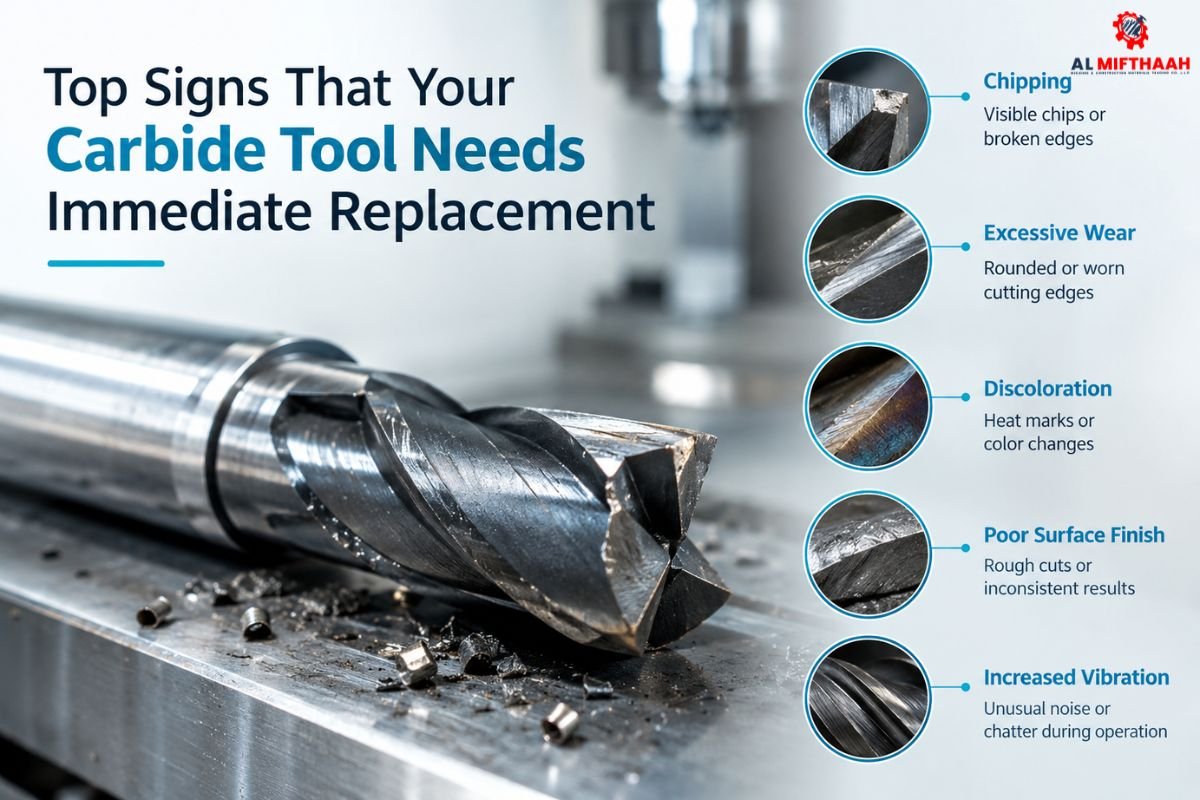
Carbide tools should be replaced immediately if there is significant flank wear, chip formation or breakage at the cutting edge; roughness or unevenness in the surface finish; burning damage on the workpiece; increasing force required for cuts; dimensional deviation from specification. All these indicators indicate that a cutter is unable to shear metal effectively. Running this software increases waste levels, stresses out machines, and may damage products. The document describes all of these symptoms, their cause, and how you should respond to them.
Almifthaah supplies milling, drilling, cutting, and threading tools to workshops in Dubai and the UAE. Worn-out tools usually warn well in advance of failure; knowing how to interpret these signals can save you a lot of money.
Table of Contents
ToggleKey takeaways
- Wear on flanks, chips from tools, and bad finishes indicate they should be replaced with a carbide cutter.
- Heat marks are a sign of issues with tools as well as processes due to build-up at edges or an increasing spindle load.
- A dimensional shift within a batch indicates when your software has reached its limits.
- Regular inspection and having an easy-to-follow replacement policy helps maintain product quality while minimizing expensive stoppages of production processes.
Why does tool condition matter in Dubai workshops?
Dubai workshops are exposed to situations that test tools more severely than many are accustomed to when they buy them. The ambient temperature remains high during large parts of the year, tools are subjected to dust from construction activities and outdoor work, and long shifts allow tools to be used for a variety of cycles before they are inspected. In those circumstances, a good-looking carbide cutter on the outside could be worn on the inside.
A good shop will consider the condition of the tools as a part of production planning. This includes establishing inspection points, taking note of tool hours where they apply, and establishing a clear criterion for when a tool leaves the machine. The type of tool also plays a role. Your carbide endmill supplier in Dubai will not only quote you a price, but they will help you to select the correct grade and coating for the material you are choosing to cut.
However, if you are looking for cutting and milling tools Dubai shops rely on, enquire about the grade, coating, and recommended speeds. A less expensive tool that is not well matched to the material may wear out before a more expensive tool that is well matched to the material. Explore our cutting tools range and milling tools range to discover how different types are categorized according to application.
A lot of buyers interested in Saif Precision tools supplier in UAE are looking for a partner that is aware of local timelines. Inquire about the time needed for replacements to be received, as time can make a machine inoperable.
How to spot flank wear early?
The most frequent indication of the wear of a carbide tool is flank wear. It is seen as a dull line on the cutting edge that comes in contact with the recently manufactured surface. It is a gradual process, and operators may not notice it unless they check their tool frequently with magnification.
What does flank wear look like?
Check an end mill for a dull or polished band on the flank in the area of the cutting edge. That band is also known as the wear land, and the width of that band is a key measurement. After shifting, a narrow land is normal. If the land is wide and is still growing from job to job, it is a warning.
Check for these signs during each inspection:
- A ridge of wear which can be seen along the flank parallel to the cutting edge.
- Sharp corners eliminated, replaced with rounded ones at the edge where cutting was.
- Smoothed surfaces where the tool has been repeatedly rubbing.
How much wear is too much?
No single number is suitable for all jobs. The “flank wear land” of approximately 0.2 to 0.3 mm is a practical guideline for many workshops when deciding when to replace the wear rings. However, if the tolerance need is tight or if the roughness is tight, the land will be tighter, and replacement may be necessary earlier. Check the manufacturer’s recommended wear limit for the grade and geometry that you are running.
Furthermore, it is more cost-effective to replace a tool a little early than to reject a batch of parts. Maintain a wear reference card in the vicinity of the machine to ensure that any operators can compare the machine’s performance to this standard. We have a list of our cutting and milling tools Dubai with recommended geometries to use, which can help you set reasonable limits.
What chipping and breakage tell you?
Chipping” is a small fragment of the cutting edge that separates off. It’s one of the most critical indications since a misshapen edge puts unequal stress on the following chop, causing it to break frequently. The chips may be very small and difficult to see, so inspect the cutting edges under proper visibility prior to each new operation.
Why do carbide end mills chip?
There are several reasons why chipping typically occurs: rough cuts, too much feed, poor work holding, or an excessively brittle grade. Vibration and runout exacerbate the issue. The issue is often not the tool, but it is the setup that is at fault that it is chipping. A tool chipping repeatedly is often due to a setup problem and not due to the failure of the tool.
Is a small chip still safe to use?
A burr on a roughing run may be okay, but it can ruin a surface on a finishing run. Only use a slightly chipped tool for work where finish is not important. Remove it if the chip expands or extends onto other edges. If in any doubt, replace it.
Why does surface finish get worse?
If a tool used to make a smooth, even surface appears to leave a line, smear, and chatter, it is indicating that the edge has altered. The edges are dull and rub rather than cut. This rubbing creates heat and vibration, and results in a poorer surface on the part.
What causes chatter marks?
The chatter is represented by a repetitive wavering on the surface of the part being cut. A worn tool may cause chatter due to its inability to cut effectively and its pressure on the workpiece. Check spindle speed, tool stick-out length, and clamping before blaming the machine for the problem. However, if the marks are seen after a tool has reached its limit, it’s time for replacement.
How do burrs change the picture?
One other indication of a dulling tool is an increasing burr height on the exit side. Burrs add additional deburring time, additional handling, and risk of damage to the part. If deburring suddenly becomes more time-consuming, check the tool before increasing work time. Once the cutting tool is sorted, our range of abrasive tools can assist in edge finishing.
What do heat marks and thermal cracks mean?
Excessive heat will be evident in discoloration on the tool or on the workpiece. When cutting, high temperatures on the surface of the steel cause blue or straw-coloured colors to appear. Heat has a detrimental effect on the cutting edge and contributes to the increased rates of all other modes of wear.
What is crater wear?
Crater wear is produced on the rake face where chips run across the tool. It may be acceptable to have a shallow crater, but if it is deepened, the edge of the back crater is weakened. Another coating may cause the tool to lose its coating as well, altering the colour and sometimes the heat resistance of the tool.
How do thermal cracks form?
Thermal cracks can be seen as fine lines on the cutting edge. Typically occur when the tool is not heated and cooled evenly. Common triggers include:
- There can be intermittent flow of coolants into the cut.
- Dry running of materials that require flood coolant.
- Chopping that is frequent leads to heating and cooling the same area again and again.
Therefore, as soon as there is a crack, the appliance should be removed from operation. Cracks will develop under pressure and may cause sudden failure.
Why do cutting forces and spindle load rise?
Your machine can tell you when it’s worn before the tool is worn. If the spindle load increases when the feed and speed are increased, then the tool is probably not cutting efficiently. Many contemporary controls have load meters; the meters are most important to check, not just when an alarm is activated.
Sound also matters. If the cutting noise is squealing, or heavier and rougher, it is likely that the edge is rubbing instead of shearing. If the operator uses the same program daily, they will most likely be the first to see these changes; therefore, ensure that they report any anomalies observed.
Maintain a basic log of spindle load for each job. One of the most obvious early warnings you can receive is a gradual upward trend – and it’s free to follow!
How does a built-up edge damage parts?
Built-up edge (BUE) occurs when material in the workpiece welds to the cutting edge. The edge then becomes rounded or uneven, and the layer may delaminate and scratch the surface. BUE is most often observed when cutting softer, gummy materials, like some aluminium alloys and low carbon steels.
BUE can sometimes be corrected by changing speed, feed, or coolant. However, if it comes back again and again following these changes, then examine the coating. Once the coating has become worn, it is no longer able to prevent adhesion, and replacement is recommended. A continuous BUE on a tool will result in scratching of the parts and variations in the tool’s finish.
When dimensions start drifting?
A worn tool doesn’t just get dulled. It also loses size. The effective diameter of the cutting edge decreases as it wears, and may cause a progressive movement of parts out of tolerance in a batch. Search for a run with the first part of the run being different from the last part.
How should you check dimensions?
Weigh the first and final portions of each quantity and record the weights. Measure using calibrated instruments, like micrometres or gauges, and compare results with the drawing tolerances. Most workshops use these types of tools, and our range and gauge collection includes them.
Trends are more important than one-time readings. If the measurements continue to trend toward the tolerance limit, arrange for a tool change before the appearance of a reject. If the part is rejected, there is a real cost in waiting for the tool to report back that it’s worn.
Do the same signs apply to carbide burrs and single-point tools?
Yes. The majority of the above-mentioned signs are related to carbide tooling. Carbide burrs for deburring, die work, or light shaping exhibit dull flutes, reduced material removal, and heat on the workpiece due to wear. Once a burr begins to skate rather than cut, it has come to the end of its useful life.
When choosing a carbide burr supplier in Dubai UAE, you should be able to get the same design and size of flute that you are used to. Take a worn sample for discussion to ensure the correct specification is being used.
The same is true of Carbide Tipped Single Point Tools in Dubai. Look for flank wear, nose radius chipping, and sound changes. If the tool body and geometry are still intact, it may be possible to replace it with a new tip or re-grind. We also offer a variety of cutting tools for various turning and boring applications.
How to decide between replacing, regrinding, or continuing?
Not all worn-out tools are to be thrown in the scrap pile. Some can be reground, and others need to be taken out of the grinder right away. The table below provides a handy decision guide for common scenarios.
| Sign Observed | Severity | Recommended Action |
| Light flank wear with stable finish | Low | Keep running and monitor each batch |
| Wear land growing toward the manufacturer limit | Medium | Schedule regrinding or replacement |
| Small chip on a finishing edge | High | Replace before the next finishing pass |
| Large chip, visible cracks, or breakage risk | Critical | Stop the machine and replace the tool |
| Heat discolouration on the part | High | Stop, check coolant and parameters, then replace |
| Built-up edge that returns after adjustment | Medium | Replace if the coating appears worn |
| Dimensions drifting toward the tolerance limit | High | Replace the tool and recheck the first part |
If there is still enough material left to completely restore the original geometry, this is a good reason for regrinding. Before making a commitment, request a check on the tools before you purchase them; some tools can be reground, and some cannot be.
Moreover, to assist with that decision, please reach out to our team and include the tool, material, and symptoms you are experiencing.
How to choose a reliable tool supplier?
Consistency is as important as cost when choosing a supplier. A tool that is like the one from your last order is more important than one that is a little cheaper, but works slightly differently each time. Find out more about our approach on the About page.
Which qualities matter most?
When assessing a supplier, consider the following:
- Repeat orders at consistent grade and geometry so that you don’t have to continually tweak your programs.
- Provide technical information on speeds, feeds, and recommended applications that are easily understood.
- Common sizes are available in case of urgent replacement; production will not be interrupted.
- Easily manage returns and documentation of quality records.
A supplier willing to ask questions about your machine, material, and cut types is more useful than a supplier who merely quotes a price. Almifthaah’s team can assist you to whittle down your choices before ordering.
When it comes to buying from a Carbide Tipped Single Point Tools supplier in Dubai, users tend to compare two things, which are the tip grade of the tools and the quality of the body of the tool. Request written specifications to enable future orders to be matched to the tool that worked well.
How can Dubai buyers source tools locally?
By buying from local suppliers, downtime can be minimized, as supplies can be received sooner than imported. Inquire about the speed of your carbide burr supplier in Dubai uae to deliver regular sizes and have a shortlist of tools that halt production if they break down. Maintaining that list is a lot less stressful for your reordering.
Saif Precision tools supplier in UAE has transparent stock information that aids in making informed decisions. Request lead times for the most frequently used sizes, and set a reorder point to ensure that you never run out of a tool that you need.
Additionally, they also have a number of magnetic drill machines and machine tool accessories that are used in the majority of shops to handle heavier tasks. Maintaining and sharpening holders, collets, and drive accessories also contributes to consistent cutting, minimizing early tool wear.
Bottom line
Usually, a worn carbide cutter gives a signal before it fails. Watch signs of flank wear, chipping, changes in finish, heat marks, and dimension drift so you can change the tool before it damages components. Make these checks every shift, so changing becomes regular and not an urgent issue.
Almifthaah supplies dependable milling, drilling, cutting, and abrasive tools, which can be found at their Deira location. Get in touch with one of our experts today if you want to know more about the right tool you need, or have a look at the whole range of products we have to find your next carbide end mill seller in Dubai.
Frequently Asked Questions
No definitive timeframe applies. Change the end mill when wear, chip-out, or poor finish occurs, or at the manufacturer’s recommended tool life.
If geometry can be restored and sufficient material is available to be ground away, then some carbide tools can be reground. It is vital to check first with a specialist.
Breakages early on are often due to too much feed rate, incorrect speed settings, or low stiffness levels of materials used during processing.
Worn tools are expensive to replace due to scrapping, repair work, and machinery breakdowns. Early replacement helps preserve product quality.
What Is Pressure Angle in Gear Cutters? 14.5° vs 20° Explained

Why Does Stainless Steel Shim Stock Corrode Despite Its Rust Resistance?