
- August 24, 2026
- by Almifthaah
Magnetic Drill vs Conventional Drill: Which Is Better for Steel Fabrication?
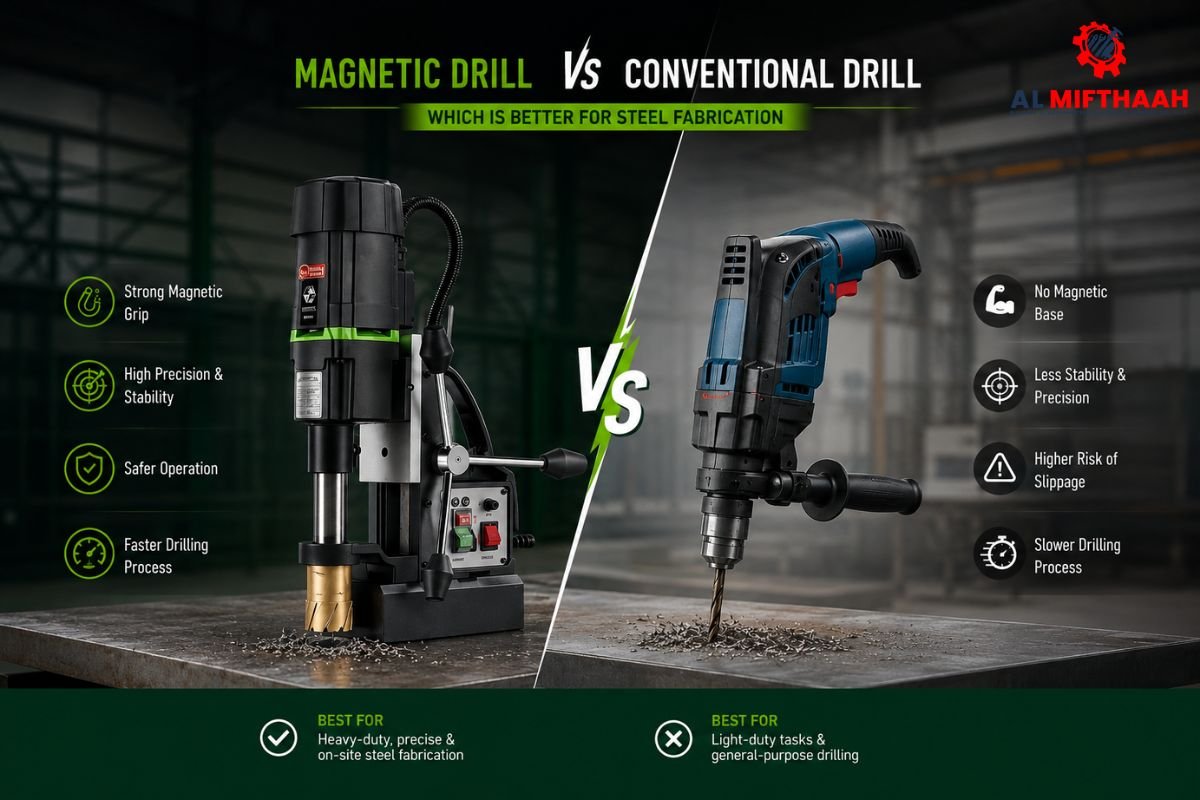
When it comes to steel fabrication, if the plate thickness exceeds 6mm, or the hole size is bigger than what a hand drill can do, magnetic drills pull ahead; their magnetic base has the strength to hold the steel surface with approximately 800 to 3,600 pounds, depending on the model. This strength allows the machine to operate from vertical columns, ceiling spaces, and curved beams without any requirement for clamps or bolted mounting. An AC-powered electromagnetic drill usually has the capability to retain a density of 2,000 to 3,000 kg once it is switched on.
With the addition of HSS annular cutting bits, the process becomes faster; while traditional drill bits need several minutes to finish making the hole, this option would use just a fraction of that time, since only part of the material needs to be removed. A standard drill is still relevant for small holes, deep bore applications beyond the limits of the drill bit, and applications where there are no ferrous materials to retain the magnet. Machine producers looking for drilling machines often first check magnetic drilling machine distributors in the UAE for stock, warranty conditions, and drill compatibility; it is also advantageous to go for a supplier also dealing in universal drilling tools.
Table of Contents
ToggleKey takeaways
- Magnetic drills allow vertical and overhead drilling without additional support since they grip steel effectively.
- HSS annular cutters need less power because they only cut material that surrounds holes.
- Conventional drillers are better for boring little holes and working with non-magnetic materials or when the holes go deeper.
- Steel that is thinner than 6- 8 mm might not provide enough thickness for magnetic grip.
What does a magnetic drilling machine actually do?
A magnetic drill press is a well-designed portable tool that relies on the electromagnetic base for its functioning. The magnet is turned on to attach to any ferrous metal with sufficient grip to keep the machine stable during the drilling process. In general, customers expect a holding capacity of two thousand to three thousand pounds, energy consumption of 10 – 12 amperes, and the ability to drill around 2 inches-diameter holes at a depth of 2 inches, which is applicable to most constructions involving structural steel elements.
However, the great thing about a magnetic drill is that it doesn’t need the workpiece to be delivered to it; it goes to the workpiece. It could be at the bottom of a structure that is being built, on a beam, on a curved pipe, etc. However, the disadvantage is that a magnet needs a significant amount of steel to be effective. Anything thinner than 3/8 of an inch cannot be considered effective for gripping, so fabricators should carefully place two pieces of scrap steel between two pieces of material that are too thin for use.
What does a conventional drill do in a fabrication shop?
A conventional drill, whether it is a benchtop model or a manual one, uses mechanical clamping rather than magnetism for the workpiece itself. It gets bolted, vice-clamped, or held in place, after which the twist drill moves on to carve through the entire volume of the hole, transforming it into continuous chips.
This grinding approach presents its primary limitation. Since twist drill bits have to do all the work of cutting through the entire hole volume rather than just cutting the perimeter, they take much longer and require greater torque to work through a hole; consequently, drilling a plate gets slower and hotter.
Besides, a hole may turn out to be ragged or oval if the workpiece is not securely fixed. However, a conventional drill can still have the advantage when it comes to drilling smaller pieces of work; after all, it is indifferent to whether the material is ferrous or not, reaching the full depth of the hole, and costing much less in terms of set-up costs needed for one-time jobs.
Magnetic drill vs conventional drill: key differences
| Factor | Magnetic Drill | Conventional Drill |
| Mounting | Electromagnetic base, no clamps needed | Bolted, vised, or clamped setup |
| Best plate thickness | 6mm and up (thinner stock needs sandwiching) | Any thickness, including thin sheet |
| Hole size | Large diameters via annular cutters, up to 100 mm on some machines | Best suited to smaller-diameter holes |
| Orientation | Works vertical, horizontal, overhead, curved | Mostly flat, bench-mounted work |
| Cutting speed on thick steel | Faster, lower motor load with annular cutters | Slower, higher torque demand |
| Material requirement | Must be ferrous/magnetic | Works on any material |
| Portability | High, moves to the job site | Limited without a mobile cart |
| Upfront cost | Higher | Lower |
Why do HSS annular cutters change the comparison?
The gap between the two machines widens once annular cutters enter the picture. An annular cutter is a hollow cylindrical tool with teeth around its rim. Instead of drilling through a solid core, it cuts only the ring at the hole’s edge and ejects a slug from the center once the cut is done. Because it’s only removing material at the perimeter, it typically needs about 30% of the power a twist drill would require for the same hole- which is why a portable magnetic drill can cut holes a hand drill motor could never manage with a full-core bit.
Furthermore, the speed difference shows up directly on the shop floor. An annular cutter removes roughly 80% less material than a twist drill cutting the same diameter, and that’s the main reason it finishes so much faster. Depending on the setup, that translates to boring large holes three to four times faster than a twist drill on the same job. Shops that switch from twist bits to annular cutters on structural plate work tend to see the biggest gains on connection holes above 20mm, where a twist drill was already struggling with heat and chip clearance.
For fabricators buying cutters locally, checking with established HSS Annular Cutters suppliers in dubai before a big order matters more than it sounds. Cutter quality varies a lot between brands, and a poorly ground HSS cutter dulls halfway through a batch of holes, which wipes out the speed advantage it’s supposed to give you.
When is a conventional drill still the right call?
The conventional drill hasn’t been made redundant. It’s still the correct tool in a few specific situations:
- Small holes under roughly 12mm, where a twist drill sets up faster and costs less than switching over cutters and arbors.
- Holes deeper than a cutter’s rated depth of cut, since annular cutters have a fixed maximum depth and a twist drill doesn’t.
- Non-ferrous material- aluminum, stainless steel without magnetic properties, or anything a magnetic base simply can’t hold.
- Thin sheet under about 3mm, where a slug won’t form properly and a step drill or hole saw does a cleaner job anyway.
Shops that own only magnetic drills tend to improvise badly on these jobs. Experienced fabricators usually keep at least one conventional drill on hand specifically for this overflow work. Drilling tools suppliers in the UAE can provide the best one.
Choosing equipment for your fabrication shop
Picking between the two isn’t really an either/or decision for most shops doing regular steel work. It comes down to matching the machine to the job mix. A fabricator running structural connections all day needs a magnetic drill as the primary tool and a bench drill for the small stuff. A shop doing mostly sheet metal or mixed materials might lean the other way.
What matters more than the brand name is who’s supplying the machine and the consumables behind it. Motor quality, magnet reliability, and cutter availability all come down to the supplier relationship, not just the spec sheet. Reputable Drilling tools suppliers in the UAE will usually walk through duty cycle, warranty terms, and what cutter sizes are actually in stock before recommending a model, instead of pushing whatever has the highest margin.
Therefore, fabricators buying in bulk often find it worth checking a couple of magnetic drilling machine dealers in Dubai side by side before settling on one, since stock and lead times shift often in this market.
Common mistakes fabricators make
- Buying a magnet base without checking minimum steel thickness- A drill rated for a 3,000 lb hold does nothing useful on a 4mm sheet without sandwiching.
- Skipping the safety strap on vertical or overhead work. Manufacturers include a mechanical strap for a reason — power loss or a surface irregularity can drop the magnet’s hold instantly.
- Running annular cutters at twist-drill speeds- Cutter RPM needs to drop as diameter increases; run it too fast, and you burn out the cutting edge fast.
- Ignoring surface preparation- Paint, rust, or scale under the magnetic base reduces holding force significantly, even on thick steel.
- Buying cutters on price alone- A cheap HSS blank from an unverified source rarely holds an edge, which is exactly why sticking with known HSS Annular Cutters suppliers in Dubai pays off over a full production run.
Expert insights from the shop floor
Fabricators who’ve run both machines for years tend to agree on one thing: the magnetic drill earns its cost back on volume, not on any single hole. A single connection hole doesn’t justify the price gap. Forty holes across a steel frame in a day does, easily. The other pattern worth flagging is cutter management- shops that resharpen HSS cutters instead of replacing them every time see a real drop in tooling spend, but only if they’re buying from suppliers who stock decent steel to start with. A cheap cutter doesn’t hold an edge through resharpening the way a properly heat-treated one does.
Finding reliable dealers in Dubai
Dubai’s steel fabrication and construction sector runs on a mix of local and imported tooling, and equipment quality between suppliers varies more than most buyers expect. Before ordering, it’s worth confirming stock availability, after-sales support, and whether the supplier carries matching consumables rather than just the machine itself. Working with established magnetic drilling machine dealers in Dubai who also stock arbors, cutters, and replacement magnets cuts out a lot of downtime compared with sourcing each part from a different vendor.
Saif Precision tools supplier in UAE, operating as Almifthaah, is one of the shops’ fabricators in the region they go back to for exactly this reason- the machines and the cutters that go with them come from the same place, so there’s less waiting between placing an order and actually cutting steel on site.
Bottom line
Most active fabrication shops end up needing both tools, but the magnetic drill is doing more of the heavy lifting once plate thickness, hole size, or job location gets demanding. It grips steel from angles a conventional drill press can’t reach, and paired with an HSS annular cutter, it cuts large holes at a fraction of the time and motor strain. The conventional drill still earns its keep on small holes, deep bores, and non-magnetic material, so it’s rarely worth retiring.
If you’re weighing options for your shop, Almifthaah works with fabricators across the UAE- as a trusted Saif Precision tools supplier in the UAE and one of the best drilling machine suppliers in Dubai– to match machines and cutters to the actual job mix, rather than selling a one-size-fits-all setup.
Frequently asked questions
Only on magnetic grades. Austenitic stainless, like 304 or 316, doesn’t hold a magnetic charge well, so the base won’t grip reliably without a clamp-on adapter.
Most machines need roughly 6- 8 mm of solid ferrous steel for a safe hold. Thinner stock should be sandwiched between scrap plates before drilling.
They are, and that’s their main advantage over carbide-tipped versions. Resharpening keeps long-term tooling cost down for shops running high hole volumes.
It is, provided you’re using the manufacturer’s safety strap. The strap holds the machine in place if power cuts out or the magnetic hold weakens unexpectedly.
On large-diameter holes in thick plate, annular cutters typically finish three to four times faster, since they cut only the hole’s edge instead of the full core.
You do. Flat-base magnetic drills don’t grip curved surfaces safely, so round stock needs a pipe-saddle or chain-mount base instead.
A 1 HP motor handles most structural work up to 1-inch plate. Heavier fabrication or stainless work usually needs 1.5 to 2 HP.
Rust, paint, or scale creates a gap between the magnet and the steel, which weakens the hold noticeably even on thick material.
Ideally, yes. Sourcing from the same supplier for both avoids compatibility issues between arbors and cutters down the line.
For occasional small-hole work, it usually is. The lower upfront cost and simpler setup win out when volume and hole size stay modest.

How Long Do Mounted Points Last and When Should You Replace Them?
Everything You Need to Know About Tool Wear in Carbide Tipped Cutting Tools