- August 21, 2026
- by Almifthaah
Mounted Points for Internal Grinding and Mold Finishing
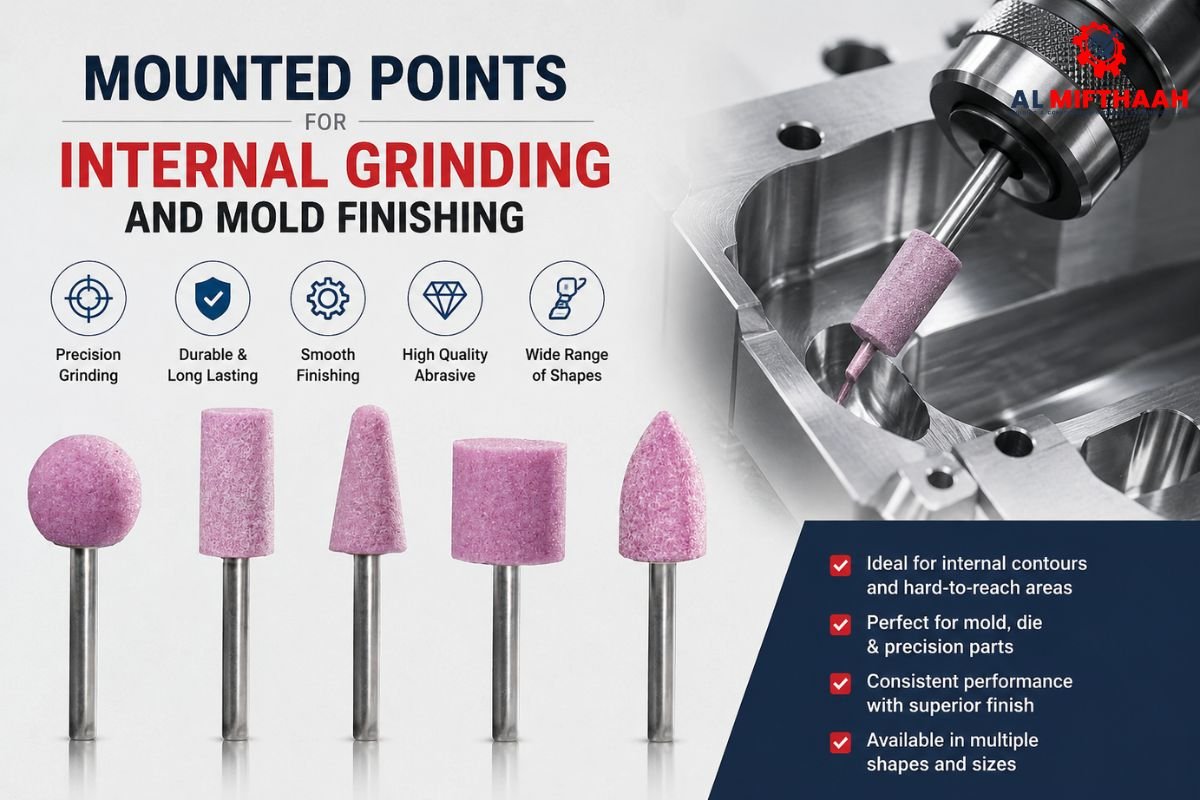
Mounted points are small abrasive forms that are made up of a metal shank. They help grind, polish, and deburr surfaces that cannot be reached using conventional wheels. Mounted points have a wide range of designs and sizes, and they serve various purposes depending on the material being worked on.
According to projections, the global market for abrasives was valued at $43 billion as of 2026 and is estimated to grow to $59.5 billion per annum if the trend continues. For the workshops in the UAE, working not only means saving from waiting for shipments from other countries but also faster access to the right shape and grit needed.
Table of Contents
ToggleKey takeaways
- Mounted points can access both internal bores, cavities, and molds that larger wheels cannot reach.
- Grit selection is of utmost importance; the coarse one is for stock removal while the fine one is for smoothing out the finishes.
- The abrasives market is still expanding along with the need for precision finishing tools.
- A trustworthy supplier of abrasive tools in Dubai saves time in addition to the cost of units.
What do mounted points actually do?
A mounted point is literally what it sounds like: an abrasive shape that is typically made from either aluminum oxide, silicon carbide, or a ceramic material that is bonded to a steel mandrel. The mandrel is then inserted in a die grinder or air tool, using the abrasive head as the cutting mechanism.
This invention was created to provide more access to areas where traditional methods may not work effectively, such as inside mold cavities, in the bore of a hydraulic valve, or in the interior of a casting. Mounted points can get into tight spaces, angles, and depressions due to the length of the shank, which provides access.
For example, toolsmiths and machinists frequently use mounted points to remove burrs left over from separating parts and to smooth out welds on mold steel or to remove roadblocks during boring that may require costly rework.
Types of mounted points and shapes
The shape is responsible for what type of geometry is possible, and the grit will define how aggressively the cutting tool works. The common shapes include:
- Cylindrical: flat or rounded, for straight hole walls
- Chiseled shapes: for slanted holes and sink holes
- Ball-shaped and oval: for rounded pockets in molds
- Inverted cone: for undercuts and grooves
Most shops maintain a limited variety in stock rather than only one style, since an average job depends on two or three styles. A single hardware tools supplier in Dubai that offers a wide choice of types minimizes the transportation effort needed compared with getting parts from various producers.
Picking the right grit for the job
It is mostly because of grit that one encounters problems while buying. Coarse grits (36 to 60) help in removing materials fast but leave visible scratch marks. They are OK if you only want to make rough shapes, and will not produce quality finished surfaces. Medium grits (80 to 120) are the grits frequently used for general deburring and blending tasks. Fine grits (150 and more) are ones you use after completing shaping work when all you need to do is improve a surface finish.
However, there is also an important difference in the bond type. Vitrified bond types are stable and more appropriate for harder tool steels. Resin-bonded points are not very stiff and can produce a smoother scratch pattern that is better for softer mold materials or when chatter is an issue.
Don’t forget the rule of thumb that is generally accepted in the work environment: never skip stages while changing grits. Trying to switch right from 60 to 220 grit in order to save time will usually force you to come back to 60 grit at some point since it is impossible to get rid of rough marks completely.
Internal grinding: where mounted points shine
Internal grinding covers any operation happening inside a bore, cavity, or recess rather than on an outer surface. Mounted points earn their place here because a full internal grinding machine setup often isn’t practical for a one-off repair or a low-volume mold.
Common internal grinding tasks include cleaning up bore taper after heat treatment distortion, removing tool marks left by boring bars, correcting minor out-of-round conditions in bushings, and blending radii where two machined surfaces meet.
Speed control matters more here than people expect. Running a mounted point too fast on a small-diameter bore generates heat quickly, which can glaze the abrasive surface and, on hardened steel, even draw temper in the part. Slower speeds with light, consistent pressure usually outperform aggressive, fast passes.
Mold finishing and surface quality
Mold finishing is arguably where mounted points matter most, because the surface finish on a mold cavity transfers directly onto every part molded from it. A scratch, pit, or uneven texture in the tool steel shows up on thousands of molded pieces afterward.
The typical mold finishing sequence moves from stock removal to progressively finer abrasives. Mounted points usually cover the middle stages: after rough EDM or milling, before hand-polishing with stones and diamond paste takes over. Skipping this middle stage is a common shortcut that backfires, because hand polishing alone struggles to remove deep EDM recast layers efficiently.
For textured mold surfaces, like leather grain or matte finishes, the approach flips. You’re not chasing a mirror finish. You’re maintaining a consistent scratch pattern across the whole cavity so the texture reads evenly once it’s etched.
Mistakes that ruin tool life and finish
A few recurring errors show up across most workshops.
- Using a worn point too long is one of the most common. A glazed or loaded abrasive surface stops cutting efficiently and starts generating heat instead, so it’s worth dressing or replacing it rather than pushing through.
- Wrong shank diameter is another. A loose-fitting shank causes runout, which shows up as an inconsistent finish no matter how good the abrasive is.
- Excessive pressure trips people up too. More force doesn’t mean faster stock removal. It usually just means faster tool wear and a rougher surface.
- And ignoring material compatibility costs more than people realize. Silicon carbide points work well on non-ferrous metals and cast iron but wear out fast on hardened tool steel, where aluminum oxide or ceramic grain performs better.
Mounted point comparison at a glance
| Abrasive Type | Best For | Typical Grit Range | Notes |
| Aluminum oxide | Tool steel, general mold work | 60-150 | Good balance of cut rate and durability |
| Silicon carbide | Cast iron, non-ferrous metals | 36-120 | Cuts fast but wears quicker on hard steel |
| Ceramic grain | Hardened steel, high-volume shops | 60-100 | Longer life, higher upfront cost |
| Resin bond | Fine finishing, softer materials | 100-240 | Smoother scratch pattern, less aggressive |
Choosing a supplier you can rely on
Tool selection only matters if the supply chain behind it is dependable. In the UAE, mold shops and machining workshops typically juggle several vendors: one for cutting tools, another for measuring equipment, a third for abrasives. That adds friction when a job is waiting on a specific grit or shape.
Furthermore, working with a single industrial equipment dealer in Dubai that stocks mounted points alongside related grinding and finishing consumables cuts down on that friction considerably. It’s also worth asking any potential supplier directly about batch consistency. Abrasive grain quality can vary noticeably between production runs, and a supplier who tracks this is worth more than one who simply has the lowest listed price.
Buyers researching options online sometimes come across specific supplier names, including searches for Saif Precision tools supplier in UAE, while comparing who actually stocks precision-grade mounted points versus general hardware. It’s a reasonable comparison to make. Availability and technical support usually matter more day-to-day than the brand printed on the shank.
This is where Almifthaah fits into the picture for many Dubai-based workshops. As an abrasive tools supplier Dubai toolmakers and mold shops return to, Almifthaah keeps a working stock of mounted points across shapes, grits, and bond types, so a specific job doesn’t stall waiting on an import order.
Bottom line
Mounted points look like a small line item on a tooling budget, but they carry outsized influence over how a mold cavity or internal bore actually turns out. Getting the shape, grit, and bond type right, and not cutting corners on the middle finishing stages, saves rework time that far outweighs the cost of the abrasive itself.
Pairing that technical judgment with a supplier who actually stocks what you need, when you need it, is what keeps a finishing job on schedule. If you’re weighing options among abrasive tools dealers in Dubai, it’s worth talking to Almifthaah about what a specific mold or grinding job actually calls for before defaulting to whatever’s already on the shelf.
Frequently asked questions
A mounted point is a small abrasive shape on a shank to use on internal or inaccessible surfaces, and a grinding wheel is larger and attached to a bench or floor machine for use on flat or exterior surfaces.
Yes, but not as long as the silicon carbides wear out more quickly at this hardness than do aluminum oxide or ceramic-grain points.
Begin with a coarse grit to clear away EDM recast and then switch to medium and fine grits, but not to the polishing grit.
Typically, too great a pressure, improper material selection, or excessive running speed causes heat to build up and glaze the abrasive surface too soon.
Yes, they are used to provide a uniform scratch pattern on a textured surface and not to smooth it out.
The majority of mounted points have either a 1/8” or 1/4” shank, corresponding to the size of the collet found on standard die grinders and flexible shaft tools.
Vitrified bonds tend to have a longer service life and are better able to withstand hard materials, whereas resin bonds are selected for their ability to create a smoother surface rather than for their durability.
When cutting efficiency begins to decline noticeably, or surface heat marks appear, it’s time to dress the point or replace it.
Instead of buying hardware from various vendors, workshops usually seek a Dubai-based, technically savvy hardware supplier, such as Almifthaah.
Not necessarily. While price is important, it is not the most important, and questions about sourcing and QC are worth asking a supplier.

How Long Do Mounted Points Last and When Should You Replace Them?
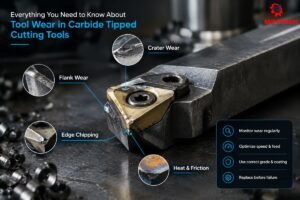
Everything You Need to Know About Tool Wear in Carbide Tipped Cutting Tools