
- August 17, 2026
- by Almifthaah
Stainless Steel vs Brass Shim Stock: Which One Is Better?
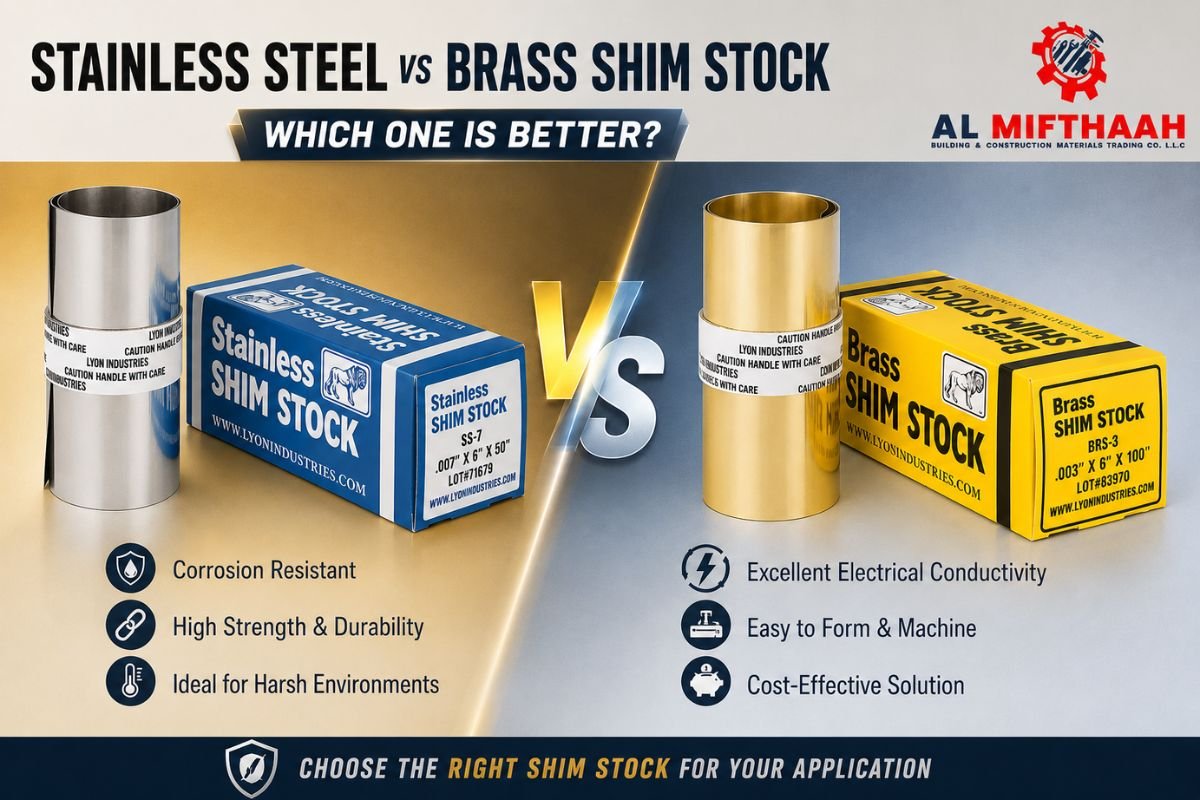
There is no one single winner. Stainless steel has the following: takes heavy load and does well in corrosive environments; brass is good for conductivity and easy machining. Another issue is that stainless steel has a higher tensile strength, around 505-515 MPa, compared to brass, whose tensile strength ranges between 340-470 MPa. The choice should depend on the application. Most Shim Stock suppliers will recommend the materials according to the needs of the customer.
Table of Contents
ToggleKey takeaways
- 304 grade stainless steel possesses greater tensile strength in comparison to the conventional brass shim stock.
- Brass is superior to stainless steel in terms of heat and electrical conductivity.
- The corrosion-resistant properties of stainless steel are better than those of brass, especially in the humid coastal climate of Dubai.
- However, brass is easier to machine and is cheaper to buy, provided that heavier loads are not applied.
What does shim stock actually do?
Shim stock refers to a material that is flat in structure and occupies gaps in surfaces and also maintains the desired clearance between mechanical parts. This is all pretty straightforward. But actually, the choice of material makes the difference between the design being noisy in the months after production or providing long-lasting performance with almost no noise for many years.
Therefore, shim stock is manufactured by various manufacturers in different thicknesses, starting from about 0.05 mm but can reach one millimeter in length. Engineers apply these materials depending on the tolerance they want to achieve. However, if the wrong material is applied, thickness concern does not really matter. For example, a brass shim in a hot and humid compressor housing would wear out much quicker than a stainless steel shim.
Stainless steel shim stock: strength and corrosion resistance
304 is the standard grade for shim stock. Tensile strength around 505 to 515 MPa, yield strength near 205 MPa, and it holds its shape under pressure instead of deforming the way softer metals do. Brinell hardness comes in around 200 HB, nearly three times harder than brass.
The chromium content, usually 18 percent, is what keeps rust off. In this region, that’s not a minor detail. Coastal humidity, AC condensation, dust that holds moisture against a surface- it all adds up, and a brass shim left outdoors or in a semi-industrial setting will start showing green corrosion sooner than most people expect. Stainless steel doesn’t run into that under normal conditions.
Moreover, it has a limit, though. Heavy chloride exposure at high temperature can trigger pitting or stress corrosion cracking in 304 over time. Near saltwater, chemical processing lines, or anything chloride-heavy, 316 is the better grade because of the molybdenum it adds.
You’ll see it in aerospace fasteners, marine equipment, machinery alignment, oil and gas fittings, and medical devices where sterilization and long service life both matter.
Brass shim stock: softness, conductivity, and ease of use
Brass is a copper-zinc alloy and sits closer to the opposite end of the spectrum. Tensile strength runs 340 to 470 MPa, about a third below stainless steel, with Brinell hardness down around 55 to 73 HB. That’s not a downside in most brass applications. It’s why brass cuts, bends, and stamps so much more easily, saving machining time and tooling wear on high-volume precision parts.
Thermal conductivity is where brass actually pulls ahead by a wide margin, 109 to 115 W/m·K against stainless steel’s 16. Electrical conductivity tracks the same way. That’s why brass turns up in switchgear, connectors, and heat exchanger parts where the shim needs to carry current or heat, not just fill space.
Additionally, it resists corrosion fine in dry, mild conditions, and it’s non-sparking, which makes it a safer choice around flammable materials or gas lines. Non-magnetic too, useful in instrumentation where a stray magnetic field can throw off a sensitive reading.
Moisture and salt are its weak point. Zinc can leach out under alkaline or salty conditions, a process called dezincification, and it weakens the metal from the inside without much outward warning.
Stainless steel vs brass: side-by-side comparison
| Property | Stainless Steel (304) | Brass (C36000) |
| Tensile strength | ~505–515 MPa | ~340–470 MPa |
| Yield strength | ~205 MPa | ~125–310 MPa |
| Hardness (Brinell) | ~200 HB | ~55–73 HB |
| Thermal conductivity | ~16 W/m·K | ~109–115 W/m·K |
| Corrosion resistance | Strong in humid/wet conditions | Good in mild, dry conditions only |
| Machinability | Slower, needs harder tooling | Fast, easy to stamp and cut |
| Magnetic properties | Slightly magnetic (304) | Non-magnetic |
| Typical cost | Higher | Lower |
Which one should you pick?
Look at the environment first. Humid, outdoors, exposed to cleaning chemicals? Stainless steel is worth the extra cost there. Dry and indoors, doing light adjustment work in a panel or small instrument? Brass gets it done for less, with less machining effort.
Load counts too. A shim under constant compression, between a motor base and its mounting plate for instance, needs the strength only stainless provides. A shim adjusting valve clearance in a low-vibration setup doesn’t need nearly that much backing it up.
Furthermore, buyers working with precision instruments suppliers in Dubai sometimes ask about mixing materials in one assembly. It’s a reasonable approach: stainless where load or moisture is the concern, brass where conductivity or fine stamping matters more.
Mistakes buyers make when choosing shim stock
Picking by price alone, without weighing the environment, is the most common one. A shim that’s 30 percent cheaper but corrodes within a year ends up costing more once downtime and replacement labor are added in.
Treating every stainless grade as interchangeable is another. 304 and 316 look almost identical on a spec sheet, but 316’s extra corrosion resistance matters in chloride-heavy settings. Skip that distinction and pitting shows up somewhere it shouldn’t have.
Buying from inconsistent industrial equipment dealers in Dubai causes its own trouble, mainly unreliable thickness tolerances and unclear certification. A shim off by a few microns can throw an entire alignment job off, so checking material source and batch documentation before buying saves a lot of grief later.
Where to source shim stock in Dubai?
Dubai’s industrial base runs on precision work, automotive service centers, structural fabrication, and demand for shim stock suppliers in Dubai holds fairly steady across the year. The market ranges from small custom-cut shops to established suppliers carrying full material certification.
A Lyon shim stock supplier in Dubai is worth checking for standardized sheet sizes and gauge ranges. A Saif Precision tools supplier in UAE tends to handle more custom-cut work tied to specific machinery specs. The name on the invoice matters less than whether the supplier can confirm material grade, thickness tolerance, and hand over traceable certification when asked.
Expert Insight
Sourcing shim stock for clients across automotive, structural, and industrial machinery work, I keep running into the same thing: people treat the shim material as an afterthought until something fails. It doesn’t get the scrutiny that bearings or fasteners get, even though a bad material choice causes the same kind of downtime.
However, if the environment is anywhere close to harsh, stainless is the safer default. The cost gap on a small shim is nothing next to a machine going out of alignment because a brass shim corroded and lost thickness. Lyon shim stock supplier in Dubai can be helpful.
Wrapping it up
Stainless is better able to handle load, heat, and moisture. Brass conducts heat and can be easily fabricated. None of them win all of the time; so fit the metal to the place where the shim is meant to fit and not to the place that sounds more expensive.
Almifthaah collaborates with clients throughout the UAE to provide the most suitable shim stock grade and thickness with appropriate certification for each material requirement.
Frequently asked questions
Yes. 304 stainless has a tensile strength of 505-515 MPa while brass has 340-470 MPa; this means that the stainless carries more load before failure.
Stainless steel. Chromium content prevents it from rusting, and brass can leach zinc over time in wet conditions.
Only in areas with continued dry, mild weather. It corrodes faster in a location that is constantly wet or salted than stainless.
That’s what makes it a key material in switchgear and connectors for its ability to conduct electricity and heat, about seven times as effectively as stainless steel.
Yes – the molybdenum is added in chloride rich environments. Generally 304 stainless steel is sufficient for basic dry industrial applications.
Usually. It is softer and will machine faster, helping to reduce tool wear and manufacturing costs.
Most suppliers have it available in most thicknesses from around 0.05mm up to 1mm or more depending on the adjustability required for the job or whether more spacing is required.
Look out for material certification, uniform thickness tolerances, and grade documentation. Don’t apply the price filter.
Yes, this is fairly common. S/S where load or moisture is the concern, brass where conductivity or fine stamping is the major concern.
No, that’s why it is still employed in instrumentation, because it could upset a sensitive reading by a magnetic shim.

How Long Do Mounted Points Last and When Should You Replace Them?

Everything You Need to Know About Tool Wear in Carbide Tipped Cutting Tools