

- August 7, 2026
- by Almifthaah
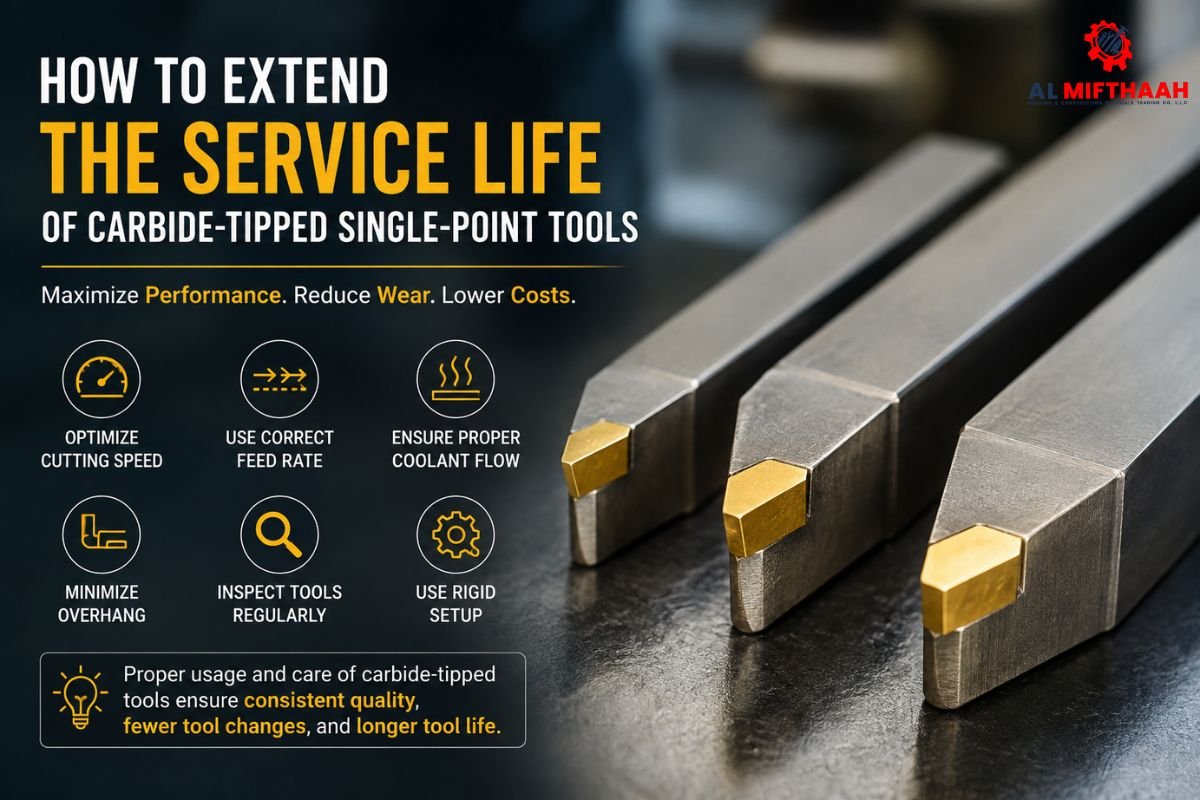
How to Extend the Service Life of Carbide-Tipped Single-Point Tools
Table of Contents
ToggleKey takeaways
- The longevity of a tool is more closely related to the cutting conditions and coolant use than to the type of cemented carbide used.
- Inappropriate speeds and dry cutting lead to most premature failures of the tips.
- The cost of regular maintenance and regrinding is certainly cheaper than that of replacing the tool once worn out.
- Purchasing from a reputable Carbide Tipped Single Point Tools supplier located in Dubai ensures stable quality of the products and a reliable contact in case any problems arise.
A carbide-tipped single-point tool doesn’t fail because carbide is weak. It fails because of small, repeated mistakes in how it’s used, cooled, and stored. Talk to most machinists who complain about short tool life, and you’ll usually find the correct tool running at the wrong speed, or coolant getting skipped on a pass that needed it. Fix the process, and the same tool that lasted two shifts can run for two weeks.
In this blog, we will explain the reasons for reduced tool durability on the shop floor rather than in laboratory conditions, as well as what a good procedure for maximizing the operation of each insert or brazed tool looks like.
Why do carbide tipped tools wear out faster than expected?
In spite of the fact that carbide is very strong, it is still more fragile compared to high-speed steel, which is responsible for the majority of problems associated with the use of carbide tools. HSS bends before it breaks. Carbide chips before it bends. So the wear you’ll actually see usually isn’t gradual dulling. It’s small edge fractures caused by heat shock, vibration, or an interrupted cut catching the tool off guard.
However, heat buildup from incorrect speed or feed does the most damage over time. Mechanical shock from interrupted cuts or a workpiece that isn’t held firmly comes next. Chemical wear, where the tool reacts with certain materials at high temperature, matters less often but still shows up on stainless and some alloys.
None of these points to a flaw in the tool itself. It’s a process, which means it’s fixable.
Choosing the right grade for the job
Not every carbide grade suits every material. A grade built for cast iron behaves differently on stainless, and using the wrong one is a common, avoidable reason tools underperform.
| Workpiece Material | Recommended Carbide Grade | Notes |
| Cast iron | K-grade (uncoated or coated) | Good abrasion resistance |
| Mild steel | P-grade | Balances toughness and wear resistance |
| Stainless steel | M-grade | Handles built-up edge tendency |
| Aluminum, non-ferrous | N-grade | Sharp edge geometry, polished flutes |
| High-temp alloys | S-grade | Heat-resistant coatings recommended |
If you’re not sure which grade fits your job, ask your supplier rather than guessing from a catalogue. A reliable carbide tip single point tool Dubai stockist should have technical staff who can match grade to material and cutting conditions before you buy anything.
Setting correct cutting parameters
This is where most tool life gets won or lost. Operating a tool faster than the specified speed of 15 to 20% can reduce the time taken for each cycle, but it can lead to a reduction in the lifespan of the tool. The cost-benefit usually does not work out in your favor.
- Speed (SFM/RPM): Always follow the manufacturer’s guidelines for speed limits. Too much speed creates excessive heat and cannot be dissipated by the carbide..
- Feed rate: A very low feed rate leads to tool rubbing without cutting, creating heat without removing material. Too high a feed rate increases the stress on the tool edge.
- Depth of cut: Shallow, repeated passes on hard materials often outlast one aggressive pass, especially on interrupted cuts where shock loading matters more than how much material you’re clearing per pass.
Moreover, here’s a rough test some experienced machinists use: if the chips are showing blue or purple, the tool’s running too hot. On most steels, chips should come off silver to light straw colored.
The role of coolant and lubrication
Dry cutting isn’t automatically wrong. Some carbide grades and coatings are built for it. But when coolant is specified and skipped anyway, tool life drops fast. Thermal cycling results in the periodic heating and cooling that leads to tiny cracks developing along the edges that cannot be observed until the tool breaks down.
Flood coolant needs to reach the cut zone, not just sprayed outside it. Intermittent coolant can be worse than having no coolant at all because it creates thermal shock cycles instead of continuous cooling. Concentration of the coolant is important as well – if it is too low, it may not be effective in removing heat while if it is too strong, it can leave residue that negatively affects the surface finish.
Tool geometry and rake angle adjustments
A single-point tool ground with the wrong rake angle wears unevenly no matter how good the carbide is. Positive rake cuts cleaner and works well on softer, gummy materials. Negative rake trades higher cutting forces for a stronger edge, which is what you want on harder materials and interrupted cuts.
Relief angle matters just as much. If the tool is given insufficient or excessive pressure, it will cause friction heat from the contact with the surface. If there is not enough force applied, the tool will not cut, creating only friction heat. If the force is way too high, the cutting edge becomes a weak point and breaks when put under pressure.
So, that means that if you regrind your tools in-house, you have to make sure your geometries are consistently applied. A tool that is re-grinded awry every time will perform worse at every next operation even though it seems sharp when you check it with a loupe.
Handling, storage, and transport
A lot of tool damage happens before the tool ever touches a workpiece. Worth building into your shop routine:
- Store tools in individual slots or cases instead of loose in a drawer, where edges chip against each other.
- Keep tools away from moisture. Brazed carbide tips can suffer thermal stress if storage temperature swings around.
- Don’t drop inserts or tips, even from a short height. Carbide’s brittleness means an impact that wouldn’t scratch steel can crack a cutting edge outright.
- Clean tools before storage so coolant residue doesn’t corrode the shank or braze joint over time.
Common mistakes that shorten tool life
- Running the same speed for every material- Cast iron, mild steel, and stainless don’t behave the same way under a cutting edge. Treating them identically is one of the most common shortcuts that quietly costs tool life.
- Ignoring early wear signs- A slightly worn edge caught early can be reground. Left in service until it fails, that same edge often chips deep enough that regrinding wastes more material, or isn’t possible at all.
- Using the wrong tool for interrupted cuts- Geometry built for continuous cuts usually can’t handle the repeated shock loading of interrupted work, and it chips sooner than most people expect.
- Skipping coolant on “quick jobs”- Even a five-minute cut generates real localized heat. That assumption, that short jobs don’t need coolant, is one of the more expensive habits in a busy shop.
Signs a tool needs regrinding or replacement
- Visible chipping along the cutting edge, even minor
- Discoloration on the tool itself, not just the chips, which points to heat damage
- Increased cutting noise or vibration on a cut that used to run smooth
- Poor surface finish despite unchanged parameters
- Built-up edge that won’t clear with normal coolant flow
Furthermore, catch these early and send the tool, such as cutting and milling tools Dubai, for regrinding instead of running it to failure. It’s usually the cheapest way to stretch the effective service life of your whole tool inventory.
Working with the right supplier
Tool life isn’t only about how you use a tool. It starts with what you bought. Poor carbide quality, bad brazing joints, or mechanical errors from a poor batch can spoil even a well-thought-out cutting process; nothing can be done after the fact.
Almifthaah provides precise cutting tools and abrasives to its partners from all over the UAE; the company cooperates with machine shops directly to match tool grade and geometry to actual cutting conditions instead of forcing them to comply with predetermined items.
Moreover, a reliable supplier of Saif Precision tools supplier in UAE makes it easy to get replacement tools or regrind from them in a timely manner.
For workshops weighing their options in the region, sticking with one cutting and milling tools Dubai supplier, rather than switching between vendors purely on price, tends to produce steadier tool performance over time. The supplier gets to know your material mix and cutting conditions well enough to actually help.
Wrapping it up
Extending the service life of carbide-tipped single-point tools comes down to a handful of controllable factors: matching grade to material, keeping cutting parameters in range, managing heat with proper coolant use, and handling tools carefully between cuts. None of it requires exotic equipment or a process overhaul. It just requires consistency.
If your shop is burning through tools faster than expected, check speeds and coolant delivery before blaming the tool. And if you’re sourcing new tooling, working with an experienced Carbide Tipped Single Point Tools supplier in Dubai like Almifthaah can help you catch quality issues before they ever reach the machine.
Reach out to Almifthaah for grade recommendations, technical support, or bulk pricing on precision tooling for your workshop.
Frequently asked questions
How long should a carbide tipped single point tool last?
That depends on material and application, but correct speeds, coolant, and handling can often stretch tool life by 30 to 50 percent over poorly managed use.
Can carbide tipped tools be reground multiple times?
Most can, several times, if you catch them before major chipping sets in. Each regrind removes a bit of material, so overall life still drops with each pass.
What causes carbide tools to chip unexpectedly?
Usually sudden mechanical shock from an interrupted cut, the wrong rake angle, or thermal shock from inconsistent coolant application.
Is dry cutting bad for carbide tools?
Not necessarily. Some grades and coatings are built for it. The real problem shows up when coolant is specified but applied inconsistently, which causes thermal cycling.
How do I know if I’m running the tool too fast?
Watch the chip color. Blue or purple tinted chips almost always mean the speed is too high for the material.
Does storage really affect tool life?
Yes. Loose storage lets edges chip against other tools, and moisture exposure can weaken braze joints on brazed-tip tools over time.
What’s the difference between P, M, and K carbide grades?
P-grade suits steel, M-grade suits stainless steel, and K-grade suits cast iron and non-ferrous materials. The split comes down to how each grade balances hardness against toughness.
Should I always buy the hardest carbide grade available?
No, and this trips people up. Harder grades are more brittle and chip more easily under shock loading. Match toughness to your actual cutting conditions instead of chasing maximum hardness.
How often should tools be inspected for wear?
A quick visual check during use, plus a closer look at the start of each shift, catches most wear problems before they turn into failures.
Why does supplier quality matter for tool life?
Because inconsistent braze joints, grinding tolerances, or carbide batches from an unreliable supplier undercut tool performance no matter how carefully you machine.

How Long Do Mounted Points Last and When Should You Replace Them?

Everything You Need to Know About Tool Wear in Carbide Tipped Cutting Tools