
- July 30, 2026
- by Almifthaah
How Magnetic Drill Machines Increase Productivity in Fabrication Shops
Table of Contents
ToggleKey Takeaways
- Magnetic drill machines work directly on the steel itself, so there’s no clamping table to fight with
- One person with a portable mag drill can now do what used to take two workers and a crane
- Reliable magnetic drilling machine dealers in Dubai are worth paying attention to, since weak after-sales support is what actually causes downtime, not the machine
- A cutter chosen for the wrong job wears out fast- maintenance and the right cutter size are what keep output steady month after month
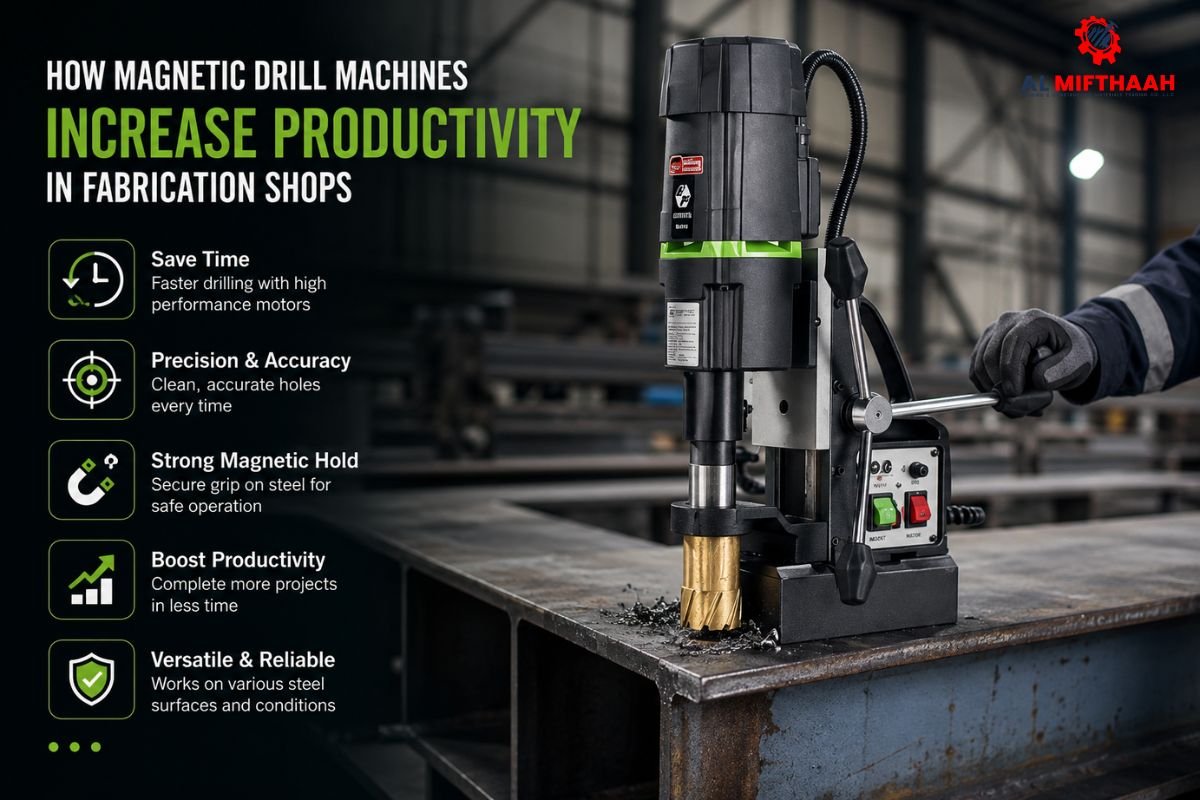
Magnetic drill machines increase productivity in fabrication shops because the drill goes to the steel, not the other way round. The magnetic base clamps onto beams, pipes, and plates on the spot, so a job that once needed a crane, a fixed table, and two extra hands can be done by one person. Shops that make the switch tend to see faster turnaround and lower labour cost per project pretty quickly. Working with dependable magnetic drilling machine dealers in Dubai makes that transition less bumpy, since the right machine and the right support keep a production line from stalling out mid-project.
Fabrication runs on deadlines. Push back drilling by a day and welding, assembly, and delivery all slide with it. That’s part of why more workshop owners in Dubai are looking at their tool setup again this year.
What do magnetic drilling machines actually do?
A magnetic drill, or mag drill, has an electromagnet built into the base that grips steel hard once it’s switched on. It stays put on a vertical wall or under a beam just as well as it does on a flat surface, which means operators can drill at odd angles without dragging the material to a stationary machine first.
However, a regular drill press works the other way. The material comes to it. That’s fine for small parts, but for large steel sections in construction or shipbuilding, hauling everything to a fixed drill is slow and often needs extra manpower just to move things.
Most current models include:
- Variable speed settings for different metal thicknesses
- Annular cutters, which remove a ring of metal instead of the whole core and cut drilling time noticeably
- Coolant systems that keep the cutter from overheating
- Lighter, more compact bodies built for one person to carry and operate
That’s the core reason shops report faster output after switching tools. Nothing complicated about it; the drill just spends less time being moved around.
Why do fabrication shops need speed?
Speed isn’t only about wrapping up early. It decides how many jobs a shop can realistically take in a month, how tight a delivery date can be, and how sharp a quote can get against a competitor.
Moreover, a shop doing structural steel, HVAC ducting, or metal furniture might drill dozens of holes on a single project. Add a few extra minutes per hole for setup or repositioning, and across a few hundred holes that adds up to hours, sometimes a full extra shift.
A magnetic drill mounts directly onto the steel, so the marking, clamping, and table adjustment steps disappear. A task that needed two workers and a crane can now run with one technician, a portable mag drill, and a power outlet.
Shops that switch suppliers to more experienced magnetic drilling machine dealers in Dubai often notice the change within the first couple of projects. Getting matched with the right cutter size, motor power, and base strength for the steel grade they actually work with removes a lot of the trial and error.
Cutting downtime on the shop floor
Downtime is the cost nobody puts on a spreadsheet, but it’s there. Every minute a machine sits idle waiting to be repositioned or fixed is a minute nothing gets built.
Mag drills chip away at three specific sources of downtime:
- Setup delays- The machine clamps onto the material itself, so nobody’s lifting a heavy steel section onto a drill table first. On a large piece, that alone can save 15 to 20 minutes.
- Repositioning time- Multi-hole jobs just mean lifting the magnetic base and moving it along the same beam or plate. No re-clamping, no starting the alignment over.
- Breakdowns- Mag drills with brushless motors run cooler under continuous use and tend to hold up better across a full shift, which cuts down on midday repairs.
However, shops that actually track their numbers before and after switching to magnetic drilling usually see idle machine hours drop. A few have said their structural steel batches finish in close to half the time, mostly because nobody’s hauling heavy material back and forth anymore.
Safety gains that save money
Productivity and safety get treated as separate topics more often than they should be. An accident doesn’t just hurt the person involved. It stops the line, generates paperwork, and can raise insurance costs that quietly eat into margins for months.
Magnetic drilling cuts down on a few specific risks that come up constantly in fabrication work:
- Less manual lifting, since the steel stays where it is instead of getting hauled to a fixed drill
- Fewer pinch points, because the magnetic base holds the tool without someone bracing it by hand
- Lower vibration exposure on newer models with anti-vibration handles
- Less risk of a dropped tool, thanks to safety chains and a secure mount
Avoid even one lost-time injury a year and a shop has already clawed back a decent chunk of what the equipment cost. It’s part of why buyers who’ve been burned before look hard at build quality when picking from drilling tools suppliers in UAE, instead of grabbing whatever’s cheapest.
Choosing the right machine setup
Not every mag drill fits every job, and picking the right specs matters just as much as picking the right supplier. Worth checking before buying:
- Magnetic force rating– A higher rating holds better on thinner or curved steel, which matters a lot for pipe and tank work
- Motor power– Structural beam work needs a stronger motor so it doesn’t overheat during a long shift
- Stroke length – A longer stroke means deeper holes without swapping cutters halfway through
- Portability– Shops moving between sites do better with lighter models and a carry case
- Cutter compatibility– Standard annular cutter sizes keep replacement costs from creeping up over time
Therefore, some Dubai workshop owners now talk specs through directly with the best drilling machine suppliers in Dubai before buying, because matching the machine to the actual job avoids expensive mismatches down the line. A machine built for light sheet work will struggle on thick structural steel, and a heavy-duty one is overkill and awkward for delicate precision jobs.
Comparing standard vs magnetic drilling
| Factor | Standard Drill Press | Magnetic Drilling Machine |
| Setup time | Material must be moved to machine | Machine moves to material |
| Crew needed | Often two or more workers | Usually one worker |
| Drilling angle | Fixed, mostly horizontal | Any angle, including vertical and overhead |
| Portability | Stationary | Fully portable |
| Best for | Small parts, workshop-only jobs | Large steel structures, on-site fabrication |
| Hole accuracy | High on flat, clamped parts | High, with magnetic base stability |
| Typical cost | Lower upfront | Moderate upfront, lower long-term labour cost |
Most shops end up keeping both. But the bulk of structural and on-site work tends to shift toward the mag drill once people get used to it.
Where to buy in Dubai?
Dubai’s fabrication and construction sector doesn’t leave much room for slack schedules. A machine breaking down mid-project shifts the whole timeline, sometimes by more than the repair itself takes. So the supplier matters almost as much as the machine.
A solid magnetic drilling machine dealer in Dubai usually goes beyond just the sale. Worth checking for:
- Genuine spare parts and cutters, not unbranded copies
- Actual after-sales servicing and warranty support
- Technical guidance matched to your specific job type
- Stock on hand for urgent replacements
Almifthaah has built a name among UAE fabrication shops for stocking a wide range of precision tools alongside magnetic drilling equipment, which saves buyers from juggling several vendors just to keep a shop running. Shops that deal with professionals, or comparable names like Saif Precision tools supplier in UAE, tend to find it easier to plan replacement schedules instead of scrambling at the last minute.
If you’re still comparing options, ask for a demo before committing to anything. A quick test on your own material tells you more in ten minutes than a spec sheet will in an hour, and Almifthaah is one of the names that comes up when shop owners talk about doing exactly that kind of hands-on comparison.
Bottom line
Shops that switch to magnetic drilling machines usually feel the difference by their first couple of large projects. Less setup time, fewer safety incidents, a smaller crew needed for the same job. It adds up over a busy quarter. But the machine is only half the equation. Working with a magnetic drilling machine dealer in Dubai you can actually rely on is what makes sure the machine, the support, and the spare parts show up when a deadline is tight.
Still running stationary drill presses for structural steel work? Might be worth a call to a local supplier for a demo. Try a couple of models on your own material, ask about the after-sales terms honestly, and talk to a team that understands fabrication schedules rather than one that’s just moving inventory. That one conversation tends to save a lot more downtime than it costs in time spent having it.
Frequently asked questions
Drilling precise holes in steel structures, on site or in a workshop, with the machine holding itself in place magnetically instead of by clamps.
It varies by job, but shops commonly report saving 15 to 30 minutes per large piece just by skipping clamping and repositioning.
Yes. The magnetic base holds firmly on vertical or overhead steel as long as the surface is clean and the magnetic force is adequate for the job.
Magnetic force rating, motor power, stroke length, and cutter compatibility, all matched against the kind of work your shop does most.
Yes, typically annular cutters. They remove a ring of metal instead of the full core, which is most of why drilling gets faster.
Mostly, yes. Most models are built for single-person operation, which is a big part of why crew size drops compared to a drill press.
Look for established drilling tools suppliers in UAE offering real warranty support, genuine parts, and technical guidance, not just a sale.
Yes, provided the magnetic force rating and cutter size are matched correctly. Thin and curved surfaces are handled fine without losing accuracy.

How Long Do Mounted Points Last and When Should You Replace Them?
Everything You Need to Know About Tool Wear in Carbide Tipped Cutting Tools