- June 6, 2026
- by Almifthaah
How to Select the Right Grit Size in Mounted Points for Perfect Finishing?
Table of Contents
ToggleKey Takeaways
- Smaller grit numbers will remove material more rapidly but will give rougher finishes.
- The higher the grit number, the smoother and more precise the surface finishes will be.
- The best grit size will depend on the type of material and finishing desired.
- Performance and consistency are maximized by using quality abrasives from reliable suppliers.
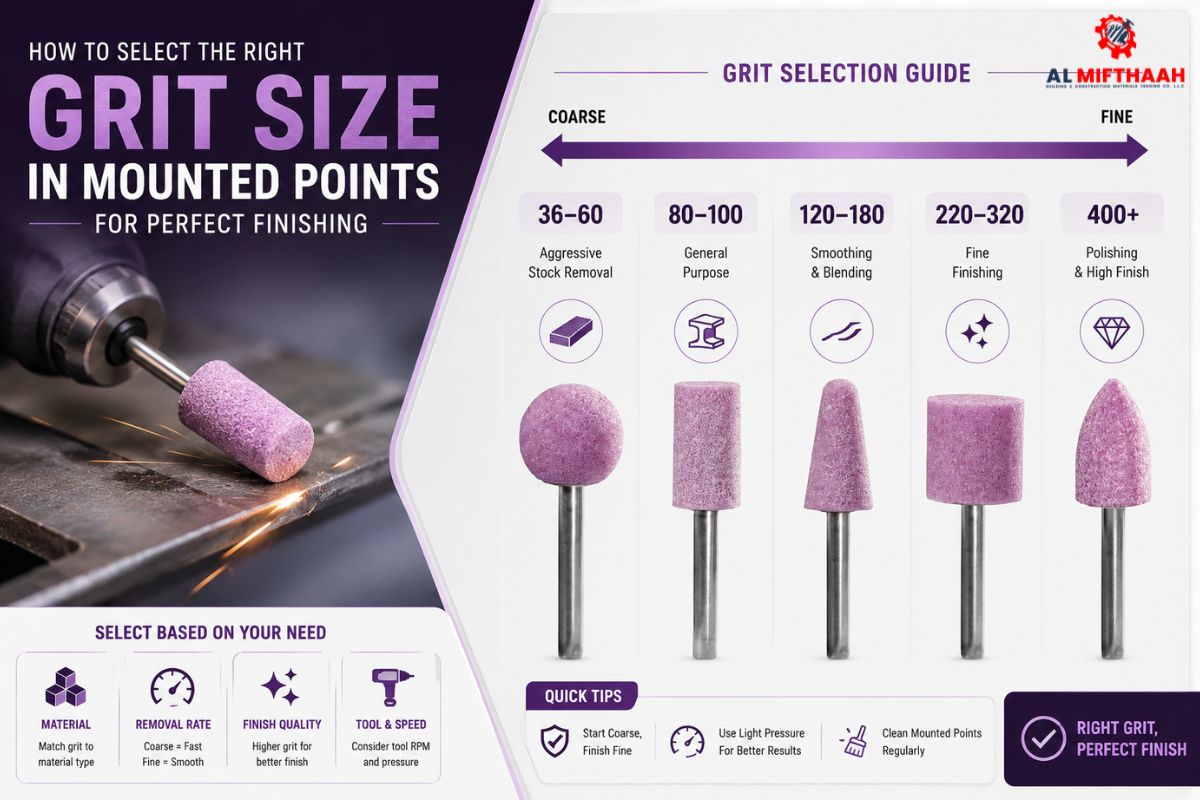
The perfect size of the grit in mounted points is among the most essential components of obtaining a smooth, accurate, and professional finish. Briefly, coarse grits are used to remove material rapidly, and the fine grits are used to make the surface smooth and to achieve a precision finish. From metal fabrications to mold polishing, die grinding to precision engineering, the proper selection of a particular size of grit can make the difference in surface quality, productivity, and tool life.
Industrial abrasives and grinding experts frequently turn to trusted suppliers like Almifthaah, a top supplier of industrial abrasives and grinding solutions, for predictable finishing results in various applications.
What is grit size in mounted points?
The size of the particles of abrasives, which are used in a mounted point, is called grit size.
Definition
The grit number is a measure of the coarseness or fineness of the abrasive particles:
- Lower grit numbers = Coarser abrasives
- The higher grit numbers= Finer the abrasives.
For example:
This grade removes the most material. This grade removes the most material (24-46 grit).
- 60- 80 grit: General grinding
- 100- 120 grit: Fine finishing
- 150+ grit: Precision polishing
Correctly choosing the grit will ensure the required surface finish without excessive material removal.
Why does grit size matter?
The result can be several finishing issues if the wrong size grit is used.
Common Issues
- Excessive surface scratches
- Poor dimensional accuracy
- Increased finishing time
- Higher tool wear
- Additional rework costs
On the other hand, the right grit size ensures the following:
- Better surface quality
- Faster production
- Improved consistency
- Reduced operating costs
That is why established manufacturers will seek advice from an expert abrasive tools supplier Dubai to choose grinding and finishing solutions.
How to choose the right grit size?
1. Understand the Material
The type of abrasive aggressiveness needed varies by material.
| Material | Recommended Grit |
| Cast Iron | 24–46 |
| Carbon Steel | 46–80 |
| Stainless Steel | 60–120 |
| Aluminum | 80–120 |
| Tool Steel | 80–150 |
| Precision Components | 120+ |
However, the finer grit control the more accurate the finish is going to be, in general, harder the material the finer it will be.
2. Define the Finishing Goal
Ask yourself:
- Are you removing excess material?
- Are you getting ready to coat?
- Are you polishing a finished surface?
For Material Removal
Use coarse grit:
- 24
- 36
- 46
For General Grinding
Use medium grit:
- 60
- 80
For Fine Finishing
Use fine grit:
- 100
- 120
- 150+
3. Consider Surface Finish Requirements
Smoother finishes are sometimes needed in industries like aerospace, automotive, and mold making.
For high-precision applications:
- For best results, use finer grit sizes.
- Use less grinding pressure.
- Maintain consistent speed
Moreover, quality consistency is ensured across the different projects by many workshops getting their abrasives from abrasive tools dealers in Dubai.
4. Match Grit Size with Tool Speed
Mounted points have high rotational speeds.
A mismatch of grit and RPM may lead to the following:
- Overheating
- Surface damage
- Reduced tool life
Additionally, follow the manufacturer’s instructions for mounted points.
Grit size selection table
| Grit Size | Application | Surface Finish |
| 24–36 | Heavy stock removal | Rough |
| 46–60 | General grinding | Medium |
| 80–100 | Surface preparation | Smooth |
| 120–150 | Fine finishing | Very Smooth |
| 180+ | Polishing | Mirror-like Finish |
Furthermore, this quick reference may be useful for operators to select the best mounted point for their projects.
Benefits of using the correct grit size
Choosing the correct grit offers a number of benefits.
- Better Surface Quality
Consistently creates neat and professional finishes.
- Higher Productivity
Minimizes extraneous grinding passes.
- Longer Tool Life
Reduces rubbing and overheating.
- Reduced Production Costs
Less rework means lower operational expenses.
- Improved Precision
Aids in maintaining critical dimensions of critical components.
At Almifthaah, their reputation for quality and industrial performance makes it a preferred choice for businesses seeking high-quality abrasive products.
Industry insight example
In a metal fabrication shop, the surface finish on parts made of stainless steel varied from time to time. Coarse 46-grit mounted points were initially used for both grinding and finishing by operators.
Reviewing the process, they changed to:
- Use 60-grit first for shaping.
- 120 grit is used for final fine finishing.
The outcome was noteworthy:
- Smoother surface finish
- Reduced polishing time
- Lower abrasive consumption
- Improved customer satisfaction
This example shows how a correct selection of the grit can have a direct impact on productivity and product quality.
Additionally, companies that buy from a high-quality flap abrasive wheels supplier in Dubai are more likely to achieve a uniform finish, as they can access a range of solutions tailored to specific applications.
Why do quality abrasives matter?
The right grit size can be used, but if the abrasive quality is not high enough, it may not achieve the desired results.
When making choices about mounted points, remember the following:
- Abrasive grain quality
- Bonding strength
- Heat resistance
- Consistency of manufacturing
That is why many industrial buyers rely on Saif Precision tools supplier in UAE, and reliable suppliers such as Almifthaah for reliable abrasive products that can meet the rigorous production needs.
Bottom line
The selection of the appropriate grit size for mounted points is very crucial for getting a perfect finish. Grit will vary according to the material, grinding purpose, and surface finish desired. The coarse grits are good for heavy stock removal, and the finer grits will give smoother and more precise finishes.
Furthemore, using the right abrasives and working with a trusted supplier such as Almifthaah, businesses can boost productivity, cut costs, and ensure exceptional finishing results. For safe abrasive products, seek advice from industry professionals that can guide you on which mounted points are suitable for your type of work.
Frequently asked questions
The grit range for harsh material removal and rough grinding is 24 to 46.
For smooth finishing, use 100 to 150 grit mounted points depending on the required surface quality.
No. Each application will need a different grit size to perform best and achieve the highest finish quality.
Not necessarily. The type of grit will vary with material, application, and finish desired.
Change mounted points when worn or when efficiency and/or surface finish is not consistent.

How Long Do Mounted Points Last and When Should You Replace Them?
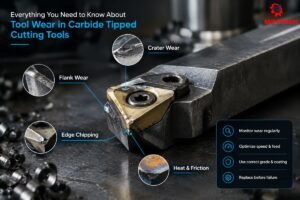
Everything You Need to Know About Tool Wear in Carbide Tipped Cutting Tools