
- November 7, 2025
- by Almifthaah
Choosing the Right Flap Wheel for Wood and Metal Projects
Table of Contents
- What is a flap wheel?
- Why use a flap wheel for wood and metal?
- Key factors to consider when choosing a flap wheel
- Matching the flap wheel to your project: wood vs. metal
- How to use a flap wheel safely and effectively?
- Maintenance and best practices
- Conclusion
- FAQs
A flap wheel is an abrasive tool made of layered sanding flaps used in the process of smoothing either wood or metallic surfaces. Beginning a project in wood or metal? A good flap wheel makes your work go smoother and more quickly. Whether you’re shaping wood or finishing metal, a good wheel matters. You can easily find one from trusted hardware tools suppliers in Dubai who offer quality abrasive tools and hardware.
Table of Contents
ToggleWhat is a flap wheel?
A flap wheel, as the name suggests, consists of many abrasive “flaps” laid in an overlapping fashion around a hub. This design gives it more flexibility and better contact with the work surface.
Therefore, due to its construction, it wears evenly and continues to offer fresh abrasive material.
When used on wood or metal, it adapts to curves, flat surfaces or irregular shapes more gracefully than a rigid sanding disc.
Why use a flap wheel for wood and metal?
There are a number of good reasons for using it:
- Versatility: It works on both wood and metal surfaces. For example, in wood it can sand or shape, whereas in metal it can deburr, clean, or polish.
- Better finish: On wood, you can go from rough to smooth with increasingly finer grits, minimizing the chance of deep scratch marks.
- Efficiency: As the flaps wear down gradually and reveal fresh abrasive, you may get a longer life from the wheel than compared with a flat abrasive disc.
- Shape adaptation: The flap wheel can handle edges, curves, and welds more easily in metal work, particularly.
Because of these advantages, many trustworthy suppliers make sure to carry quality flap wheels in their catalogues along with other abrasive tools, for example, services provided by Saif Precision Tools.
Key factors to consider when choosing a flap wheel
When choosing a flap wheel for wood or metal, consider the following:
- Grit size: Coarse grit (like P40-P60) for big amounts of material removal; finer grit (like P120-P220 etc.) for finishing. For wood in particular, you don’t want deep gouges.
- Material of abrasive: For metal, you might look for zirconia or ceramic abrasives; for wood, aluminium-oxide is common.
- Wheel diameter and arbor size: Make sure it fits your tool (angle grinder, drill, etc.).
- Backing and flap construction: The strength of the hub and how the flaps are built matters to durability, especially on tough metal jobs.
- Intended use: Are you polishing, deburring, shaping, or preparing for finishing? The type of job determines which flap wheel you will select.
Paying attention to these factors will yield the best results and prevent frustration from trying to utilize the wrong tool for the job. Moreover, a flap disc supplier in Dubai will help you to select the right one.
Matching the flap wheel to your project: wood vs. metal
Projects made of wood:
- If removing material or shaping, start with a coarser grit. Move to finer grits (such as P120, P150, P180) for a smooth surface that’s ready for finish or paint.
- Choose the flap wheel whose flaps are less aggressive but will give good finishes for wood.
- Work neither too slowly nor with too much pressure, or you risk charring the wood.
Metal projects:
- You will have a choice of using a strong abrasive, zirconia or ceramic with medium grit for deburring or removing welds.
- If you’re polishing, you shift to finer grit.
- Make sure the flap wheel is rated for your tool’s speed and for use on metal (since metal produces more heat).
In both cases:
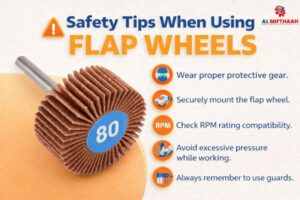
- Use correct protective gear: Gloves, eye protection.
- Don’t press too hard: Let the wheel do the work.
- Check frequently to make sure you are getting the finish you desire.
How to use a flap wheel safely and effectively?
Properly using a flap wheel will both improve your results and prolong tool life:
- Look for any damage or wear before using a wheel.
- Mount it properly on your tool, making sure it attaches securely.
- Use the right tool and speed for the job; follow manufacturer guidance.
- Take the wheel across the surface in a smooth pattern. Avoid dwelling too long in one spot, which causes gouging or even heat damage.
- For wood, go with the grain where possible.
- For metal, keep the wheel moving to avoid overheating which could change metal colour or structure.
- Clean the tool after the job and store your flap wheels in a dry place.
Maintenance and best practices
To keep your flap wheel and your tool performing at their best:
- Clean off any accumulated dust or debris after use.
- Store the abrasive tool in a place where humidity and temperature fluctuations are minimal.
- Rotate through flaps or replace the wheel when you notice diminished performance (slower removal, rough finish).
- Match the wheel to the job: A fine-grit flap wheel is inefficient for heavy material removal and will wear out faster.
- Keep all your abrasive tools in order for quick selection of the right wheel for the job. You will find this helpful when you are dealing with any good abrasive tools supplier Dubai or the best hardware tools suppliers in Dubai because a variety of available quick project flows.
Conclusion
Choosing the right wood and metal flap wheel is not difficult, yet it requires serious attention. Everything plays its role in the choice: grit size, material, build-the lot. In some cities, such as Dubai, the presence of reliable suppliers like Saif Precision Tools and abrasive tools dealers in Dubai makes life easier. With the right wheel, its proper use and maintenance, you will have smoother finishes with longer tool life and less effort.
FAQs
This tool effectively smoothes, polishes, and removes imperfections from both wood and metal surfaces.
Medium to fine grit sandpaper produces a smooth finish and is best for sanding and finishing a wood surface.
Yes, but choose suitable grit and material depending on the type of surface the project requires.
For safety, match the wheel’s diameter and arbor size to your tool’s specifications.
Recent Posts

Indexable Milling Cutter Explained: Benefits, Types, and Applications
Gear Cutter Maintenance Tips to Increase Tool Life