- February 18, 2026
- by Almifthaah
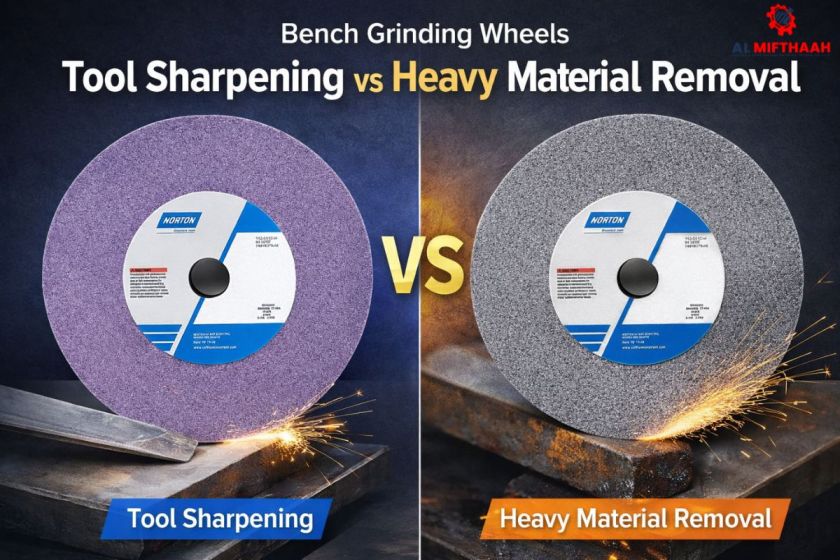
Bench Grinding Wheels for Tool Sharpening vs Heavy Material Removal
Table of Contents
- Key Takeaways
- Why do bench grinding wheels matter so much?
- When should you use these wheels for tool sharpening?
- How are wheels used for heavy material removal?
- What key differences should you know before choosing?
- How does wheel selection affect tool life and safety?
- Where do professionals usually buy the right wheels?
- Conclusion
- Frequently asked questions
Key Takeaways
- Different wheels are required for tool sharpening and heavy grinding.
- Fine grit wheels for protection of edges
- Coarse wheels remove metal quickly
- Correct selection enhances safety and tool life
Bench grinding wheels are made to sharpen tools or cut heavy material, and selecting the wrong one may harm tools and decrease safety. The main distinction is on the wheel grit, hardness, and speed of material removal. Almifthaah, as an experienced abrasive tools supplier Dubai, is a witness of this confusion in workshops and factories.
Table of Contents
ToggleWhy do bench grinding wheels matter so much?
Bench grinding wheels might appear to be straightforward, but they directly influence the accuracy, finish quality, and the life of the tool. The incorrect selection of a wheel may overheat the tools, cut away too much material, or even crack.
Furthermore, grinding wheels are not universal products. Every wheel has a distinct purpose. Thus, the knowledge of the difference assists users to work more quickly, securely, and smartly.
Professionals have confidence in Almifthaah, since practical work experience demonstrates that the proper choice of wheels enhances performance and lowers cost in the long term.
When should you use these wheels for tool sharpening?
Sharpening of tools is not about speed. The idea is to sharpen a tool without altering the shape of the tool.
What type of grinding wheel is used for sharpening?
To sharpen operations, wheels typically possess the following:
- Fine grit size to smooth finish.
- Weaker bonding to avoid overheating.
- Regulated material deposition.
- Better edge retention
Additionally, sharpening wheels do well under constant pressure. Exerting excessive effort kills their intent.
Tools commonly sharpened on bench grinders
- Chisels and hand tools
- Drill bits
- Cutting blades
- Lathe tools
However, even though sharpening may be easy, bad wheels may burn edges. This is the reason why most of the abrasive tools dealers in Dubai advise on testing wheel grit before it can be used on a daily basis.
How are wheels used for heavy material removal?
Removal of heavy material is all about speed and strength. In contrast to sharpening, here the goal is to take away metal quickly, even though the finish of the surface may be coarse.
What makes heavy-duty grinding wheels different?
These wheels are built with:
- Coarse grit for fast cutting.
- More difficult bonding to make it tough.
- High pressure resistance.
- Higher stock removal rate
Consequently, they are suitable for shaping, cleaning of welds, and leveling of the surface.
Typical Applications
- Removing weld joints
- Shaping raw metal parts
- Cleaning rust and scale
- Reducing metal thickness
Therefore, the workshops that deal with fabrication tend to have separate wheels to remove heavy objects rather than sharpening wheels inappropriately.
What key differences should you know before choosing?
A clear understanding of differences is a way to prevent mistakes. It is simple, as explained in the table below:
| Feature | Tool Sharpening Wheels | Heavy Material Removal Wheels |
| Grit Size | Fine | Coarse |
| Material Removal | Slow and controlled | Fast and aggressive |
| Heat Generation | Low | High |
| Surface Finish | Smooth | Rough |
| Tool Safety | High | Moderate |
| Best Use | Precision edges | Bulk metal removal |
Moreover, cutting tools supplied by hardware tools suppliers in Dubai
are usually maintained by two grinders by professionals who work with cutting tools.
How does wheel selection affect tool life and safety?
The choice of the wheel has a direct impact on the tool life and operator safety.
Impact on tool life
- Sharpening wheels increase the life of the tool.
- Tool edges can be shortened by heavy wheels.
- Cracks arise due to the wrong choice of wheel.
However, excessive heat during grinding undermines the strength of the metals forever.
Impact on safety
Incorrect wheels can lead to:
- Wheel breakage
- Tool slipping
- Excess vibration
- Operator injury
Furthermore, this is the reason why Almifthaah always recommends the use of matching wheel types and applications, particularly in the use of precision tools such as Single Flute Carbide Endmill UAE products.
Where do professionals usually buy the right wheels?
Experienced technicians do not purchase grinding wheels without a reason. They depend on suppliers who are aware of actual conditions of use.
What professionals look for in a supplier
- Product knowledge
- Usage guidance
- Consistent quality
- Industry experience
Due to this fact, Almifthaah has earned trust by providing the right wheels depending on the use and not merely selling products.
Moreover, instructions of specialists can prevent typical errors like coarse wheels to sharpen or fine wheels to do welding.
Conclusion
Choosing between sharpening wheels and heavy removal wheels depends on your task, tool type, and safety needs. The right wheel is more precise, has less wastage, and is safer for the operators. Moreover, to get good advice and quality products, the professionals still rely on Almifthaah and other professionals such as Saif Precision tools supplier in UAE, to get the right grinding solutions.
Frequently asked questions
No, every wheel is to serve only a certain purpose of grinding.
Yes, they take out metal gradually to keep tools in order.
Yes, overheating lowers the quality of tools and safety.
Change wheels when they become shaped or dull.

Indexable Milling Cutter Explained: Benefits, Types, and Applications
Gear Cutter Maintenance Tips to Increase Tool Life