

- November 24, 2026
- by Almifthaah
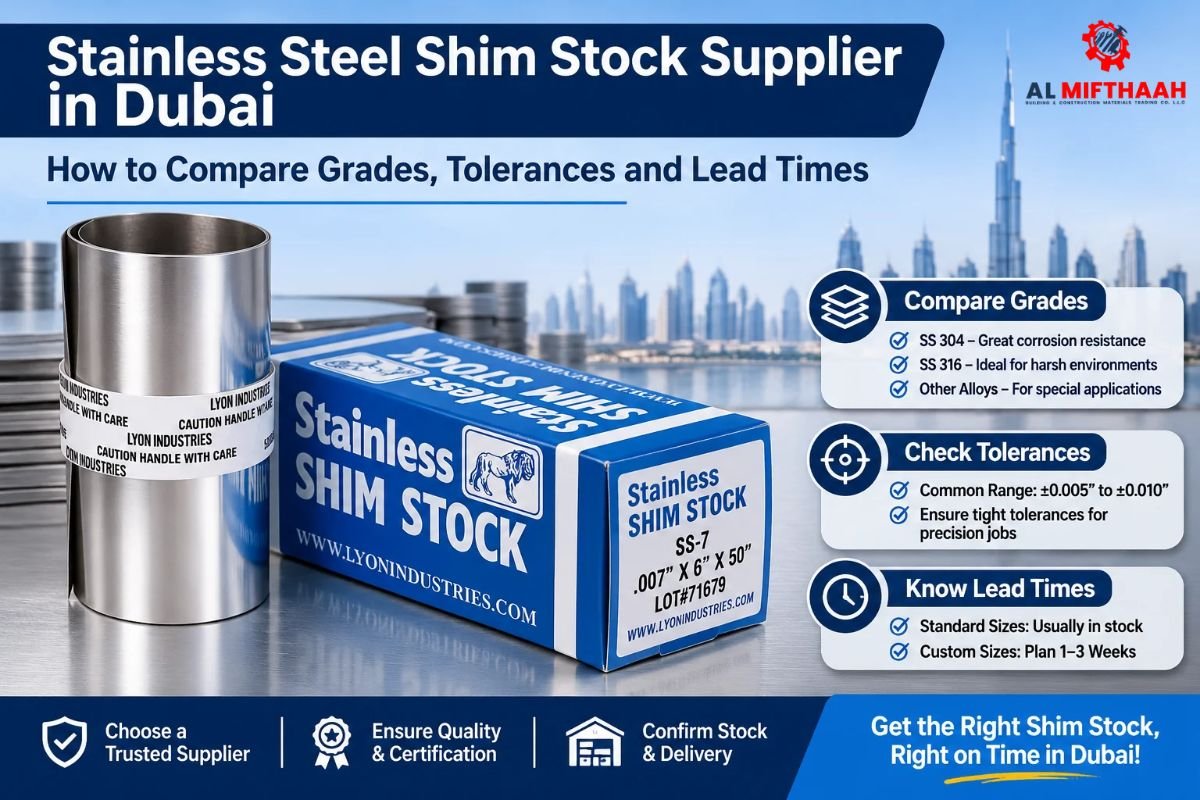
Stainless Steel Shim Stock Supplier in Dubai: How to Compare Grades, Tolerances and Lead Times
Selecting a supplier of stainless steel shim stock in Dubai is not just about price per kg. The ideal supplier will ensure that the right type of material is selected according to your work environment, the necessary thickness tolerance is reached, and timely delivery of the material is made so as to keep the project on schedule.
Basically, three things need to be compared – stainless steel grade, tolerance class, and realistic lead time. This guideline will explain all three features so that you will understand how to effectively select shim stock providers in Dubai.
Table of Contents
ToggleKey takeaways
- Correlate stainless grade with environment and use 316 if coastal or chemical exposure is anticipated.
- Use tolerances that are appropriate for the actual application, as the tolerances for the thickness are multiplied when more than one thickener is used.
- Compare stocked and made-to-order lead time; confirm delivery and documentation by written agreement.
- Evaluate vendors based upon their certificate status, inspection results, and response time instead of just price.
What is stainless steel shim stock?
Stainless steel shim stock is a thin, flat sheet or strip of corrosion resistant steel that is cut to an exact thickness to adjust the gap, height, or alignment between two components. It is resistant to rust and maintains its form when under load, making it a reliable material for machinery and structural applications throughout the UAE.
Shims come in rolls, strips, and pre-cut pieces. The factors affecting their performance are the alloy, the accuracy of the thickness, and the uniformity of the batch. Shims are frequently stacked, so a change of even a few thousandths of an inch in one layer will make a difference in the end.
Where is shim stock commonly used?
Shims can be found in many industrial and maintenance applications. The most popular uses are:
- Splining of motor mounts, pump bases, and gearbox housings
- Making clearances in bearings and sliding assemblies.
- Heavy equipment leveling when installing and commissioning.
- Aligning fabricated steel frames, structures and buildings.
These tasks each rely on a predicted gap. The consequences of an out-of-specification shim can include vibration, uneven wear, or premature failure. Therefore, it’s often more important to find consistency and accuracy, rather than the cheapest unit price.
However, humid and coastal areas are an added risk. Corrosion can work its way in and out of a shim with little sign and may also cause the shim to lose its flatness against the surfaces it’s supposed to be flat on. Before specifying your stainless steel shim stock, read more about our stainless steel shim stock range.
Which stainless steel grades should you compare?
The first and most crucial technical decision is with respect to grade selection. All the stainless families have different corrosion resistance and are different in terms of hardness, springiness, and machinability. A workshop that does well on a grade in dry indoor conditions could have problems early in a chemical or coastal grade.
Your supplier should confirm the exact grade and temper for every order and provide a mill test certificate that references the applicable standard, such as ASTM A240 or ASTM A666. These papers provide details of the chemical content and mechanical characteristics of the material, allowing you to be sure that you received the material, not the one described on the label.
How do 301, 304, and 316 differ?
Grade 301 provides high strength and springiness, grade 304 is highly resistant to corrosion for general use, and grade 316 has molybdenum added for extra corrosion resistance against chlorides. A more suitable material for Dubai’s coastal and saline conditions is 316, whereas 304 might be adequate for dry indoor applications.
Paper grading is just part of the task. The accuracy instrument suppliers in Dubai you communicate with should clarify these differences clearly, indicating each grade for what you’re doing and not just a code. A helpful technical discussion will include temperature extremes, moisture or cleaning chemical exposure, and anticipated service life.
| Grade | Main Strength | Typical Shim Use | Key Consideration |
| 301 | High strength and springiness after cold rolling | Spring-type shims and clips | Less corrosion resistant than 316 |
| 304 | Balanced corrosion resistance and wide availability | General machinery and indoor work | Suitable for most dry environments |
| 316 | Better resistance to chlorides and salt exposure | Coastal, marine and chemical settings | Usually priced higher than 304 |
| 17-7 PH | High strength after precipitation hardening | High-load and high-stress assemblies | Requires controlled heat treatment |
| 420 | Hardenable with good wear resistance | Wear-prone components | Lower corrosion resistance than 304 or 316 |
When should you consider 17-7 PH or 420?
But some applications require more than general-purpose stainless. If specific shim applications are subjected to heavy loads or subjected to frequent use, 17-7 PH and 420 may be considered. Both can be heat-treated to increased hardness, but would need careful processing and more stringent supply checks. Check the condition of the heat-treatment with the supplier before assuming that the material behaves accordingly.
Specialty grades are typically more expensive to stock and have fewer distribution points, and are frequently available long before regular season offerings, so prioritize them in your program planning. One of the most preventable delays in shim procurement is waiting until the last minute to find a grade.
Before you finalize a grade, ask your supplier:
- What is the standard setting and key that you are providing?
- If so, does this particular batch have a mill test certificate?
- Has the material been annealed, cold rolled, or heat treated?
- Will the corrosion performance be guaranteed at my site?
How do thickness tolerances affect shim performance?
The tolerances that are permitted on a shim’s thickness, typically expressed as a plus or minus range, usually in mm. A tighter tolerance will result in more consistent fits or stack height; however, it is usually more expensive, and it may require longer production or inspection time. Select the tightest tolerance that your application actually needs, rather than the tightest that a supplier can provide.
Tolerance errors accumulate. A thin shim (a few hundredths of a millimetre too thick) might not seem to cause any harm at all; but when stacked five or six times, a shim might push a bearing clearance or misalign a coupling. Don’t accept nominal sizes quoted on a price list; also ask suppliers for measured data for the actual batch.
What tolerance classes should you ask for?
The level of precision required varies from application to application. A general guideline to consider is presented in the table below that you can modify with your engineer. Always use the value from your drawing or the manufacturer’s specification.
| Application | Tolerance Need | Why It Matters |
| General maintenance and packing | Standard commercial tolerance | Loose fits can absorb small variation |
| Machinery alignment and leveling | Close tolerance | Consistent stack heights improve alignment |
| Precision tooling and measuring equipment | Precision tolerance | Small errors directly affect accuracy |
Typically, for example, a ±0.01 mm band is quite different from a ±0.05 mm band when working with five or six shims. Make sure to include exact tolerances in your purchase order, as there is little room for error at the supplier’s end or on your shop floor.
How should you verify tolerances on arrival?
Verification safeguards you from identifying issues at assembly time when rework is costly. Most problems can be detected by a simple inspection routine before materials get to the workshop:
- Use a calibrated micrometer to measure a number of pieces from each batch.
- Readings should be taken at several points on each shim and not at one point.
- Make comparisons with the supplier’s certificate and drawing.
- Write down the information and store it for future reference.
Regular checking is easier to standardize amongst teams, as many buyers receive calibrated micrometers and gauges from machine measuring tools dealers in Dubai.
Moreover, keep measuring equipment calibrated on a regular basis to ensure that measurements remain accurate over time. If the people using the tools don’t use them in the same way each time, good tools are not useful.
How should you evaluate lead times?
Lead time is the time span from ordering shim stock to having it delivered to the location where you need it. It covers the sourcing, slitting or cutting, inspection, packing, and transport of goods. Check lead times for stocked and made-to-order goods, and ensure they are confirmed in writing, taking documentation and delivery into account.
What factors influence lead times?
There are a few factors that can affect the time it takes for your order to be processed:
- Availability as a grade and temper in the required thickness.
- The width, length, and cutting needs are addressed.
- The concept and process of tolerance level
- Packaging specification and surface protection.
- Customs clearance & import planning.
Request each supplier to provide a stage breakdown of their lead time. When a supplier is able to explain each step, it is easier to plan around them than if the supplier only provides a single vague number. As you consider a Lyon shim stock supplier in Dubai, ask about delays in the process, as you’ll need to understand what risks to handle, like material sourcing or final inspection.
Stocked vs made-to-order: which is better?
Stocked items are appropriate for routine maintenance and standard sizes, whereas made-to-order shims are used for projects requiring custom sizes. This will depend on the urgency of your need and the exact definition of your application.
| Factor | Stocked Items | Made-to-Order Items |
| Typical delivery | Faster | Longer, depends on production |
| Size flexibility | Standard sizes only | Custom thickness and width |
| Unit cost | Generally lower | Often higher |
| Best suited for | Routine maintenance | Specialized or precision projects |
With most of the Shim Stock suppliers in Dubai, the choice all comes down to planning. When ordering made-to-order shims, it is often possible to order early and have the shim made to fit precisely without sacrificing accuracy. A stocked item that has a verified measurement report may be more practical if you can’t wait.
How do you plan around delays?
Any supply chain has its delays and schedule for this. Follow this sequence to decrease risk:
- To ensure accuracy, please check the grade, thickness, and tolerance before quoting.
- Request a written lead time with delivery and documents.
- Place a purchase order stating a clear and definite purchase date and inspection needed.
- Monitor progress at agreed milestones with supplier.
- Check and record material on arrival.
Having a few extra sizes of commonly used products on hand can help to reduce any downtime to the production process. Some customers also have a local Saif Precision tools supplier in UAE who can be called upon to meet any emergency needs during transit of larger orders, thus avoiding changing the approved specification.
What common mistakes should buyers avoid?
Common mistakes include ordering based on nominal size alone, not considering the environment, failing to undertake incoming inspection, and taking on a generic lead time. For each fault, there is a simple way to avoid it: using a specification, a documented inspection step, and a supplier with clear measurement data.
- Ordering Without a Written Specification
A common procurement issue is a short email to a supplier requesting “some shim stock, 0.5 mm”. This message lacks a grade, tolerances, width, length, temp, and packaging. Suppliers then make reasonable assumptions, and the assumptions may not be the same as your application. A short specification sheet is important for both parties and helps to compare quotes.
- Ignoring Surface Condition and Handling
Shims can become damaged before they get to your machine. Flatness and fit can be impacted by cutting, careless handling, and moisture during storage. Inquire into the packing of material, whether protective film is used, and how it is stored before dispatch. When storing shims, keeping them flat, dry, and separated by size decreases the risk of being damaged in your facility.
- Skipping Incoming Inspection
Some buyers think that a certificate is a guarantee for all. In reality, sampling and measuring a couple of samples from a batch can take just minutes and identify an issue that may come up during the installation. Incoming inspection will provide you with information to support a warranty claim or to update your shortlist of suppliers for the future.
How do you choose the right supplier in Dubai?
Look for a supplier who offers you a mill certificate, measured tolerance information, a written lead-time promise, and technical support. Get 3 quotes with the same specification so that you can compare apples to apples. If a project is time-sensitive, local stock availability and responsiveness are also an important factor, as in the event of a breakdown, a supplier that is quick to respond can save days of waiting for stock.
What should a strong supplier offer?
With a reliable supplier, your work is made easy, from the initial enquiry to the follow-up after sale. These are the characteristics you’ll find:
- Mill test certificates for each batch or lot
- Dimensional inspection is recorded on all orders.
- Delivery timetables and written lead time promises
- Technical guidance for selection of grade and tolerance
- Packaging that guards surfaces from scratches and moisture.
Furthermore, individuals attempting to shop for a Lyon shim supplier in Dubai should make use of the identical checklist for each supplier. The moral of the comparison is that if one is consistent in evaluating, the other is consistent. Check out what different shim stock and precision supply options we can offer you for your project.
How should you compare suppliers fairly?
Price comparison can be deceiving. This may be because a lower quote does not include inspection, certificate, or delivery, and this can be added later. Construct an easy-to-use scoring table based on grade accuracy, tolerance data, lead time, and service. Score the same criteria for each supplier and choose the total score, not the first number on the quote.
| Criterion | What to Check | Priority |
| Grade accuracy | Certificates match the purchase order | High |
| Tolerance data | Measured results, not only nominal sizes | High |
| Lead time | Written, staged, and realistic | Medium |
| Service | Responsiveness and technical advice | Medium |
When making comparisons across precision instruments suppliers in Dubai, the best one to choose is the one that asks the most questions about the application. If you are comparing with another Saif Precision tools supplier UAE, it is important to use the same table and the same specification sheet in order to keep the decision objective.
Final thoughts
Choosing an appropriate amount of stainless steel shims is based upon matching grade, tolerance, and timing for actual usage requirements. Clear specifications, fair comparisons of quotes, and regular inspections are necessary to prevent issues for an assembly. Dubai-based strong shim stock supplier companies are open to answering any queries about them and providing supporting evidence for those claims.
If you need an inspector for your project too, check out machine measuring tool dealers in Dubai so that they can ensure that your gauges are reliable like yours. To get current stock levels and an estimate for you, please visit Almifthaah and provide your grade, thickness, tolerance, and quantity.
Frequently asked questions
Grade 316 is generally more suitable for the salty environment of Dubai, near the sea, and humid conditions, whereas Grade 304 works better in dry, indoor environments.
Select the closest tolerances needed by an application- tighter tolerances provide a more consistent fit, but they are more expensive and take longer to produce.
Standard sizes are generally available for delivery sooner than custom orders, so provide for documents and delivery with a written lead time.
Ask for mill test certificates, dimensional inspection reports, and packing lists for grade, tolerance, and traceability
Stainless Steel Shim Stock Supplier in Dubai: How to Compare Grades, Tolerances and Lead Times

How to Identify the Correct Gear Cutter When the Markings Are Missing