- October 28, 2026
- by Almifthaah
Brass Shim Stock vs Bronze Shim Stock: Which Is Better for Precision Assemblies?
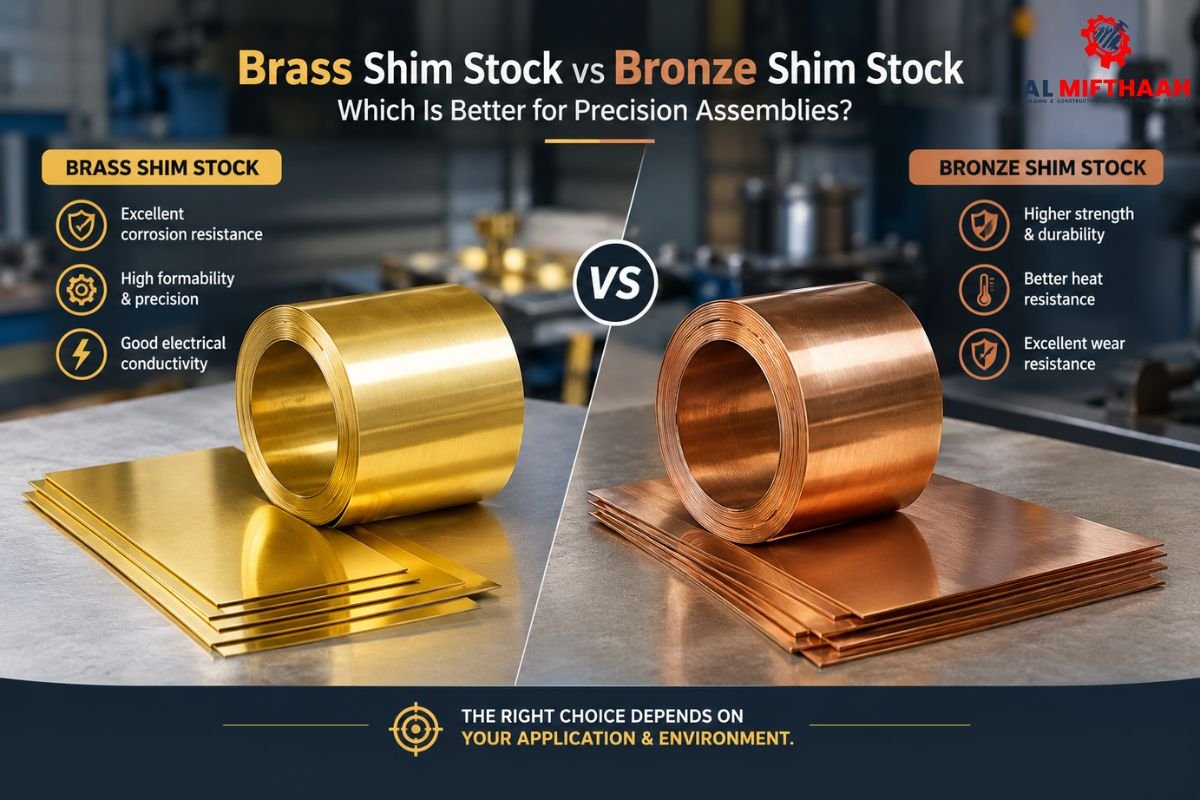
Brass shim stock is often the preferred option for most common precision assemblies. This material is easy to machine, inexpensive, and can withstand moderate loads in dry, indoor circumstances. In contrast, bronze shim stock is better suited for situations where the shim may be subject to high or repeated loads, vibration, or wet and corrosive conditions. Because of the addition of tin, bronze shim stock has superior fatigue strength and resistance to corrosion; however, it is more expensive and harder to work with.
Shim stock refers to the very thin, accurately rolled metal foil utilized to fill small gaps, align parts, and apply preload between parts. Even slight mistakes in thickness can negatively affect machine tool, fixture, or instrument operation, which means that material selection should get just as much focus as accuracy when it comes to dimensions. The choice has to be made on a regular basis by engineers and maintenance teams in the UAE’s hot and humid climate.
In the following guide, we compare two kinds of materials in detail in order to determine the best performance of each type and provide you with step-by-step instructions on selecting the right shim stock type. The information will also explain how to find reputable suppliers in Dubai and the UAE. If you want to learn more about the materials, check out the Almifthaah precision parts catalogue while reading this article.
Table of Contents
ToggleKey takeaways
- Brass shim stock is used for general precision work, as it is easy to machine and less expensive.
- For heavy-duty requirements, bronze shim stock is highly used in applications due to its greater fatigue strength, wear resistance and corrosion resistance.
- The choice should not be based solely on the cost of the unit, but on the load, environmental conditions, and the service life.
- Check the thickness tolerance and material certificates, irrespective of whether it is in the Dubai area from a Lyon shim stock supplier or elsewhere.
What is shim stock and why does material choice matter?
A thin, flat sheet of metal for adjusting gaps, alignment, and preload between mechanical parts, known as Shim stock. The type of material dictates its reaction to pressure, temperature, and moisture, and thus has an impact on long-term accuracy and the life of the assembly.
Common uses of shim stock in precision work
Shim stock is used in a wide variety of applications such as:
- The adjustment of spindles and bearing housings in machine tools.
- Establishing clearances in fixtures, jigs, and measuring tools
- Evening out heavy equipment when setting up.
- Adjusting preload in bearings and mechanical joints
Since they require precise dimensions, shim stock is normally manufactured to very close tolerances. A slightly uneven shim can cause a component to go out of square, wear unevenly, or force repeated shimming. So, thickness is not the only factor that engineers consider when approving a part; they also check the properties of the material.
Another common use for shims is to stack them for use. A number of thin layers are stacked to achieve a very accurate gap, and the load that each layer experiences is important. A softer material can compress over time, whereas a harder one can retain its dimension for years. To make a good decision, you must first be aware of these differences.
Teams that build a variety of thicknesses will begin by picking a set of Almifthaah shim stock thicknesses that they think will cover the most common gaps. A few standard thicknesses will minimize downtime if a machine needs a quick correction.
What is brass shim stock?
Brass shim stock is an alloy of the elements copper and zinc, where the predominant element is copper, and zinc is added to provide strength and workability. Its golden color is readily recognised, and it is among the most popular shim materials used for all common industrial applications.
Key properties of brass shim stock
- Excellent cutting and deburring properties, good machinability
- Moderate strength for most static loads
- Less costly material than many other copper alloys
- Acceptable corrosion performance in dry, indoor locations
- Available in common thicknesses and in sheet sizes.
The alloy can be rolled into thin foils that allow manufacturers to maintain a good tolerance at acceptable cost. This facilitates easy processing of the custom shims, which can save on tool wear and labour time in workshops making frequent shim cuts.
Brass isn’t always the perfect solution, however. It may undergo dezincification (a type of corrosion) in wet, saline, or acidic conditions, where the zinc is leached out of the alloy, resulting in a weaker structure. This risk is a motivation for engineers not to use brass in bad environments without additional protection.
However, standard sizes are available in brass and are available on record in the Almifthaah industrial tool catalogue for a range of precision accessories.
What is bronze shim stock?
Bronze shim stock is a copper alloy that contains the greatest amount of tin, sometimes with the addition of a small amount of phosphorus. Phosphor bronze is the most common type used for shims because of its excellent properties of springiness and resistance to fatigue and wear.
The following are important properties of bronze shim stock:
- Estimates of the fatigue strength for repeated loading cycles are also higher.
- Very good corrosion properties, including in humid and marine environments
- Excellent resistance to wear under sliding or vibrating contact
- Stable spring behaviour, which will help maintain preload
- Higher material cost and more demanding machining
The beautiful reddish-brown colour of bronze distinguishes it on the shop floor. Harder than brass, meaning more resistant to scratches and deformations when handling. For this reason, it is a good choice for assemblies that are expected to last for many years.
There are economic considerations in terms of cost and usability. Bronze alloys are more expensive and harder to cut and finish. New tools and process control may be required to obtain clean edges in shops. The extra expense is not likely to be worth it for one-off projects with low volume.
If they require reliable long-life parts, they can also take a look at Almifthaah precision assembly components page for compatible parts to go with bronze shims.
Brass vs bronze shim stock: how do they compare?
There are numerous similarities between the two materials and some significant differences in strength, corrosion characteristics, and cost. The major differences are summarised in the table below.
| Property | Brass Shim Stock | Bronze Shim Stock |
| Main alloying element | Zinc | Tin, often with phosphorus |
| Strength | Moderate | Higher |
| Fatigue resistance | Adequate for light cycling | Strong under repeated loading |
| Corrosion resistance | Good in dry conditions | Excellent in humid and marine conditions |
| Wear resistance | Moderate | High |
| Machinability | Excellent | Fair to good |
| Relative cost | Lower | Higher |
| Best suited for | General alignment and spacing | Heavy-duty and long-life assemblies |
Strength and spring behaviour
One of the obvious differences between the two materials is strength. A general rule is that bronze will retain shape more readily under prolonged compression, as would be required if a shim were to maintain a pre-loaded joint. When static loads are light to moderate, brass will hold up fairly well but will take a permanent set when the force is high or repeated.
Applications with flexing also require consideration of the spring behaviour. Repeated deflection of phosphor bronze returns it closer to its original position, which helps to maintain consistent clearances. Brass is a more forgiving material for installation, but may require change more frequently in dynamic environments.
Corrosion resistance in humid climates
The biggest benefit of bronze is corrosion. Bronze is much more resistant to surface degradation than brass in humid, coastal, or saline environments. This applies in the Gulf, where there is high humidity, salty air, and condensation from air conditioning systems, which can all speed up corrosion of exposed metals.
Brass is used in varieties of equipment that operate in controlled environments such as workshops and enclosed machinery. Common issues occur when brass shims are used in areas such as washdown areas, outdoor equipment, or areas that are prone to moisture. If these are the situations, it is generally better to opt for bronze.
Machinability and finishing
Brass is one of the most easily machined copper alloys. It cleaves easily, makes clean edges, and reduces tool wear. Brass is a practical material for shops making unusual geometries of shim sizes or cutting parts to a custom size.
Bronze is more difficult to manipulate. Requires sharper tools, slower feed rates, and attentive deburring to prevent burrs that would negatively affect a precise fit. Very good results can be obtained from skilled operators, but it will generally be more expensive and take longer.
Cost and availability
Brass is typically cheaper both in terms of material and processing. This makes standard thicknesses commonly available, and for common orders, lead times may be short.
Bronze is more expensive and may take longer to source for particular thicknesses. When considering various options, buyers can look at a Saif Precision tools supplier in UAE to see the status of their stock in the region, which could mean less shipping time than if they ordered from overseas.
Which is better for precision assemblies?
There is no “best” material for either. Brass shim stock is ideal for use in general precision applications, moderate loads, dry environments, and low-cost assemblies. Often used when high load, vibration, humidity or extended service life is required, bronze shim stock is suitable for assemblies where durability and corrosion resistance are desired for the added expense.
When is brass shim stock the better choice?
- Indoor machine setups with constant temperatures
- Light to medium level static loads
- Projects which require regular custom cutting.
- Budget-sensitive production runs
- Assemblies that are scheduled for inspection and replacement.
Moreover, brass also makes a good prototype material. The costs are kept in check during early stages of the design process because engineers can test fit and alignment using brass shims before moving forward with bronze for production.
When is bronze shim stock the better choice?
- Machines that operate continuously or vibrate.
- High humidity, coastal, or washdown areas
- Multiple flex or sliding contact
- Where the alignment is critical and re-calibration is expensive.
- Installations that will serve for a long period of time, have reduced access for maintenance.
A good guideline for this is if a shim’s failure would result in downtime or scrapping or would pose a safety problem, then consider bronze, even if brass is the lower initial cost. The value of an unelected shutdown is typically greater than the value of the two materials.
For a complete upgrade, some teams also want to check out Almifthaah, the best industrial equipment dealers in Dubai, as shim material is just a component of a successful assembly.
How do you choose the right shim stock?
Use the process below to achieve a well-informed decision:
- Determine load profile: Decide if a shim needs to support static weight, dynamic forces or both.
- Evaluate operating environment: Record temperature, humidity, chemical exposure, and frequency of washing down equipment.
- Establish the thickness and tolerance needed: Verify the size of the gap and acceptable tolerance (mm or 0.001”).
- Estimate service life: Determine the frequency of inspection, adjustment, and replacement of the assembly.
- Keep in mind total cost, not unit cost: Consider the replacement cost, labour and time outages.
- Confirm supplier capability: Inquire from industrial equipment dealers in Dubai regarding material certificates, minimum order quantity, lead time and if precision instruments suppliers in Dubai can provide matching measuring equipment.
It is important to test a sample in actual operating conditions to ensure that you have made the right choice. A lot of engineers order a prototype to test out before ordering an entire order, and check wear, corrosion, and fit after a few weeks.
Furthermore, check out the Almifthaah homepage to see the variety of shim and precision accessory sizes available and compare against the specification sheet.
Where should you buy shim stock?
When searching for Shim Stock suppliers in Dubai, it’s not all about the price. Check for uniform tolerances, clear certifications for materials, and capacity to provide standard and custom sizes. With the right precision application supplier, time can be saved at the design stage as they can advise on material choice.
The buyers looking for a lyon shim stock supplier in Dubai would prefer having the standard sizes readily available for maintenance requirements. When a machine is down, local stock can reduce waiting time, but it is advisable to check each batch to make sure it is within the specified tolerance before installation.
Businesses that rely on measuring instruments such as gauges and micrometers may want to have accuracy instruments suppliers in dubai who can offer them shims and measuring devices together in 1 order. This makes it easier to document and to track the calibration process throughout the facility.
Industrial equipment dealers in Dubai also help plant maintenance teams by providing machine tools and spare parts with shim kits. While the purchasing of materials in bulk will save some administration, it is important for the purchaser to ensure that the materials supplied are of the correct material grade for each component.
Outside of Dubai, a Saif Precision tools supplier in the UAE might come in handy for those who require coverage outside of the UAE. Before making a decision, be sure to compare the availability, delivery dates, and warranties offered by each stock.
When considering any supplier, ask for
- Material test certificates
- Sample pieces for fit testing
- Written lead-time commitments.
These measures ensure your project won’t come with any shock and will be easier to reorder in the future.
Closing line
For most precision parts, brass shim stock is the practical choice, and for applications where strength, humidity, and long life are important, bronze is the better choice. Use the right material for the load, the environment, and your budget, and check quality prior to purchase. When dealing with trusted Shim Stock suppliers in Dubai, you can easily get the correct specification the first time. Visit Almifthaah for more resources.
Frequently asked questions
Brass shim stock is typically less expensive as it is a cheaper alloy and can be rolled thin more easily.
Yes, bronze is more corrosion resistant in many environments, particularly those involving humidity, sea and coastal locations, and saline environments, making it well suited for many industrial properties in the Gulf region.
Avoid looking for stock that does not have certified thickness tolerances, small quantities, and material test certificates.
Although both are important, thickness accuracy may have a more significant impact on alignment, so always check tolerance before making comparisons of materials.
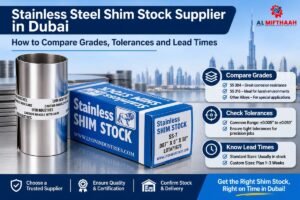
Stainless Steel Shim Stock Supplier in Dubai: How to Compare Grades, Tolerances and Lead Times

How to Identify the Correct Gear Cutter When the Markings Are Missing