- September 17, 2026
- by Almifthaah
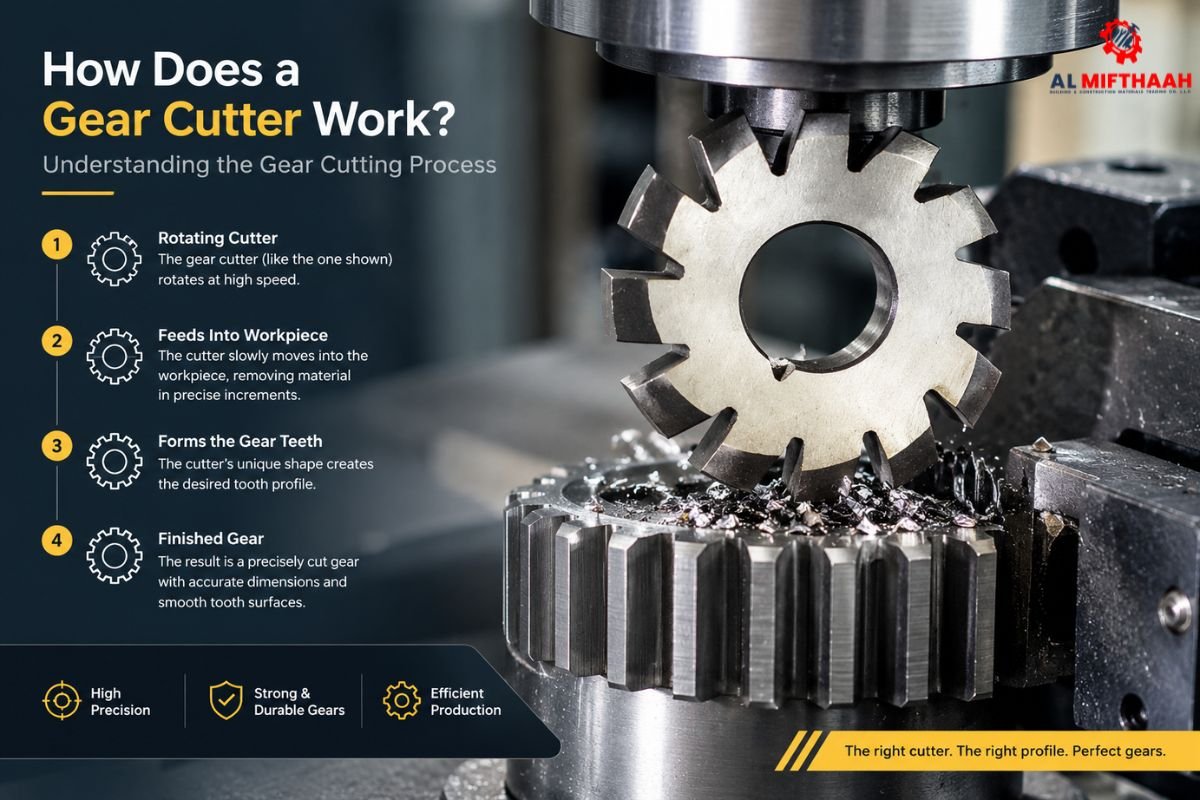
How Does a Gear Cutter Work? Understanding the Gear Cutting Process
A gear cutter is a device that has cutting teeth that shape the gear teeth in a round piece of plastic, metal, or sometimes nylon composite material. The tool functions by cutting the required material from the blank by following a specific pattern that reflects the shape of a gear tooth. This can best be accomplished by using either a single-point reciprocating motion, a revolving disc, or a helical hob which continuously feeds into the blank.
This procedure gives the number of teeth that are equally spaced around the circumference of the gear and to a required module, pressure angle, and tooth count. The rest of this comes down to which of those methods gets used and why.
Table of Contents
ToggleKey takeaways
- Gear cutters are used to create teeth by using either profile copying or motion to form teeth.
- Different gear types, quantities, and tolerances require hobbing, shaping, milling, or broaching.
- The wrong cutter can lead to noise, incorrect wear, and insufficient gear meshing.
- Dubai’s heat and dust can shorten the life of the cutter and lead to more frequent resharpening.
What does a gear cutter actually do?
Before it becomes a gear, it’s just a disc. It has been turned on a lathe to the correct outer diameter, bored through the center, and perhaps a keyway has been cut. This disc, known as a blank, doesn’t have any teeth on it yet. The function of the cutter is to cut out a pattern of metal around the edge of that blank until what remains between the pieces cut out is the profile of the tooth.
It seems clean and simple, but it’s not. Gear teeth aren’t flat wedges. They trace an involute curve, which is the curve that a string traces as it unwinds from a circle. Two gears with involute teeth work perfectly at different center distances, with no teeth sticking or slipping. The ability to make a usable (relatively quiet and long-lasting) gear is what counts, and it’s made by making the cut correctly, hundreds of times around a single blank.
What determines how a cutter is built:
- Diametral pitch or module: the size of the teeth relative to the gear’s diameter
- Pressure angle: typically 14.5° or 20° and influences the transfer of force between meshing teeth.
- Number of teeth: some cutters have teeth ground for a specific number; others will create a number in a range
- Tooling type: high-speed or carbide/coated tooling for harder alloys and high production volumes
How does the gear cutting process work?
When you get to the machine level, gear cutting reduces to the controlled relative motion of the cutter and blank. The blank is mounted on a mandrel or arbor that is typically positioned through a dividing head or rotary table to ensure that the cut tooth spatial increment is exactly at the correct location. The cutter removes a slice of material with each pass; it is spinning, reciprocating, or sweeping through an arc.
Here’s roughly what happens on a manual milling setup, since it’s the easiest to picture:
- The blank is mounted and centered on the dividing head.
- A disc-type gear cutter matching the module and tooth count is fitted to the milling machine’s arbor.
- The cutter is fed into the blank to the correct depth, cutting one tooth space.
- The blank is indexed by rotating it a precise fraction of a turn.
- The cutter cuts the next space, and the cycle repeats until the full circle is done.
Moreover, that’s form cutting at its most basic. Hobbing and shaping work differently, and the difference matters more than most buyers realize when they’re comparing quotes or tooling costs.
Form cutting vs generative cutting
This distinction comes up constantly in gear shop conversations, so it’s worth slowing down on.
- Form cutting- This uses a tool shaped exactly like the space between two teeth. The cutter doesn’t need to move in sync with the blank’s rotation; it plunges in, cuts, retracts, and the blank indexes to the next position. It’s the method used in the milling example above. Cheap to set up, fine for one-off gears or repair jobs, but a single cutter only works for one module and a narrow range of tooth counts. Order a different tooth count, and you often need a different cutter.
- Generative cutting- Which covers hobbing, shaping, and planing, works on a different principle. The cutting tool and the blank rotate together in a fixed ratio, and the tooth shape emerges from that combined motion rather than being copied directly from the tool’s profile. A single hob can cut gears with many different tooth counts of the same module, because the envelope of successive cuts builds the involute curve rather than stamping it in one shot.
Furthermore, generative methods dominate production work because one tool serves many jobs and the resulting tooth accuracy tends to be higher. Form cutting still has its place in small shops, prototype work, and repairs where buying a dedicated hob for a single gear doesn’t make financial sense. Gear cutters suppliers in Dubai can be helpful.
Main types of gear cutting methods
- Hobbing- The hob looks like a worm screw with cutting flutes machined into it. As it rotates, it feeds along the length of the blank while the blank rotates in a timed relationship to it, generating the full tooth profile continuously rather than tooth by tooth. Fast, relatively inexpensive per part, and the standard choice for spur and helical gears in volume production.
- Shaping- A reciprocating cutter, either pinion-shaped or rack-shaped, strokes up and down while both tool and blank rotate slightly between strokes. Shaping handles internal gears, gears near a shoulder where a hob can’t clear, and herringbone gears where the tooth pattern runs in two directions from a center groove. Slower than hobbing, but more flexible for awkward geometries.
- Milling- Covered above under form cutting. Best suited to low volumes, large-module gears, or shops that don’t have hobbing or shaping equipment on hand. Milling cutters cost considerably less than hobs, which is why smaller workshops lean on the cutting and milling tools Dubai suppliers tend to stock in bulk for exactly this kind of job.
- Broaching- A tool with progressively larger teeth is pushed or pulled through the blank in a single pass, cutting the full profile at once. Fast for internal splines and certain gear forms, but the tooling cost is high enough that it only pays off at real production volumes.
- Grinding- Usually a finishing step rather than a primary cutting method. After hobbing or shaping, a ground gear gets a final pass with an abrasive wheel to tighten tolerances and improve surface finish, particularly on gears running at high speed or under heavy load.
Choosing the right cutter for the job
There’s no universal best option here. It depends on quantity, gear type, and how tight the tolerances need to be.
| Factor | Favors Hobbing | Favors Shaping | Favors Milling |
| Production volume | High | Medium | Low |
| Internal gears | No | Yes | Rarely practical |
| Setup cost | Higher upfront | Moderate | Lowest |
| Tooth accuracy | High | High | Moderate |
| Turnaround for one-off parts | Slow (tooling lead time) | Moderate | Fast |
A shop running a batch of forty identical spur gears will almost always hob them. A repair job needing one replacement gear by Friday is more likely to end up on a manual mill with a form cutter, even if the finish isn’t quite as clean.
Therefore, buyers working with gear cutters dealers in Dubai often ask about cutter material too. High-speed steel handles mild and medium-carbon steels fine and costs less. Carbide-tipped or coated cutters last longer in hardened alloys or abrasive materials, but the price difference only makes sense once run length justifies it.
Where do these gears end up?
Gear cutting shows up in more places than people expect:
- Automotive transmissions and differentials
- Industrial gearboxes for conveyors, mixers, and pumps
- CNC machine tool drivetrains
- Agricultural and construction equipment
- Elevators and hoisting mechanisms
- Precision instruments where backlash has to stay near zero
Structural engineering and fabrication clients, HVAC contractors, and general machine shops all draw on the same base processes, just at different tolerance levels. A hoist gearbox tolerates more backlash than a CNC spindle drive ever could.
Common mistakes and maintenance habits
Some issues keep showing up across shops of every size, regardless of how experienced the crew is:
- Running a dull cutter too long- Tooth edges round off gradually, and by the time it’s obvious in the finished gear, several parts have already been scrapped.
- Wrong pressure angle match- Mixing a 14.5° cutter setup with 20° gear specs produces gears that look fine but mesh poorly.
- Skipping deburring- Sharp edges left on cut teeth accelerate wear on the mating gear.
- Inconsistent coolant flow – Heat buildup during cutting distorts tooth geometry, especially on thinner-module gears.
- Storing cutters loose in a drawer- Chipped cutting edges from careless storage are one of the more preventable causes of tool replacement.
Regular resharpening on a cutter grinder, correct storage in dividers or cases, and matching feed rates to the material being cut all extend tool life meaningfully. A cutter maintained well can outlast three that are run to failure and tossed. Milling cutter dealers in Dubai will give you the right advice.
Sourcing gear cutters in Dubai
Heat and airborne dust change how tooling behaves here compared to cooler, cleaner environments. Ambient shop temperatures pushing past 40°C in summer mean coolant systems work harder, and cutters running dry, even briefly, wear faster than they would in milder conditions. Fine sand particles that get into open gearboxes or unsealed machine ways also speed up abrasive wear on both the cutter and the gear teeth being produced.
Local sourcing matters more than it might seem for exactly that reason. Shops working with gear cutters suppliers in Dubai get faster replacement turnaround when a cutter chips mid-run, instead of waiting on an overseas shipment while a production line sits idle. It also helps to work with a supplier who understands regional demand, since automotive service centers, signage fabricators, and structural steel shops all pull from a similar but not identical range of cutter modules and pressure angles.
Almifthaah, known in the trade as Saif Precision, comes up often when shops in the UAE are comparing gear cutter suppliers in Dubai for both standard and custom-module tooling. Whether the requirement is a single replacement cutter or a set for a new production run, working with an established Saif Precision tools supplier in UAE generally means access to a wider range of modules without long lead times.
For businesses weighing options among milling cutter dealers in Dubai, it’s worth asking directly about stocked modules, cutter material options, and whether resharpening services are offered locally. A supplier who only sells and doesn’t support resharpening ends up costing more over a cutter’s working life, even if the upfront price looks competitive. Gear cutter suppliers in Dubai that also stock general cutting and milling tools that Dubai shops rely on day-to-day tend to be the more practical long-term fit, since a single order can cover both gear-specific tooling and general shop consumables.
Conclusion
Gear cutting comes down to two ideas: copying a tooth shape directly onto a blank, or generating that shape through coordinated motion between tool and workpiece. Hobbing, shaping, milling, broaching- all of it is a variation built around one of those two principles, chosen based on volume, gear type, and how tight the tolerances need to be. Getting the cutter type and maintenance right early on saves far more in scrapped parts and downtime than it costs upfront, which is usually what actually decides it for shops weighing their options.
Frequently asked questions
A gear cutter is shaped specifically to cut tooth profiles; a general milling cutter removes material in flat or contoured passes without that tooth-specific geometry.
Not with form cutting. A hob can generate several tooth counts within its module, but the module itself stays fixed per cutter.
Usually a pressure angle mismatch, misalignment during cutting, or inconsistent heat treatment across the blank causes uneven wear over time.
It depends on material and run length, but most shops resharpen after noticeable rounding on the cutting edge, often every few hundred parts.
No. Hobbing suits external gears in volume; shaping is necessary for internal gears and geometries a hob physically can’t reach.
Yes, though feed rates and cutter sharpness need adjusting since plastic behaves differently under heat and cutting pressure than metal.
Impact from interrupted cuts, incorrect feed rates, or poor storage where cutters knock against other tools are the most common causes.
High-speed steel works for most general steel gears; carbide is worth the added cost for hardened alloys or high-volume production runs.
Why Industrial Workshops Prefer Magnetic Drill Machines

How Thick Should Copper Shim Stock Be for Electrical Busbar Connections?