
- September 8, 2026
- by Almifthaah
Carbide Tipped vs High-Speed Steel Tools: Which One Delivers Better Performance?
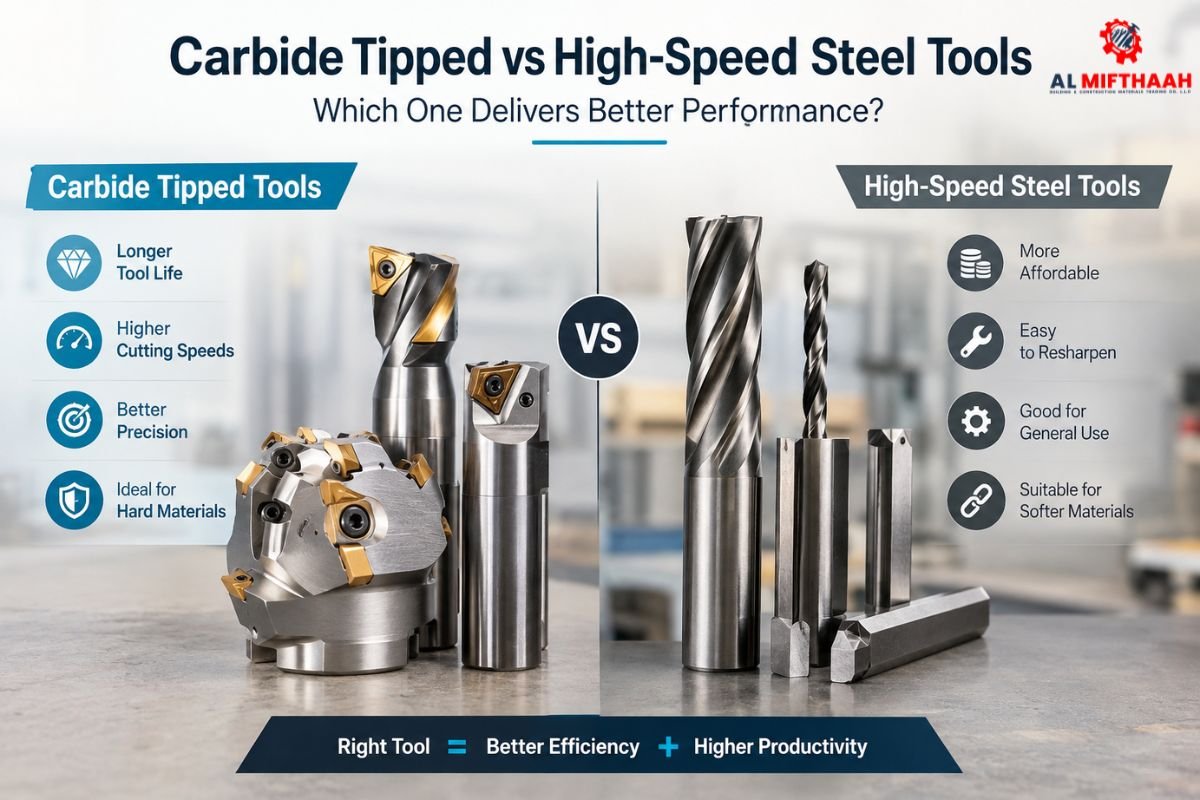
Carbide-tipped equipment is superior to high-speed steel (HSS) in all jobs where there is a high volume and heat involved, as carbide retains its cutting capabilities at speeds 3 to 5 times faster than those used with HSS. However, in terms of toughness, price, and ease of sharpening, HSS remains in the lead, which is quite important when it comes to low-speed or interrupted cutting.
The selection of tools should be determined by the material, batch size, and machine sturdiness rather than brand preference. Most workshops in the UAE use both types, specifically carbide for aluminum, mild steel, and stainless steel in high-volume production, and HSS for tool-room work, irregular orders, etc.
Table of Contents
ToggleKey takeaways
- Carbide is tough at temperatures over 1000 degrees Celsius, making it a good material for fast and hot cutting.
- HSS is better at resisting shocks, thus increasing the safety of older machines.
- It is not just about saving money by using cheaper tools; it is also about finding proper combinations of tools, materials, and machines.
- A good supplier of HSS end mills in Dubai, together with carbide experts, can provide the best results.
Why does this comparison actually matter on the shop floor?
Every machinist confronts this dilemma at some point and often at the least convenient time. Unable to continue working due to having a worn cutter while the deadline approaches. The choice between carbide and HSS isn’t a purely theoretical matter. It converts into measurable losses like wasting components, burning edges, and having to stop your machine for someone to take a ride to buy an alternative tip for the tool.
There is no clear winner among the two materials. Carbide cuts at faster speeds and withstands temperatures that would ruin steel, while HSS bends before breaking completely. This way of evaluating the two materials makes most of the decision obvious.
What carbide-tipped tools are built for?
Tungsten carbide is a sintered compound: tungsten carbide particles bound in cobalt, pressed and heated until it behaves more like synthetic stone than metal. It sits around 90-93 HRA on the Rockwell scale, against roughly 62-65 HRC for good HSS. That hardness is why carbide holds a sharp edge at temperatures that would soften steel into something closer to putty.
In practice:
- Cutting speeds 3-5 times faster than equivalent HSS tools on the same material
- Better performance on abrasive materials like cast iron, composites, and hardened steels
- Longer tool life between changes on production runs
- A brittleness that punishes interrupted cuts, chatter, and sloppy workholding
I’ve watched shops switch an entire production line to carbide, cut cycle time by a third, and then act surprised when tool breakage went up too. It’s rarely the carbide. It’s rigid. Carbide rewards a stable setup and punishes a shaky one, full stop.
A good carbide endmill supplier in Dubai will usually ask about your machine and fixturing before recommending a grade, because pairing the wrong grade with the wrong setup turns a durability advantage into an expensive habit of snapped tools.
Where does HSS still hold its ground?
HSS gets treated like the outdated option, which isn’t fair. It’s an alloy steel with tungsten, molybdenum, chromium, or vanadium added for wear resistance, and it has one thing carbide doesn’t: toughness. HSS deforms under shock loads instead of chipping.
However, that matters in manual lathe work and tool room jobs where interruptions are constant, on older or lower-rigidity machines that can’t hold carbide’s tolerances, in low-volume runs where regrinding a worn HSS bit beats buying new carbide inserts, and on softer materials like aluminum or plastics, where carbide’s extra hardness just adds cost for nothing.
A shop running short batches on a 20-year-old manual mill doesn’t need carbide’s speed. It needs a tool that survives operator error. That’s the gap an HSS endmill supplier in Dubai fills, and it’s why most established UAE workshops keep both material types on the shelf instead of committing to one.
Carbide vs HSS: side-by-side comparison
| Factor | Carbide Tipped | High-Speed Steel (HSS) |
| Hardness | ~90-93 HRA | ~62-65 HRC |
| Heat resistance | Holds edge above 1000°C | Softens around 600°C |
| Toughness/shock resistance | Low, chips under vibration | High, bends before breaking |
| Cutting speed | 3-5x faster than HSS | Baseline speed |
| Tool cost | Higher upfront | Lower upfront |
| Resharpening | Difficult, needs diamond wheels | Easy, standard grinding wheels |
| Best fit | High-volume, hard/abrasive materials | Interrupted cuts, older machines, low volume |
Single point tools and welded tool bits: A practical note
End mills get most of the attention, but single-point tools and welded bits follow the same logic at a smaller scale. A carbide tip single point tool Dubai turners rely on holds its edge through long, continuous cuts on stainless or alloy steel, exactly where HSS would overheat and dull.
Furthermore, welded tool bits are a different animal. They’re HSS shanks with a separate cutting tip welded on, built for general turning, facing, and boring jobs where the whole tool doesn’t need to be premium-grade steel. An HSS Welded Tool Bit supplier in Dubai typically stocks these for repair shops and general fabrication, where the work changes daily, and a full carbide setup would be overkill.
Common mistakes workshops make when choosing
A few patterns come up again and again, and most of them cost more in scrapped parts than they save on tooling.
- Buying carbide for every job “to be safe.”- It doesn’t help on soft materials and just adds cost.
- Running carbide on a loose or worn machine- The chipping that follows gets blamed on the tool, never the setup.
- Ignoring coolant strategy- Carbide tolerates dry cutting better than HSS, but the wrong coolant approach on either accelerates wear.
- Sticking with one supplier out of habit- Needs to change as jobs change, and a supplier who only sells one material will keep recommending it regardless of fit.
Expert insights from the floor
Machinists who’ve spent years running both materials tend to land on the same point, and it’s not about the tool. It’s the setup. Carbide’s reputation for brittleness usually comes down to worn spindle bearings or a loose collet, not the insert. Fix the rigidity first, and carbide does exactly what the spec sheet says.
HSS gets blamed for slow cycle times just as often, when the real problem is someone running it at carbide speeds out of habit. Each material has an operating window. Staying inside it matters more than which one you picked. HSS Welded Tool Bit supplier in Dubai will help you to choose the right one.
How to choose based on your actual job?
- What’s the material? Hardened steel, cast iron, or composites lean toward carbide. Aluminum, plastics, and softer alloys often don’t need it.
- How rigid is the machine and workholding? Older or lighter setups favor HSS’s shock tolerance.
- What’s the batch size? High volume favors carbide’s speed. One-off jobs favor HSS’s lower upfront cost and easy resharpening.
- Is the cut continuous or interrupted? Interrupted cuts favor HSS, unless the carbide grade is specifically toughened for it.
Moreover, a supplier stocking both, rather than one pushing whatever they happen to sell, is worth more than a small discount on either. Saif Precision tools supplier in UAE is one UAE-based example carrying both carbide and HSS lines, which helps when a job flips from a production run to a same-week repair.
Conclusion
Carbide and HSS are not the most suitable materials for all machining applications. The strengths and limitations of each tool depend on the individual tool. Carbide cutting tools are suitable for high-speed cutting, heat resistance, and large-quantity production. HSS tools give increased toughness, reduced cost, and increased flexibility in general machining operations.
Carbide tools and HSS tools are available in most workshops in the UAE. The right choice depends on material, machine, cutting speed, and type of job. Selection of the tool based on these factors can help to enhance cutting performance and avoid unnecessary tool costs.
Almifthaah has a wide selection of carbide and HSS cutting tools when stocking or restocking your tool crib. It covers single-point tools, welded tool bits, and other solutions for machining. Their team can also be able to assist you in choosing the right grades of tools for the materials and machines you use.
Frequently asked questions
No. It is fast and has a high capability for heat on hard materials, but it has a better capability for shock loads and incomplete cuts on older machines.
Higher difficulty, less ductile, and frequently chipping due to vibration, workholding problems, or too high a feed rate; not a bad tool.
Easier, if anything. HSS is re-grindable using standard wheels, whereas carbide requires diamond wheels and will be sacrificed more with each re-grind.
Carbide is generally two to four times the initial price, but in volume production can often pay for itself due to tool life.
Not suitable for fast grinding operations. They are good for general turning and repair work, and in these applications there’s no need for solid carbide.
It needs to be managed properly for both. Carbide performs better in dry or light cutting fluids, and loses its hardness quicker if there is not enough cooling fluid available. HSS softens quicker with inadequate or no cooling fluids available, and is more tolerant of minimal-coolant cutting.
HSS wears rapidly when used at high speed on hardened steel, cast iron, and composites. This is where carbide is the preferred choice.
Stiff, low-runout spindle with excellent work-holding. Where there is play or vibration in your setup, then HSS is typically the safer bet.
Yes, for most shops that deal with a wide variety of jobs. Staying within one material type comes at a high cost for some jobs and a low cost for others.
Check with a supplier that offers both ranges, including single-point welded-bit ranges, to avoid switching vendors for every job.

Common Magnetic Drill Machine Problems and Solutions

How Does a Gear Cutter Work? Understanding the Gear Cutting Process


1 Comment
Top Dubai Industries That Rely on Carbide Tipped Cutting Tools
September 15, 2026 - 1:30 pm[…] a shop like this, a carbide tip single point tool Dubai order isn’t a one-time purchase; it’s a recurring line item, and the supplier […]