

- April 15, 2026
- by Almifthaah
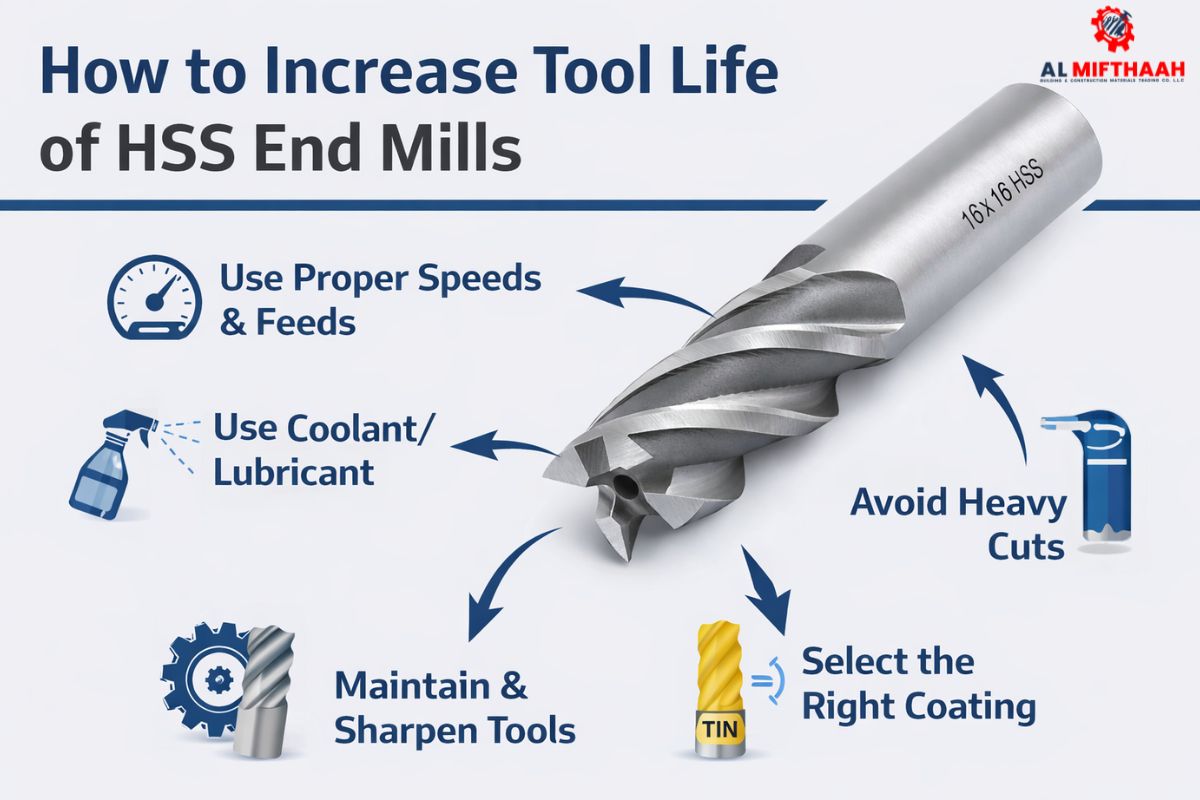
How to Increase Tool Life of HSS End Mills
Table of Contents
ToggleKey takeaways
- Apply proper speeds to prevent overheating.
- Use proper feeds to ensure smooth machining.
- Always use coolant to enhance tool life.
- Ensure stable tool holding and alignment
- Regularly sharpen tools before wear occurs.
To make the life of HSS end mills longer, pay attention to proper speed, feed, cooling, and setup. The majority of tool failures occur because of heat, improper parameters, or improper handling. Therefore, improving these basics can easily double tool life.
HSS (High-Speed Steel) end mills are popular due to their durability and affordability. Nevertheless, they do not last as long as carbide tools unless they are used in a proper manner. In actual workshop scenarios, a lot of operators overwork tools in order to save time. This causes overheating, edge damage, and premature failure.
Additionally, ignoring simple measures such as good clamping or coolant application also diminishes life. Experience shows that even minor modifications, such as changing RPM or enhancing chip removal, can have a significant impact.
Brands such as Almifthaah usually provide information on how to use the tools properly, and this prevents unnecessary damage to the tools and enhances performance in the long run.
Why is correct cutting speed important?
The rate of cutting has a direct effect on heat production. When the speed is excessive, the tool becomes overheated and hard. Consequently, the cutting edge becomes worn off.
To extend the life of tools:
- Apply the suggested RPM depending on the material.
- Slow down on harder metals.
- Avoid sudden speed changes during cutting
As an example, when working with mild steel, a slightly lower speed than the maximum recommended value can greatly extend the life of the tool. Higher speed can result in faster results but decreases durability.
Most industrial configurations have practitioners who depend on the reliable HSS endmill supplier in Dubai to receive effective speed charts and instructions. This makes sure that there is the use of tools within safe limits. Therefore, never sacrifice speed and performance in favor of productivity.
How does proper feed rate improve tool life?
Feed is a control that determines the amount of material that the tool removes per pass. When the feed is too small, the tool will rub rather than cut. If too high, it overloads the cutting edge.
To keep the correct feed:
- Use constant and regular feed.
- Avoid stopping mid-cut.
- Vary feed depending on material hardness.
Additionally, an appropriate feed rate aids in the development of good chips that remove heat off the tool. This minimizes wear and enhances efficiency.
In one example of a workshop, the feed fluctuation was minimized and increased the tool life by almost 30%. This demonstrates the power of making minor changes that will make a huge difference.
When dealing with various materials, professionals usually seek the advice of milling cutter dealers in Dubai on proper feeds.
Does cooling and lubrication matter?
Yes, cooling is one of the most significant aspects. The largest HSS tool enemy is heat. Unless the tool is cooled, it becomes soft and unable to cut.
Best practices include:
- Use coolant during continuous cutting
- Apply cutting oil to make it more lubricated.
- Make sure the coolant flow is correct.
Moreover, lubrication decreases the friction between the tool and material. This does not only enhance the life of the tool but also provides a better surface finish.
In practice, dry cutting can be cost-effective in the short term, but it lowers the life of the tools. It is always more advantageous to use coolant in the long run.
Most of the workshops that modernized their cooling systems reported an increase in tool life and reduction in tool changes.
Why tool holding and setup are critical?
It might seem that tool holding is a minor aspect, but it is significant. Vibration is a result of poor clamping and harms the cutting edge.
To improve setup:
- Use good-quality tool holders.
- Ensure proper alignment.
- Prevent runout (wobbling of the tool).
However, vibrations cause uneven cutting, resulting in more wear on certain edges. This decreases tool efficiency with time.
One of the real-life problems is the use of deteriorated holders. A good tool cannot work when the holder is not stable. As such, it is always advisable to verify the setup prior to commencing machining.
Best milling tools dealers UAE and experts tend to emphasize that correct configuration can extend the life of tools without altering any cutting parameters.
How does material selection affect wear?
Various materials respond differently to machining. Hard materials produce more heat and wear the tool quicker.
Important tips:
- Hard metals should be used at lower speed.
- Choose suitable tool geometry.
- Avoid unnecessary deep cuts.
In the case of softer materials such as aluminum, tools can be used longer provided that they are well maintained in terms of removing the chips. But sticky materials may lead to accumulated edges, which also decrease life.
In other cases, hard materials are better off using carbide tools. This is the reason why a carbide endmill supplier in Dubai is also involved in many industries with certain applications.
So, it is always important to use the tool with the material in order to achieve the best results.
When should you resharpen tools?
Resharpening is also a neglected aspect that can greatly increase the life of a tool. Sharpening can be used to restore cutting performance instead of replacing tools.
Indications that you need to sharpen:
- Poor surface finish
- Increased cutting force
- Visible edge wear
Additionally, resharpening will avoid additional damage in time. Delaying it, the tool can become ineffective.
In practice, resharpened tools used in time can be reused several times, which is cost-effective and efficient.
Single Flute Carbide Endmill UAE industries tend to have strict maintenance schedules, which contributes to maintaining the same performance.
What role does coating and quality play?
The quality of the tools and their coating directly affects the durability. Under the right circumstances, high-quality HSS tools are more efficient and durable.
Benefits of coated tools:
- Reduced friction
- Better heat resistance
- Improved wear resistance
Moreover , the reliability of the suppliers will guarantee quality. Even when the tools are used correctly, poor-quality tools wear out more quickly.
For example, collaborating with a reliable Saif Precision tools supplier in UAE will help to make sure that the tools are of industry standards and will work in a reliable manner.
Thus, it is always worth investing in quality tools in the long run.
Wrapping up
It is not difficult to increase the life of HSS end mills. It primarily relies on the appropriate speed, feed, cooling, and configuration. Additionally, it is significant to select quality tools and take care of them.
Workshops can save money and enhance productivity by adhering to these simple and practical steps. Reliable suppliers such as Almifthaah are also significant since they offer effective tools and guidance.
The combination of correct technique and professional help of an HSS endmill supplier in Dubai will guarantee a stable performance and extended tool life in the long run.
Frequently asked questions
Overheating and inappropriate cutting conditions are the leading causes of tool failures.
Yes, coolant decreases heat and friction, making the tools more durable while machining.
Sharpen tools whenever there is a deterioration in cutting performance and wear on the edge is observed.

Common Magnetic Drill Machine Problems and Solutions

How Does a Gear Cutter Work? Understanding the Gear Cutting Process

