- July 9, 2026
- by Almifthaah
How Do Mounted Points Improve Surface Finish Quality in Metalworking?
Table of Contents
ToggleKey Takeaways
- Mounted points get into corners and curves that a flap wheel or grinding disc can’t touch.
- Grit and bond type decide how rough or smooth your final surface ends up.
- Cheap abrasives wear unevenly, which means more rework and lost shop time.
- A dependable abrasive tools supplier Dubai fabricators trust makes this whole process easier.
Anyone who’s finished a weld seam knows the feeling – the part looks fine from three feet away, then you run a hand over it, and there’s a rough patch nobody warned you about. That’s usually a tool problem, not a skill problem. Mounted points solve a lot of that.
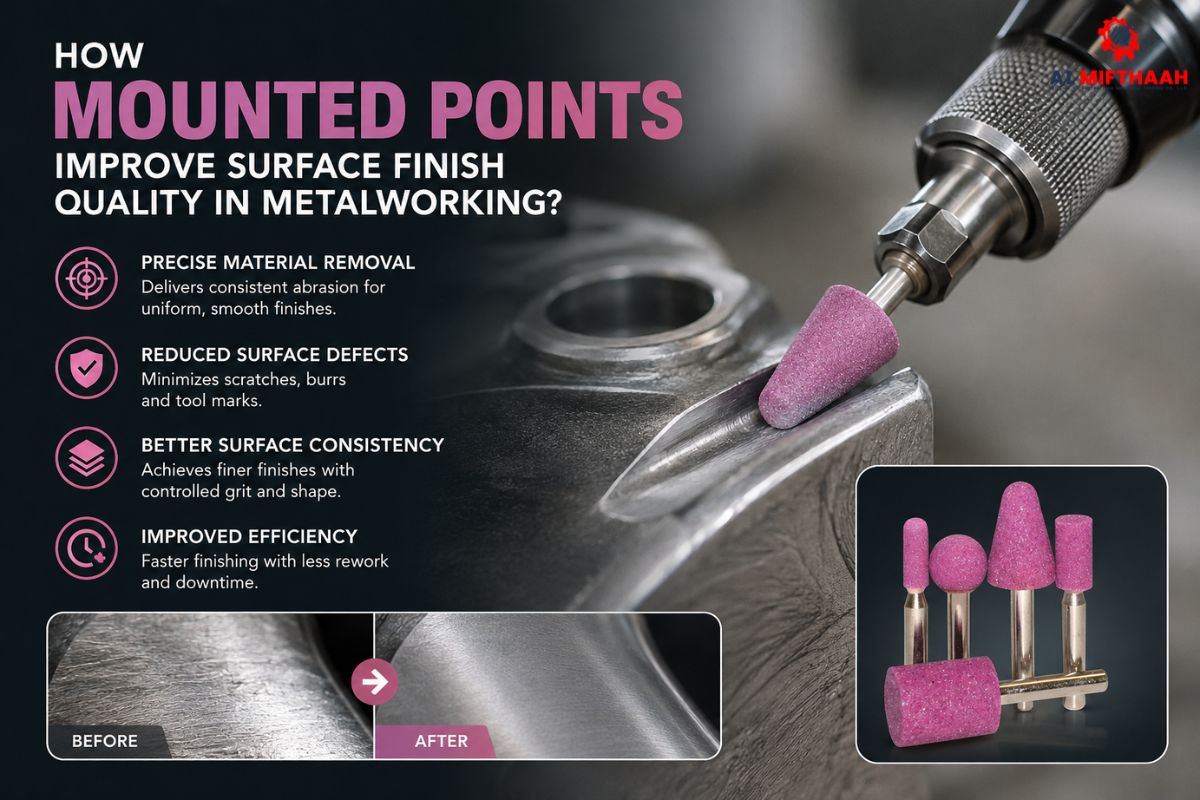
These are small, shaped abrasive heads fixed onto a metal shaft, built to work with die grinders and flexible shaft tools. They get into the narrow slots, internal bores, and curved edges that bigger discs just skip over.
Below, we’ll walk through why they work, what to look for when buying them, and why the abrasive tools supplier Dubai shops rely on matters more than most people think.
What are mounted points in metalworking?
Mounted points are cone, cylinder, or ball-shaped abrasive heads permanently attached to a mandrel. You chuck them into a rotary tool and use them to grind, deburr, or smooth metal in spots that a flat wheel can’t reach.
A few things set them apart:
- Small enough for detail work in tight spaces
- Fixed shaft, so there’s no separate mounting step
- They come in several shapes for different contours.
- Made with different abrasive grains, mainly aluminium oxide and silicon carbide
However, you’ll see these on benches everywhere from tool-and-die shops to weld cleanup lines to mould finishing stations across Dubai’s fabrication scene.
Why does surface finish quality matter so much?
A rough surface isn’t just a cosmetic issue. It changes how the part behaves over time.
- Friction goes up between moving parts, which shortens machine life.
- Paint and coatings don’t stick properly to an uneven surface, so they bubble or peel.
- Rough spots become stress points, and stress points crack or corrode.
- Clients and industry specs, especially in structural and automotive work, often reject parts on finish alone.
Furthermore, the whole batch may be rejected because of bad surface finish. Time-saving leads to bigger problems when people cut corners.
How do mounted points deliver a smoother finish?
There isn’t one single reason mounted points work well. It’s a handful of things stacking together.
- Even grain distribution
The abrasive grains are bonded onto the shaft in a consistent pattern, so material comes off evenly instead of leaving random gouges.
- Grit sequencing
Coarse grit strips material fast. Fine grit refines it after. Going coarse to fine, in that order, is basically the whole trick behind a mirror finish.
- Reach Every Difficult Surface
This is the big one. A flat disc can’t get into an internal corner or a weld seam. A cone-shaped mounted point can.
- Less heat buildup
A decent mounted point is designed to cut without generating excessive friction heat, which matters because heat discolours and warps metal surfaces.
- Steady speed
Pair the right RPM with the right point and the cut stays even across the whole surface. Get the speed wrong, and you get a texture you didn’t ask for.
Choosing the right mounted point for your job
Grab the wrong shape or grit and you can make the finish worse, not better. Here’s a rough guide:
| Mounted Point Shape | Best Used For | Typical Grit Range |
| Cone Point | Deburring edges, tight corners | 60–120 |
| Cylinder Point | Flat internal surfaces, slots | 46–100 |
| Ball Point | Curved or rounded contours | 60–150 |
| Inverted Cone | Weld seam cleanup, grooves | 36–80 |
Quick tips before you buy:
- Match the shape to the actual contour you’re working with.
- Coarse first, fine second, not the other way around.
- Aluminium oxide for steel, silicon carbide for softer metals
- Double-check the shaft diameter fits your tool before you leave the counter.
Therefore, if none of this is obvious yet, a solid abrasive tools dealers in Dubai team should be able to point you toward the right combo based on your metal and finish specs.
Common mistakes that ruin surface finish
Even people who’ve done this for years still trip on these:
- Running a worn-out point until it’s basically glazed over, which scratches instead of smoothing.
- Wrong RPM. Too fast burns the surface; too slow just drags without cutting properly.
- Skipping the coarse pass and going straight to fine grit, which wastes time and grit
- Leaning too hard on the tool, which glazes the abrasive and kills its cutting edge
- Using the wrong grain for the metal, which burns through tool life fast
None of these are complicated fixes. They’re just easy to forget when you’re moving fast on a deadline.
However, if you’re also shopping for precision tooling on top of abrasives, pairing that with a reliable Saif Precision tools supplier in UAE means fewer vendors to manage and fewer gaps between orders.
Where to source reliable tools in Dubai?
Dubai’s fabrication industry has grown fast, and the abrasives market has grown with it, though not every supplier keeps up on quality. Some of what’s floating around is generic import stock that wears out in half the expected time.
When you’re vetting a high-quality flap abrasive wheels supplier in Dubai, a few things are worth checking:
- Whether they actually stock industrial-grade abrasives, not just whatever’s cheapest to import
- Bulk pricing, if you’re running production volume.
- A range wide enough to cover mounted points, flap wheels, and cutting discs under one roof
Someone on staff who can talk you through grit and shape choices, not just take your order.
Almifthaah has built a decent name among fabrication shops for exactly this kind of consistency. Sourcing from an established abrasive flap wheel supplier in Dubai, an outfit like that cuts down on the surprise deliveries and inconsistent batches that waste everyone’s time.
Bottom line
Mounted points are small, but they carry a lot of weight in how a finished part actually looks and performs. Reaching the corners other tools can’t, controlling heat, and keeping the cut even. That’s the whole job. Get the shape and grit right, and get them from someone who actually knows the difference between good stock and filler stock.
If you’re hunting for an abrasive tools supplier Dubai workshops actually stick with, it’s worth a call to a team like Almifthaah. A good supplier doesn’t just hand you a box of abrasives; they help you avoid the rework in the first place.
Want fewer rejected parts and less time spent redoing finish work? Reach out to a supplier who knows what your metal actually needs.
Frequently asked questions
They use grinding stones, deburring tools, and polishing tools to work on metal in tight spaces where conventional equipment might not work.
You need to start with a coarse one around 60 grit to finish up with a fine treatment at around 120 grit or so.
They can. Mounted points made of aluminum oxide will cut through stainless steel materials effectively while keeping the temperature down.
Be sure to search for industrial quality of stock, availability of experts who know everything about the right grit and shape to choose, and stable stock of supplies.
Flap wheels can work quickly on large flat surfaces, while mounted points work on smaller, more detailed areas, including holes and other hard-to-reach points.
Replace the moment they start to wear down. When a point becomes dull, it scratches instead of smoothing the surface.
They are, but silicon carbide is preferred here since it is not easily clogged when working on soft metals and gives a cleaner finish compared to aluminum oxide.
Metal surface finish is important due to its effect on coating adhesion, friction between moving parts, corrosion resistance, and whether the part meets customer demands.

How Long Do Mounted Points Last and When Should You Replace Them?
Everything You Need to Know About Tool Wear in Carbide Tipped Cutting Tools